The case

Germany, for the intelligence services Afd is an 'extreme right-wing party incompatible with democracy'

The Office for the Protection of the Constitution has found that Alternative für Deutschland is an 'established extreme right-wing organisation' and is not 'compatible with the liberal and democratic order' of Germany. The party led by Alice Weidel and Tino Chrupalla, and supported by Elon Musk during the recent election campaign, is the second largest political force in the Bundestag with almost 21% of the votes won on 23 February. Since then it has grown further. On 8 May, the intelligence agency suspended the classification after the party appealed.

by Gianluca Di Donfrancesco

Aggiornato l’8 maggio 2025, ore 13:52

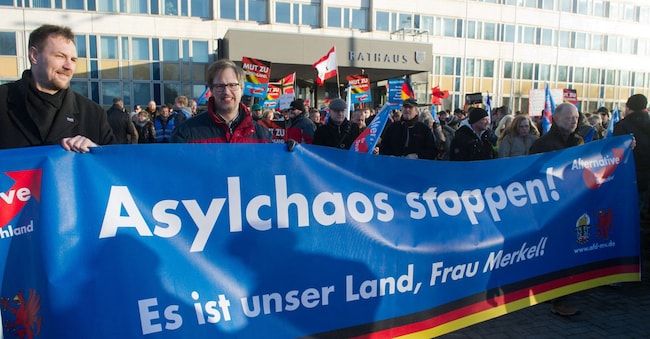
Manifestanti di Afd con uno striscione contro l’immigrazione (Afp)

6' min read

6' min read

A bombshell on German politics just days before the birth of the new government that will be led by conservative Friedrich Merz: the Office for the Protection of the Constitution ascertained on 2 May that Alternative für Deutschland is an organisation of the 'extreme right' and is not 'compatible with the liberal and democratic order' of Germany. The party led by Alice Weidel and Tino Chrupalla, and supported by Elon Musk during the recent election campaign, is the second largest political force in the Bundestag with 152 seats and almost 21% of the votes won on 23 February. Since then it has grown further and in some polls has even overtaken the Cdu-Csu, taking first place on the 80th anniversary of the liberation from National Socialism. On 5 May, the party filed an appeal and on 8 May, the Office for the Protection of the German Constitution temporarily suspended the classification until the administrative court ruled, but without recognising any legal obligation.

The Decision

.

For internal intelligence, however, there are no longer any doubts. This is the same verdict that had so far been issued for the regional federations of Thuringia, Saxony and Saxony-Anhalt, but not for the party at federal level, which until now had only been regarded as a 'suspect' case.

Loading...

Afd has in its programme the mass remigration of those who do not conform to the German way of life. Remigration is the euphemism coined by Austrian far-right ideologue Martin Sellner, who defines it as the expulsion of immigrants who break the law or simply 'refuse to integrate', regardless of their citizenship status.

The party's 'prevailing conception of the people, based on ethnicity and descent, is not compatible with the liberal democratic order', the intelligence agency claims, which confirms the suspicion that Afd is working against the democratic order and raises the alert to the highest level. For the authorities, Afd believes that Germans 'with a migration history from predominantly Muslim countries, for example, are not equal members of the German population, as defined by the party in ethnic terms'. The party acts 'continuously' against refugees and migrants, inciting 'irrational fears and hostility' towards individuals and groups, 'violating their human dignity'.

The results of the survey were expected at the end of 2024, but the fall of the government led by Olaf Scholz and the early elections forced a pause, so as not to influence the vote.

The reactions

.

Afd co-leaders announced legal action against the decision, which they called 'a blow to German democracy'. The vice-president, Stephan Brandner, speaks of 'complete idiocy'. The decision 'has nothing to do with law and order and is purely political. However, an unfair measure against the only opposition force was to be expected'.

The debate on banning Afd is reopened. The future vice-chancellor and social democratic leader, Lars Klingbeil, told Bild that the next government will consider this step. 'Afd,' he said, 'is an attack on Germany, they want to destroy our democracy. And we have to take it very seriously'. The intelligence decision 'cannot remain without consequences'.

The procedure is not automatic. As outgoing Interior Minister Nancy Faeser explained to the press: 'Nothing should be ruled out, but there is no automatism'. The issue has actually been discussed for some time, and in the last parliamentary term, a cross-party group of more than 110 MPs submitted a motion to the Bundestag requesting a ruling from the Constitutional Court, which is responsible for the decision.

Even the outgoing chancellor, Olaf Scholz, advises caution: 'I think this is an issue that should not be addressed in a hurry.

German parties have always isolated far-right movements: it is the Brandmauer, the cordon sanitaire that prevents any collaboration with Afd, not only in the Bundestag, but also in the Länder.

On such a day, Musk could not miss the call, according to whom Afd is a 'centrist' party (so what are the Cdu and Spd in the techno-visionary's mind?): 'Banning the centrist Afd party, the most popular in Germany, would be an extreme attack on democracy'. More sober was the US Secretary of State, Marco Rubio, who merely accused Germany of being a 'tyranny in disguise'.

What happens now

The power to initiate the banning procedure is in the hands of three bodies: the Bundestag, the Bundesrat (the House of Länder) or the Federal Government. Caution, in the face of a step that could deprive more than ten million voters of their party, is very high. All party office holders would automatically lose their mandate, or their seat in parliament.

Several parliamentarians were waiting to hear the results of the investigation by the Office for the Protection of the Constitution.

Based on this decision, which came at the end of a lengthy investigation and was motivated in a more than 1,100-page report handed over to the Ministry of the Interior on 2 May, the authorities will be able to more easily use invasive investigative tools already in use: observing meetings, tapping phones and recruiting informants.

The Bundestag could try to limit or block public funding to Afd, but for this the authorities would have to prove that the party explicitly aims to undermine or even overthrow German democracy. In 2023, Afd owed 45% of its income to public funds.

The radicalisation of Afd

.

Alternative für Deutschland is a young party. Founded in February 2013 as the 'no-euro professors' movement', it already has in its name the contestation of the euro, the European Union and Angela Merkel: during the single currency crisis in 2010, the former chancellor had said that the Greek bailout had no alternative. Three years later, the founder of the party, Alexander Gauland, set out to offer an alternative to Germany. In its election programme for the 2025 vote, the party still calls for an exit from the euro and the re-founding of the European Union in the form of a community of sovereign states.

The no to immigration has been a hallmark of Afd since its origins. As it rapidly radicalised, this became the central theme of an agenda that increasingly shifted to xenophobic positions, particularly after the 2015 migrant crisis, with the millions of Syrian refugees welcomed into Germany at Merkel's behest.

Then there is historical revisionism and accusations of neo-Nazi drift. Several times its exponents have ended up in the controversy for controversial statements and the use of Hitler slogans. In 2018, Gauland himself downplayed Nazism as 'mere bird poop' about German history. The Afd leader in Thuringia, Björn Höcke, has been convicted twice for using Nazi slogans. In 2017, he called Berlin's Holocaust memorial a 'monument to shame': 'We Germans are the only people in the world who have planted a monument to shame in the heart of their capital'.

Already in 2019, the Office for the Protection of the Constitution had put Afd, together with the nativist association The Wing, created by Höcke as a 'resistance movement against the erosion of German identity', under observation.

Afd is also relatively isolated in the Euro-parliament: in May 2024, the leader of the Rassemblement National, Marine Le Pen, distanced herself after Maximilian Krah, the leading candidate for the European elections, refused to condemn SS in an interview with Repubblica.

Afd has its electoral base in the eastern states, which have not yet closed the gap with the West after reunification. This is no longer just a protest vote for the party. As Oliviero Angeli, political scientist at the Technische Universität Dresden and coordinator of the Midem research centre, explains, 'Afd's voters are not the poor outcasts on the social periphery, like those of the Npd in the 1990s, which in Saxony gathered the votes of the unemployed, precarious workers or otherwise dissatisfied people. Afd is rooted in the social fabric and also has voters in the local bourgeoisie, lawyers, small entrepreneurs, economically integrated people'.

Previous ones

.

Other organisations classified as extremist in Germany are neo-Nazi groups such as the National Democratic Party, Islamic groups such as Isis and extreme left-wing movements such as the Marxist-Leninist Party.

The first two party banning proceedings in Germany date back to the 1950s. These were the Communist Party and a successor of the National Socialist Party, the Socialist Party of the Reich. They were both banned. There have since been other cases and the Constitutional Court has stated that parties can be banned not only if they oppose democracy and the rule of law, but also if they have an agenda or engage in activities that violate the principle of the dignity of human beings.

In 2017, the National Democratic Party, now known as Die Heimat, was saved because, unlike Afd, it was not strong enough, i.e. it did not have the potential to pose a threat. In 2024, Die Heimat was excluded from state party funding for a period of six years.


Copyright reserved ©

Brand connect

Loading...

Newsletter

Notizie e approfondimenti sugli avvenimenti politici, economici e finanziari.

Iscriviti