
Merz to Macron: 'Common nuclear umbrella with France and the UK'
The new German Chancellor on an official visit to the Elysée Palace to relaunch the Franco-German engine of the European Union, especially on defence. And then to Poland: focus on irregular immigration, but Tusk criticises border controls

3' min read
3' min read
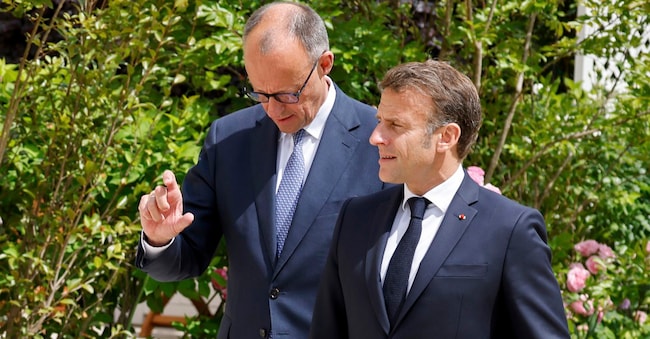
A nuclear umbrella 'made in Europe': the day after his chilling nomination in the Bundestag, the newly appointed chancellor, Friedrich Merz, relaunched his proposal and did so from the Elysée Palace in Paris at a joint press conference with President Emmanuel Macron. With France and the UK, Merz said yesterday, 'we will give our ministers the mandate to start the discussion'.
The aim, the German prime minister emphasised, is not to 'replace the security guarantees offered by the United States', but to follow a complementary approach. Back in February, Merz had already invited Paris and London to discuss joint nuclear deterrence in the face of Donald Trump's openly anti-European turn and his rapprochement with Russia's Vladimir Putin, with the parallel disengagement from the conflict in Ukraine.
Macron stated that strengthening the 'European pillar of NATO' does not weaken the Atlantic Alliance, but rather represents 'a greater assumption of responsibility by Europeans'.
Defence in the Centre
.Never more than in this bilateral, the dominant theme was defence. "We will accelerate Franco-German programmes and develop new capabilities," Macron explained, mentioning joint projects on tanks, combat aircraft and 'long-range missiles'. Paris and Berlin also agreed to set up a bilateral 'defence and security council' to address common strategic challenges, with a focus on innovation and preparing for the wars of the future.
The watchword of the two leaders of proven pro-European faith is to revive the Franco-German engine, without which the Union does not work. The French Foreign Minister, Jean-Noël Barrot, said he expects relations between Paris and Berlin to be easier than they were with Merz's predecessor, Olaf Scholz. In the new chancellor, the French government can finally find the backing it was looking for on increasing EU defence spending.


