
Michele Mari has won the Strega Prize for *I convitati di pietra*. He would have preferred to win it for *Leggenda privata*
Matteo Nucci came second, Bianca Pitzorno third, Alcide Pierantozzi fourth, Teresa Ciabatti fifth, and Elena Rui sixth

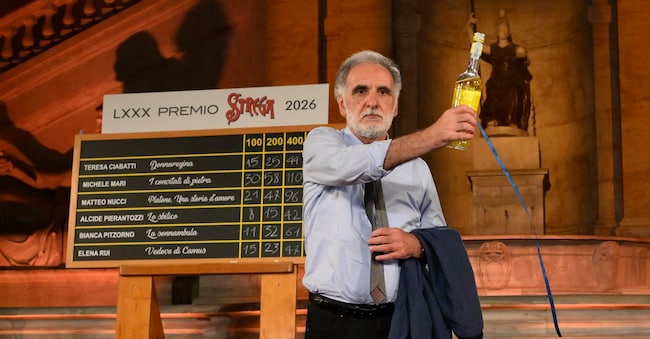
Michele Mari is the winner of the 80th edition of the Strega Prize, held in Rome’s splendid Piazza del Campidoglio – designed by Michelangelo – with his novel I convitati di pietra (Einaudi). A story with a surprising ending about a class of sixth-formers who place a bet on who the last three in the group to remain alive will be, and whose existential journey ends up taking a twisted turn in this context; it is a ‘cynical’ novel, ‘sadistic’ – to use the author’s own words – ‘modelled on the narrative structure of Ten Little Indians by Agatha Christie’. A book written in less than a month which is not – in our opinion – his best.
This is a view that Mari himself seems to share: when we ask him whether this was the book with which he would have liked to win the Strega Prize, he looks us straight in the eye and says, ‘No.’ When we ask him which of his many books he would have preferred to win it with, he replies, ‘Leggenda privata, perhaps.’ He then added that ‘it’s often not a writer’s best books that win’. And yet, ‘all a writer’s books are like children: pieces of the heart, of the soul. Of course, it does strike me a little that this particular title will be associated with this victory at the expense of others. My task will be to console the younger children a little so that they all feel they are children of the same father.”
The Strega Prize thus reaffirms its reputation as an award that often ends up recognising an author’s career rather than a single work. As for a single work, Lo Sbilico (Einaudi) by Alcide Pierantozzi would also have deserved the prize; it came only fourth, with 74 votes. A work which, through literary skill, raw honesty and courage, succeeds in bringing the reader closer to the little-understood existence of a neurodivergent person with mental health issues (“‘The worst part of having a mental illness is that people expect you to behave as if you didn’t’ is the quote from Todd Phillips in Joker cited in the epigraph to the book”).
And Bianca Pitzorno would also have deserved a lifetime achievement award; for decades she has inspired millions of girls and boys to love reading, and for the past ten years or so – has continued to write with lightness, gravity and precision for those girls (and, we hope, boys too) who have now grown up. Starting with The Sexual Life of Our Ancestors (Bompiani, 2015) right up to her most recent work, Sonnambula (Bompiani), the story of a woman fleeing an abusive husband who, in late-nineteenth-century Sardinia, manages to make a living by pretending to be a medium. This novel came third with 84 votes.
I convitati di pietra, considered by many to be the clear favourite for this year’s award, had, in their eyes, lost ground when certain remarks – taken out of context from a private conversation and relayed by Teresa Ciabatti to *La Repubblica* journalist Raffaella De Santis —in which Mari was alleged to have disparaged the intellectual integrity and physical appearance of the writer and columnist Michela Murgia, who died in 2023—had caused a furore in the press and on social media. Several literary critics, literature enthusiasts and online commentators had argued with regret that this would cost Mari the prize.


