
Microchips and data, another life for former manufacturing sites
From Aruba's Data Centre Campus, the largest in Europe, to the Data4 Campus in Cornaredo, inside an 18th-century villa, the structures of the digital economy seek new formulas to reduce their impact
by Serena Uccello and Alexis Paparo
4' min read
4' min read
In Ponte San Pietro, near Bergamo, in the Aruba Data Centre Campus, only one of the chimneys that were once part of the Legler textile site remains. It continues to stand in the centre of the complex as if it were a postcard from the past: a reminder of what it once was, the old factory that had textile production as one of its most enduring souls. Then the history made of workers and textile production (in the last period the famous jeans) had to reckon with the crisis, bankruptcy, closure, redundancy payments and finally rubble. Metres and metres of warehouses to be secured and reclaimed, some of which still survive behind and beside the chimney. So, if the latter has been left to the fate of witness, the other bricks intertwined with concrete and iron pillars have been left to the sequence of reconversion to house modernity, new design and eco-friendly cladding.
The last piece of this journey is in motion in these very weeks and "as has already happened with the other blocks we will try to preserve as much as possible," explains Giancarlo Giacomello, Head of Data Centre & Colocation Services at Aruba. As much as possible also means maintaining the hydroelectric power station, once belonging to Legler, within the Global Cloud Data Centre so as to use the waters of the Brembo river to cool the equipment.
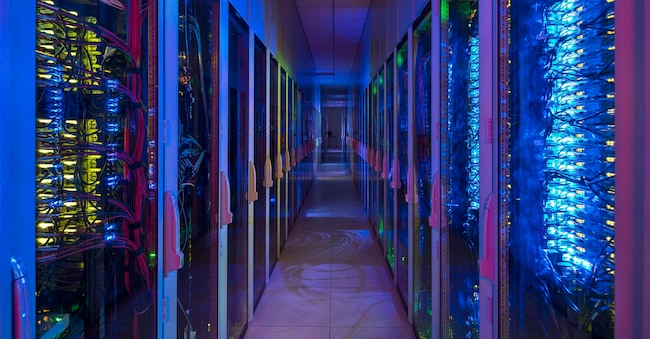
Another crucial topic is this environmental sustainability (in addition to land consumption, which has a possible solution in reuse) at the centre of the debate on the spread of these structures. "A theme that we feel very strongly about here," Giacomello continues, "all the blocks, for example, are covered with photovoltaic panels". There are currently three blocks, DC-A, DC-B and DC-C, each with its own MW allocation of 12 MW IT, 9 MW IT and 8 MW IT respectively. Behind this measurement lies an important share of the workability of our lives. There are the servers of the companies we work for, but also of public institutions. Almost certainly there are our emails, the photos we exchange and more seriously, our jobs, our income. This is enough to give us the dimension of their importance even if we do not have an exact perception of these numbers.
Thus, a new soul made of intangible data took the place of the soul made of matter to give life to what is considered the largest Data Centre Campus in Europe: 200 thousand square metres of floor space and 45 MW of achievable IT power (60 MW total power).
The Data4 Campus
.From Bergamo towards Milan, in the hinterland of the Lombard capital, the Data4 campus in Cornaredo is one of the most advanced digital poles in Europe. A 21-hectare area that includes an eighteenth-century villa, a park and a farmhouse that used to be the headquarters of the Italtel group, a historic telecommunications company. Spaces that will be sharedwith citizens and the municipality. Ten Data Centres are operational on the campus and the four others under construction will be designed to support the computing needs of artificial intelligence, with water cooling systems and more. The campus will create 500 permanent jobs, including induced employment.

