Digital Economy

Microsoft Copilot gets more 'personal' with new functions for memory, health and learning


by Alessandro Longo

5' min read

Translated by AI
Versione italiana

5' min read

Translated by AI
Versione italiana

"There is a lot of noise around artificial intelligence at the moment: headlines, enthusiasm, fears and, to be honest, I think that for many, this is all rather excessive'. And if it seems that way to him, Mustafa Suleyman, who heads Microsoft's artificial intelligence, let alone to us users - you might say. But Microsoft's AI managers seem to have the answer to the problem at hand: a more personal AI, one that really 'connects' with us. Real understanding, real connection was the leitmotif of the event at which Microsoft presented new functions of Copilot, its chatbot that is now a little behind the world stage compared to Chatgpt, Claude, perhaps even Deepseek, on 23 October.

When one hears the expression real connection referred to the relationship with a chatbot, it may be instinctive to recall the many cases of vulnerable people who in recent months have become too connected to AI, to the point of fatal outcomes. Microsoft, however, believes it can make Copilot a truly useful tool for our personal lives and thus help repair our relationship with technology, now compromised - as Suleyman says. Too little trust, too much stress.

Loading...

The goal, Suleyman explained, is in short to build an artificial intelligence 'truly at the service of people, not the other way around'.

What does it mean in detail?

Social, empathic and collaborative AI

Among the main innovations is Groups, which transforms Copilot into a social and shared experience. Up to 32 people can collaborate in real time with the AI to write, plan or brainstorm. The function also allows summarising threads, proposing options, counting votes and dividing tasks, making collaboration natural and dynamic.
Loading...

Groups is already available globally as of today at copilot.microsoft.com and on the Copilot app for Windows, Mac and mobile devices.

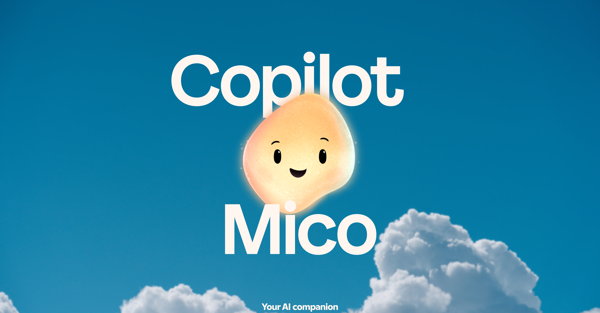
Mico pushes the relational dimension even further: an expressive and customisable character that reacts visually to emotions, changing colour or attitude according to the interaction. Mico is an optional addition - designed to make conversations more empathetic, natural and welcoming - and is already available in all markets.

For more realistic dialogues comes the Real Talk mode, which adopts a more natural and reflective tone of voice: Copilot can argue, contradict in a constructive way and propose new points of view, being assertive but always respectful. At least here Microsoft implicitly wants to avoid the risk of chatbots that give us too much reason, to the point of reinforcing our outlandish ideas or falling into hallucinations, as happened with Gpt4 (and still happens a bit with Gpt5).

Real Talk will be available in the coming months for Copilot+ and Microsoft 365 users.


Copilot that remembers, connects and anticipates

There is no relationship, however, without memory. With Memory & Personalisation, Copilot can now remember important information - such as an anniversary, a sports preparation or work preferences - and recall it in future conversations. The user remains in control at all times: he can view, edit or delete memories at any time.

Long-term storage is available as of today in the US and will gradually arrive in other markets in 2026, initially only for authenticated Copilot and Microsoft 365 Personal and Family users.

Thanks to the new connectors, Copilot accesses content distributed across different platforms - Outlook, Gmail, OneDrive, Google Drive - to quickly find files, appointments or emails, simply by using natural language. Access to data always requires the explicit consent of the user, who can manage active connections at any time.

Microsoft also introduces Proactive Actions, a first in the US: Copilot becomes capable of anticipating needs and suggesting next steps, e.g. to complete a task that has been started or to resume a document that was being worked on. This feature, initially available on Edge and Copilot for web, will be progressively extended to other platforms in 2026.


Wellbeing and Learning at the Centre

The new Copilot for Health addresses one of the most common user needs: to receive reliable answers about health and wellbeing. Microsoft has collaborated with authoritative sources such as Harvard Health to ensure secure and contextualised information.

Copilot for Health is only available in the US, at copilot.microsoft.com and on the Copilot app for iOS, and integrates a care navigation function that helps find doctors and facilities, consult profiles and prepare visits.

On the training front comes Learn Live, which transforms Copilot into a true digital tutor: a voice assistant that guides learning with explanations, quizzes and flashcards. The aim is not just to provide answers, but to encourage active and personalised learning. Learn Live will arrive everywhere in the world in the coming weeks, integrated into the Copilot versions for Windows, web and mobile.


More AI in Windows and Edge

Microsoft also wants to put Copilot at the heart of Windows 11. The assistant can be activated at any time with the voice command 'Hey Copilot', allowing instant access to files, apps and recent activities.

The function is available today for all Windows 11 users with the Copilot app pre-installed, while voice activation will be phased in over the coming months.

On the other hand, Microsoft's Edge browser introduces Copilot Mode. The user can ask the AI to book a hotel, fill in a form or summarise a page simply with a natural command. The new Journeys function, available as a preview in the US, organises the history into thematic 'paths', making it easier to return to interrupted projects or searches. Microsoft thus follows the path of AI-enabled browsers, where OpenAI also recently arrived with Atlas.

Other innovations quickly told at the end of the event: Copilot Pages allows files to be transformed into collaborative and dynamic spaces, while Copilot Search reimagines web search as a multimodal conversation, capable of combining text, images and voice. Finally, the Imagine platform evolves into a true social space where users can remix, share and discover Copilot-generated creations: an expanding creative environment, already available globally at copilot.microsoft.com.


The technological base: 'MAI' models and social intelligence

Underlying all these innovations are the new models developed in-house by Microsoft - MAI-Voice-1, MAI-Vision-1 and MAI-1 Preview - which combine speech, voice and vision to offer increasingly fluid and multimodal experiences. Microsoft thus reminds us that, despite its historical partnership with OpenAI, it has not stopped working on its own models.

The company also introduced 'social intelligence' metrics to assess how AI fosters collaboration, trust and connection between people.

In short, Microsoft wants to differentiate itself with a 'human-centred' approach: an artificial intelligence that is empathetic, proactive and personal. A philosophy that it wanted to emphasise at the event by presenting a kind of documentary where Suleyman returns to his native London neighbourhood and meets a restaurateur, a cyclist, an old-fashioned craftsman. As if to demonstrate the possible proximity of AI to ordinary people.

Microsoft believes that this approach will earn the trust of users. It will soon be discovered whether they will give it to them, in the first place, by fully using Copilot with all its new functions.

Copyright reserved ©
Loading...

Brand connect

Loading...

Newsletter

Notizie e approfondimenti sugli avvenimenti politici, economici e finanziari.

Iscriviti