Milan, the future of Leoncavallo deserves a public debate
Legal constraints, the Soprintendenza's acknowledgements and financial implications emerge from the dispute over eviction: an urgent debate on the sustainability of independent cultural production centres in Italy must be opened

6' min read
6' min read
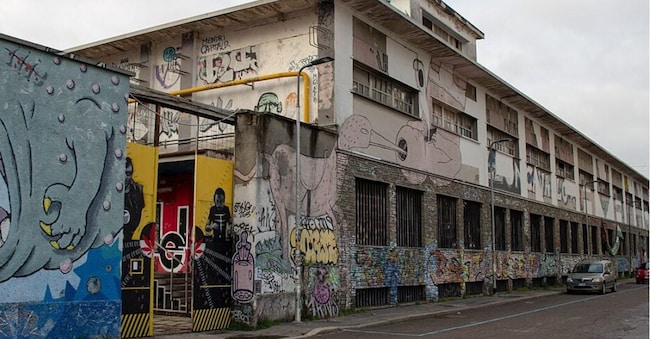
For days now, the public debate has been raging around the closure of the Leoncavallo, the historic Milanese social centre founded in 1975 in the street of the same name and evicted on 23 August. The eviction, announced and postponed several times since 2003, has returned to the centre of the political agenda after last November the Ministry of the Interior awarded a compensation of €3 million to the Cabassi family, owner of the building, thus closing a dispute that had originally estimated losses of more than €10 million. The affair, however, cannot be reduced to a simple issue of public order as it would mean neglecting the historical significance of a place that for decades has been one of Italy's main centres of independent cultural productions and a symbol of civic participation and inclusion. Its parable becomes, instead, the litmus test not only of a Milan that in pursuing a certain model of growth progressively sacrifices these alternative meeting spaces, but also of a country that still struggles to recognise and value the most underground cultural productions.
From counterculture to institutionalism
.In almost fifty years of activity, Leoncavallo has represented not only a community stronghold, but also a cultural centre with a non-marginal impact on the historically popular neighbourhood. Its spaces have been transformed into an urban canvas that over time has welcomed the works of internationally renowned street artists, from Blu to Ozmo, from Atomo to Pao, up to Mr. Wany, Zed1, Tv Boy, Bros, Tawa, Zibe, Dario Arcidiacono, Frode, Anna Muzi and Giacomo Spazio. A patrimony that in 2006 prompted Vittorio Sgarbi, then Councillor for Culture of the Municipality of Milan, to define it as "the contemporary Sistine Chapel", calling for its transformation into a museum.
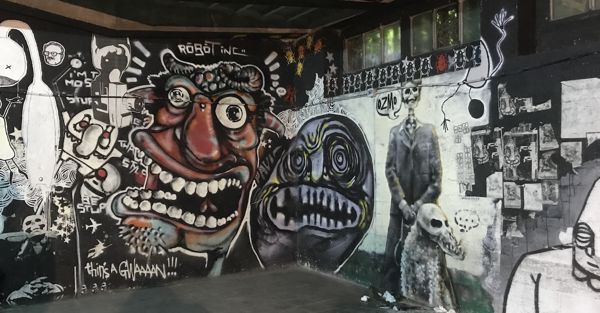
In 2023, the Superintendency of Archaeology, Fine Arts and Landscape for the Metropolitan City of Milan also recognised the historical and artistic value of the graffiti preserved in the basement of the Leoncavallo, subjecting them to legal constraint under Art. 50 of the Cultural Heritage Code, according to which 'it is forbidden, without the authorisation of the superintendent, to arrange and carry out the removal of frescoes, coats of arms, graffiti ... and other decorative elements of buildings, whether or not exposed to public view' (so para. 1 of the regulation). A historical recognition, the first at ministerial level on the Street Art front, which sanctioned the genuineness and uniqueness of that pioneering experience by institutionalising its historical and cultural value.
To understand the importance of that recognition, we need to go back to 2003 when, in the basement of Leoncavallo, in the space renamed Daun Taun, the ninth and last HIU - International Underground Happening took place, conceived by the artist Marco Teatro and rapidly becoming a point of reference for Italian underground art. For three days, dozens of Italian and international artists, from the pioneers of writing such as Vandalo, Atomo, Shah, Giacomo Spazio and Paolo Buggiani, to emerging young artists such as Bo130, Microbo, Ozmo, Pao, 108, Abbominevole, Santy, Pus, Sea Creative, invaded every surface of the underground, creating a great collective jam. What was supposed to be an ephemeral experience instead remained frozen in time: shortly afterwards the Daun Taun was closed for security reasons and no one entered it again until it was rediscovered almost twenty years later in the post-pandemic period. From there, a process of valorisation began, which, under the coordination of the Direzione Generale Creatività Contemporanea del Ministero della Cultura, involved INWARD - Osservatorio Nazionale sulla Creatività Urbana, until its final institutional consecration.
When Street Art becomes heritage protected
.In recent years, street art has experienced a real critical reversal. What was once dismissed as vandalism is now recognised as artistic expression, valued in museums and on the market where it reaches ever higher prices. As in its early days, its strength still lies in its independence from institutional circuits and to attempt to control it would be to distort it.
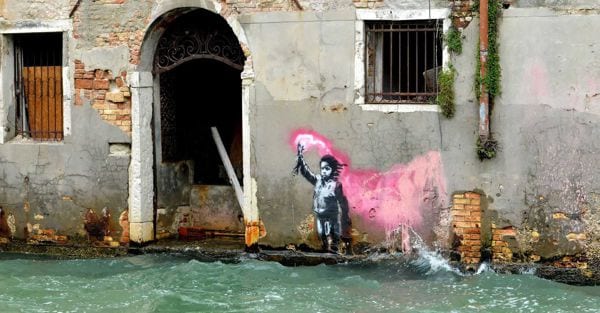
In recent years, the law has also started to deal with this: the works of street artists in fact, although they may constitute criminal offences, if original and creative, are always protected by copyright law (Law No. 633/1941), which recognises the respective authors both the patrimonial rights and the moral rights provided for, regardless of the lawfulness of the intervention or the absence of formal registrations. In some cases, such as the Leoncavallo productions, these works could even be classified as cultural heritage under the Cultural Heritage and Landscape Code (Legislative Decree 42/2004), with the consequent need for authorisation by the Superintendence for any removal or covering intervention. There is also no shortage of examples in which street art has directly affected the market value of the buildings on which the works were created. Emblematic is the case of the Venetian palace in Campo San Pantalon, where the mural 'Naufrago bambino' by Banksy appeared in 2019: the work, realised on the occasion of the Biennale, raised the value of the building up to 4.5 million euros, quadrupling the starting price. It now remains to be seen whether similar dynamics will also affect the building on Via Watteau, which is now budgeted at EUR 2.64 million. In the meantime, the first signals have already arrived from the market: at Piazza Affari, Brioschi shares, the majority shareholder of L'Orologio (the Cabassi family's company), marked a +12.42% as at 25 August and then fell, while Bastogi, Brioschi's majority shareholder, marked a 10.6% rise (as at 28 August 2025).