
Mini Aceman eJCW, the test version of the most powerful electric crossover
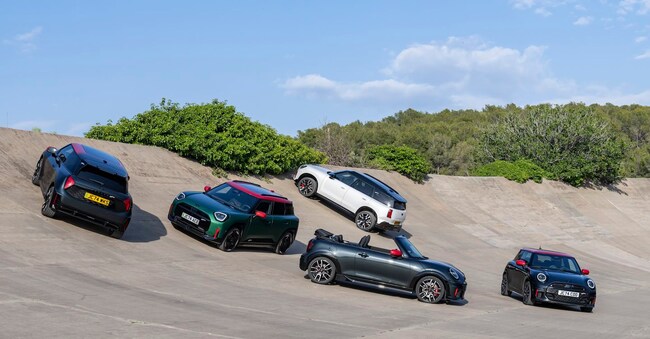
The only Mini offered only with an electric powertrain benefits from the attentions of the JCW atellier and, in practice, constitutes a range in its own right
4' min read
4' min read
The John Cooper Works treatments also involve the electric models of the Mini, bringing with them all the technical improvements and customisations of those with thermal engines, along with the indispensable increase in power. Now, there are five JCWs, as these Minis are narrowly identified, and they form a range consisting of the Cooper hatchback, both petrol and full-electric variants, the Countryman and the Aceman. The latter is the Mini that never existed and is not even replicated among those that can be chosen with petrol engines. In short, it was only designed to be electric. The real Aceman JCW, because the less powerful versions with 184 and 218 horsepower can also sport this logo but only identifying one of their fittings as in the case of the other Minis, is on sale for 44,000 euros and to distinguish itself is called the eJCW.
Mini Aceman eJCW, what it looks like
.With a length of 4.08 metres, a width of 1.75 metres, a height of 1.51 metres and a wheelbase of 2.60 metres, the Aceman is based on an architecture also developed for the three-door battery hatchback and is currently also only produced in China as part of the joint venture between the BMW group and Great Wall Motor. The eJCW is derived from the more powerful Aceman. Its powertrain develops 258 horsepower, but the electric boost function, which is engaged with a paddle to the left of the steering wheel, can temporarily add about thirty. Like that of the 218-horsepower Aceman, it is powered by a battery with a capacity of 49.2 kWh that supports both 11 kW alternating current and 95 kW direct current recharging, with which it restores from 10 to 80 per cent in half an hour. However, the higher power shifts the range of a full tank from 405 to 355 kilometres. This Aceman also has a specifically tuned set-up complemented by 19-inch wheels and differently calibrated steering.
Mini Aceman eJCW, the outfit incorporates sporty details
.The Aceman is a Mini that, in one fell swoop, stands out from all the others, but which is also impossible not to categorise in that family. In fact, its crossover line that defines an appearance that can be said to recall that of a compact station wagon is based on stretched rather than rounded features like those of other Minis, defining a muscular front where an unprecedented light signature stands out, together with sides strengthened by prominent wheel arches and a tail where concave and convex surfaces are connected by strong features. The eJCW is distinguished from other Acemans by a bonnet complemented by side ribs simulating air intakes, a splitter in the more pronounced front bumper shield, and a different rear spoiler and aerodynamic diffuser.
Mini Aceman eJCW, inside tradition marries innovation
As on the outside, there are JCW badges and red details on the inside, which also extend to the fabric upholstery. The cabin offers an adequate amount of space for four people and is furnished in keeping with current Mini standards. In fact, like the progenitor of the lineage it only places a large round instrument in the centre of the dashboard. Obviously, it is in step with the times because along with modern, comfortable sports front seats it houses a 24 centimetre diameter Oled display for infotainment along with the interface for configuring the car's services, with which you have to become familiar in order to use it with ease, and in which you can also view the dashboard for more information than can be seen in the head-up display. The system integrates wireless connectivity for smartphones and a personal assistant. Underneath the mega-screen is a dashboard also inspired by past Minis, but which now houses, next to the fake ignition key, the button for Parking mode along with levers for other gearstick modes, car configurations and some switches.
Mini Aceman eJCW, the restorative cure is well felt
.Like the other John Cooper Works electric Minis, the Aceman also offers a new format of go-kart feeling. It emerges either by engaging the driving mode of the same name or by using the boost paddle to the left of the steering wheel, in this case only temporarily but always invading the cabin with a synthetic but, on the whole, also pleasant rumble. In fact, it simulates better than in many larger and more expensive electrics even some crackling in the decisive releases, which contrasts with the quietness that reigns in the cabin with the other modes. With the Go-Kart configuration, this Aceman proves to be very snappy as it offers lightning-fast acceleration and speed changes and is fun to drive through the bends, thanks to the balanced behaviour imparted by the rather rigid set-up of the trim. At the other end of the scale is Eco, which is best suited to everyday use as it tends to maximise efficiency by downshifting the temperament of the powertrain and offering energy recovery in the more substantial downshifts to replenish the battery in city use. In any case, the typical linearity of electric powertrain delivery expresses itself well and adequately supports driveability, while at the same time making it possible to touch 200 km/h. Reaching 100 km/h in 6"4, against a declared average consumption of 14.4-16.4 kWh/100 km.

