Mission Artemis

Moon, mission accomplished: flown over the hidden side, never seen before

In 2027, if all goes according to the new plans, there will be a fundamental docking test between different vehicles, crucial for the descent to the Moon

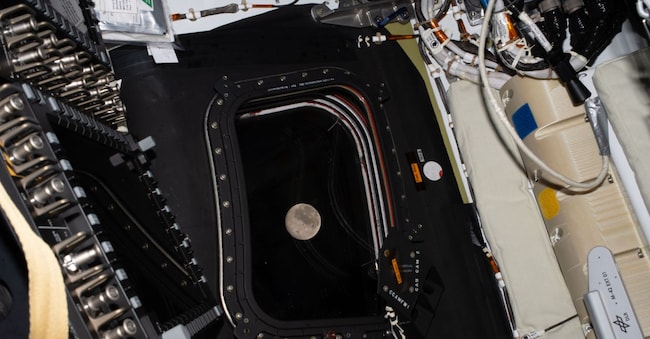
In questa foto fornita dalla NASA, la Luna è visibile dal finestrino della navicella spaziale Orion; l'immagine è stata scattata dall'equipaggio di Artemis II alla fine del quinto giorno del viaggio verso la Luna, lunedì 6 aprile 2026. (NASA via AP) APN

4' min read

Translated by AI
Versione italiana

4' min read

Translated by AI
Versione italiana

They did it, they went around the Moon, flew further from Earth than anyone else in history, saw a part of our satellite that no one had been able to see before, took images important to science, studied a solar eclipse of their own, and showed that the Artemis programme is back on track.

Now, without even needing major course corrections, they are on their way back to Earth, where they will arrive on Friday 10, facing re-entry, the most demanding part of the journey due to the heat developed in friction with the atmosphere.

Loading...

Everything went as planned. On 7 April, the Artemis II probe completed an orbit around the side of the Moon hidden from us. Thanks to the course and inclination of the orbit, the four, taking turns two by two, were able to admire through the windows, but above all photograph, our satellite for a long time in a part that could not be observed on the Apollo missions of the 1970s. The Moon also interposed itself, at one point, between them and the Sun, creating an eclipse only for the four of Artemis II.

First humans beyond low orbit

The mission began on 1 April, taking astronautsReid Wiseman, Victor Glover and Christina Koch of NASA and Jeremy Hansen of the Canadian Space Agency into orbit. They are the first humans to go beyond low orbit, just a few hundred kilometres above the ground since the Apollo 17 mission, 1972, and have reached 400,171 kilometres from Earth, exceeding by 6,606 kilometres the maximum distance ever reached, a record that belonged to the famous Apollo 13 mission, April 1970.

"Above all, we have chosen this moment to issue a challenge to this generation and the next, so that this record does not last long," said astronaut Hansen shortly after Artemis 2 passed Apollo 13.

Circumnavigation trajectory

The four asked to give the name "Integrity" to the Orion capsule that was taking them to the other side of the Moon and to give the name Carroll to a crater they were observing, in memory of Carroll Taylor Wiseman, wife of Reid Wiseman's commander, who passed away in 2020 from a fatal illness.

The encounter with the Moon began at 20:45 Italian time, when Integrity was still more than 17,000 kilometres from the Moon, but was already being studied by the Orion capsule following what was requested by the scientists in Houston. Artemis 2's particular trajectory, which involved circumnavigating the Moon but not entering a stable orbit, made it possible to observe not all of the Moon, but pieces of it that had not previously been studied and craters that were still unnamed.

The Moon is grey, and covered in dust, but the eye of the astronauts can judge better, for the moment, than robotic means.

The Artemis 2 mission confirmed many of the observations made by the astronauts of the Apollo missions and was able to document them with the 32 cameras on board, 15 mounted on Intergrity and 7 on the astronauts' smartphones and more.

Koch described the subjective feeling she had this way: "It only lasted a second or two, and I actually couldn't even relive it, but something suddenly drew me to the moonscape, and everything became real," she added. "And the truth is that the moon is really its own body in the universe.

At 00:44 today, 7 April, Integrity lost contact with the Mission Control Centre, as planned, because it passed behind the Moon. After 40 minutes, the connection was resumed as planned and it was during this short period that Integrity reached its lowest altitude relative to the Moon, only 6,545 km.

An eclipse lasting 50 minutes

The long solar eclipse, which lasted more than 50 minutes, due to Orion's position relative to the Moon, allowed the study of the solar corona for a much longer period than is allowed here on Earth, where eclipses last a maximum of seven minutes. During the overflight, the astronauts were also able to see five impacts of small meteorites that, thanks to the lack of atmosphere, reached the lunar ground. Fortunately, here on Earth they disappear and burn up, so to speak, before they reach the ground.

The Intergity capsule also received a phone call from President Trump, of obvious congratulations.

The Moon also provided, with its gravitational whip, the route home, always well supplied with water, air and electricity by the service module provided by the European Space Agency, Esa, in which Leonardo and its subsidiary Thales Alenia Space also worked, while the other, Telespazio, lent its antennas to follow the flight and communications with Earth.

First base at the south pole in 2028

After Friday, 10 April, we will have the start of the new mission, Artemis III, with a new crew. In 2027, if everything goes according to the new plans, there will be a fundamental docking test between different vehicles, which is crucial for the descent to the Moon. In fact, the Orion capsule will carry the future astronauts up to lunar orbit, but then they will have to transfer to the second craft that will get them to lunar soil. scheduled to be launched in 2027, will test the rendezvous and docking manoeuvres in Earth orbit. If all goes well, NASA will land astronauts close to the Moon's south pole with Artemis 4 at the end of 2028 and from there the construction of a first base will begin.

Copyright reserved ©

Brand connect

Loading...

Newsletter

Notizie e approfondimenti sugli avvenimenti politici, economici e finanziari.

Iscriviti