
Meloni's 'moderate optimism' on Trump's return from G7 earthquake
The expression in diplomatic jargon means that negotiations are ongoing and none, however, from Iran to tariffs, is closed yet
3' min read
3' min read
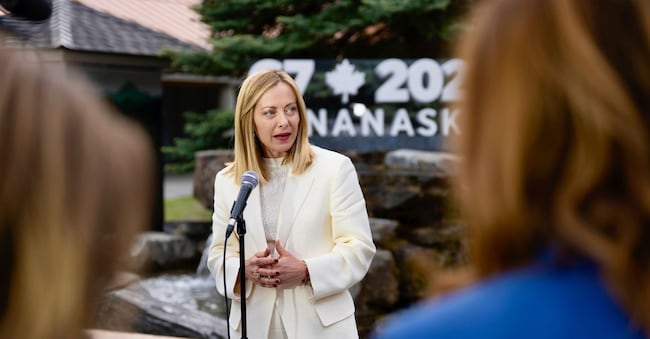
From the G7 in Canada, Giorgia Meloni brings home a baggage of 'moderate optimism', an expression that in diplomatic jargon means that negotiations are ongoing and none are yet closed. And right now, the main topic that dominated the G7 summit just concluded in the Alberta woods is the war between Iran and Israel. An 'important and complex' summit, the Prime Minister calls it, not denying the different positions at the table, starting with those of Donald Trump and the other Grandees gathered here in Kananaskis.
Meloni speaks without too much emphasis. Her tone is measured when she responds to journalists after the summit is over. She aims to smooth out the corners, the leader of the Right. Everyone agrees that Israel has 'the right to defend itself', that Iran is 'a real threat', she says citing the joint declaration obtained after a series of changes desired by the US. However, 'I think that a different scenario is possible today in which we arrive at negotiations and arrive at the objective that we all share, which is Iran's renunciation of being a nuclear power' and at the same time at the 'ceasefire in Gaza' for which Italy continues to strive and which was included in the final declaration on the Middle East crisis.
The key therefore remains negotiation, but as to how and when this will be achieved, no one is able to make any predictions. It is in this sense that German Chancellor Merz's statement about Israel 'doing the dirty work for us too' should be read - according to the PM. Much will depend on what happens in the coming weeks. "I have always thought that the best scenario is an oppressed Iranian people succeeding in overthrowing the regime. After that you have to make bread with the flour you have'. It means coming to terms with reality. It also applies to the possible use of NATO bases in Italy if the US were to side with Israel. 'We cannot give an answer now,' the Prime Minister confines herself to saying.
Certainly the role of mediator cannot be offered to Putin, he added, distancing himself from Trump who had first proposed it: 'Entrusting a nation at war with the mediation on another war would not seem to me to be the best option to consider. But it is not an option on the ground even from the words I have personally heard in recent days'.
Words certainly appreciated by Volodomyr Zelensky, who attended the final day of proceedings yesterday, but gained little from it. Not least because the main objective was missed: the face-to-face meeting with Trump, who had meanwhile flown to Washington. Canadian sources reported, among other things, that the US had prevented a statement in support of Ukraine. Meloni, however, denies it. What is certain, however, is that there has been nothing done with regard to Kiev on the sanctions against Moscow and on a further financial commitment by the major countries, as was the case at the G7 meeting chaired by Italy. And there is no doubt that this difference from one year to the next is linked to US positions. After all, the US President has returned to talk about sanctions but only to emphasise that they 'cost the Americans a lot'.


