Food

La Molisana denies opening a plant in America

Pastificio La Molisana is preparing to open a factory in the United States to avoid the obstacles linked to the 107% tariffs imposed by Trump.

Aggiornato alle ore 12:55

LA MOLISANA  AZIENDA ALIMENTARE  PRODUZIONE PASTA  IMPIANTO IMPIANTI PRODUTTIVO PRODUTTIVI  STABILIMENTO STABILIMENTI

2' min read

Translated by AI
Versione italiana

2' min read

Translated by AI
Versione italiana

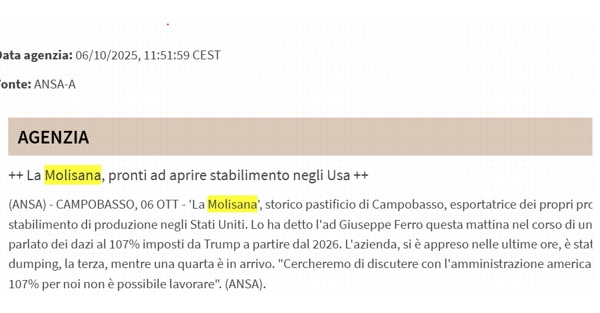
La Molisana, the historic pasta factory in Campobasso, which exports its products to 120 countries, is ready to open a production plant in the United States. This was statedby CEO Giuseppe Ferro this morning during a meeting with journalists in which he talked aboutthe 107% tariffs imposed by Trump starting from 2026.

The company, it was learnt in the last few hours, has been subjected to a new dumping procedure, the third, while a fourth is on the way. 'We will try to discuss with the US administration because,' said Ferro, 'with tariffs at 107 per cent for us it is not possible to work'.

Loading...

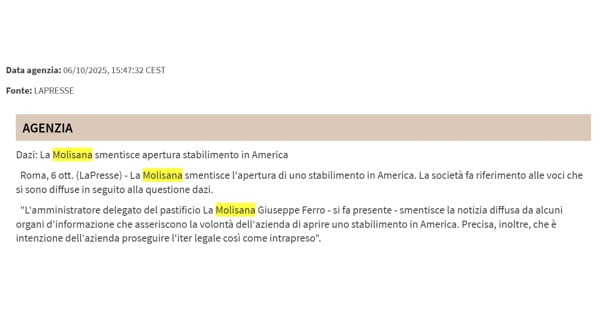
The denial released at 15:47 on 6 October 2025

La Molisana then denied - this afternoon, 6 October - the opening of a plant in America. The company refers to the rumours that have spread as a result of the tariffs issue.

"The managing director of the La Molisana pasta factory, Giuseppe Ferro, denies the news circulated by some media outlets alleging that the company intends to open a factory in America. He also specifies that it is the company's intention to continue the legal process as undertaken'.

The news of the opening of the plant was reported by Ansa at 11:51 a.m.
La notizia

the denial from the Presse at 15:47

La smentita

La Molisana, tra opzioni al vaglio anche apertura negli Usa

La Molisana: 'Unfounded dumping allegations'

.

"There is no dumping, and this had already emerged in the two previous similar procedures to which we were subjected in past years by the US Department of Commerce itself". This was stated in a note by Giuseppe Ferro, regarding the US investigation that led to the proposed tariffs of 91.74% on Italian pasta exports. 'At the end of the first procedure,' Ferro explains, 'zero dumping had been established, the second had closed with 1.6%. Now they accuse us of 91.74%, but nothing has changed on our side: we have always acted in the same way, correctly and transparently'.

The Molise company made it known that it had submitted more than 600 pages of documentation to support its position. 'We produced a colossal amount of work,' adds the CEO, 'because the procedure is very complicated and very expensive. We also asked them to come to the company to verify the data directly, but nobody came: they arrived at their conclusions without going into the merits'. On the accusations of lack of cooperation, La Molisana replies that they 'do not correspond to the truth'.

"We have submitted everything that was requested of us and will continue to provide further documentation. We are used to these procedures, but this time the numbers are completely out of proportion,' Ferro points out.

Should the tariffs come into force in January, the impact would be very serious. "With tariffs over 100 per cent, it becomes practically impossible to sell pasta in the United States," emphasises the CEO. "But the problem does not only concern us and Garofalo: we are thirteen pasta factories in the same boat, and we will look together for a solution before the measures come into force. According to La Molisana, the anti-dumping procedures "originated at the request of local American producers", a mechanism that - concludes the note - "risks becoming an instrument of trade protectionism to the detriment of fair and competitive Italian companies".

Copyright reserved ©

Brand connect

Loading...

Newsletter

Notizie e approfondimenti sugli avvenimenti politici, economici e finanziari.

Iscriviti