
'Mont Blanc emergency: we need a doubling of the tunnel'
CsC Confindustria study: closures damage regional GDP by 11.1 billion. Aosta Valley industrialists relaunch the second tunnel project
by Marco Morino
Key points
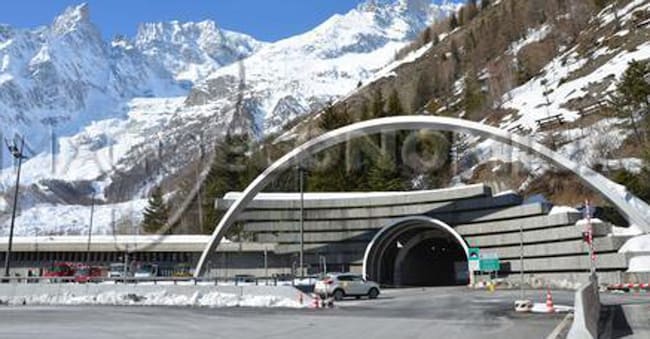
Businesses are alarmed by the Mont Blanc road tunnel, through which some 1.5 million vehicles a year, including cars and trucks, pass. Continuous and prolonged closures of the Alpine tunnel, imposed by maintenance work, as has already happened from 2023 to 2025 for about three and a half months every year, could cause serious damage to the economy of the Valle d'Aosta, the North West and, more generally, to trade flows between Italia and France. In particular, the Aosta Valley's GDP could drop by up to 8.8 per cent, for a total of EUR 11.1 billion. This is according to a study conducted by the Confindustria Study Centre (CsC), edited by Stefano Di Colli, which estimates the impact of the closure of the Mont Blanc tunnel on the economy of Valle d'Aosta.
The infrastructural alternatives (Frejus, Gran San Bernardo) do not compensate for the interruption of the direct link between Valle d'Aosta and France, generating higher logistical costs, longer transport times and reduced competitiveness for industrial activities and tourist operators. According to the companies, the only alternative to avert such a scenario is to double the tunnel, in practice building a second tunnel close to the historic one (about 11 kilometres long and inaugurated on 19 July 1965). The cost estimate for the new tunnel is around EUR 1.2 billion. But first it will be necessary to overcome French resistance, which at the moment does not seem to support this project.
Two scenarios
The CsC study considers two alternative scenarios: one under the assumption of a closure of 5 months per year for 30 years, the other of a closure of 5 consecutive years. The econometric simulations for the period 2025-2054 estimate that a closure of 5 months a year for 30 years of the Mont Blanc tunnel would result in a cumulative loss of approximately -6.1% of regional GDP to 2054, with a total impact of 7.8 billion euros and an average annual reduction of 262 million.
The scenario of continuous closure for five years would produce even more intense and lasting effects, with an estimated cumulative loss of -8.8% of regional GDP by 2054, totalling 11.1 billion euro and an average annual reduction of 371 million euro. The CsC data confirm that the Mont Blanc tunnel is a real factor in regional competitiveness. Prolonged disruptions compromise not only commercial and tourist traffic, but also overall economic growth, with structural effects that are difficult to reverse, including the relocation of traffic flows to other crossings. For tourism in particular, the Mont Blanc tunnel represents the traditional access route for French and Swiss (Suisse Romande) tourists to the Aosta Valley and neighbouring regions.
Companies in the field
France's scepticism about the second tunnel does not stop Italia and the figures in the CsC report seem to prove them right. Says Francesco Turcato, president of Confindustria Valle d'Aosta: 'Any further closure of the Mont Blanc tunnel will cause direct damage to the Aosta Valley economy, equivalent to 6-9% of the regional GDP. Preventing this for Confindustria is our priority, and we are convinced that there is only one way: doubling the current infrastructure from one to two tubes (tunnels, ed.). This is the only solution that will avoid closures altogether, and in 12 years it will give Italia a state-of-the-art, safe and more environmentally efficient infrastructure. Moreover,' Turcato continues, 'a constant cash flow would be guaranteed to the management company, which could easily finance the works without a single public euro being spent. This proposal is shared by the national and regional governments'. For Turcato, a discussion at European level on doubling the tunnel that overcomes the substantial French lack of interest, in order to reach a decision by autumn, can no longer be postponed. Because it must be clear, Turcato concludes, that even in a perspective of advanced intermodality, road transport will remain prevalent for several decades yet.


