Cheese

Mozzarella di Bufala PDO: lorries being blocked are halting production. And stocks of unused milk are rising

Stocks suitable for ‘non-IG’ products are on the rise, although demand for such products is lower: one solution is to concentrate calf births in spring and summer, when demand for dairy products is at its peak

by Vera Viola

Aggiornato il 21 ottobre alle ore 11.10

Aggiungi Il Sole 24 Ore
ai preferiti su Google

3' min read

Translated by AI
Versione italiana

3' min read

Translated by AI
Versione italiana

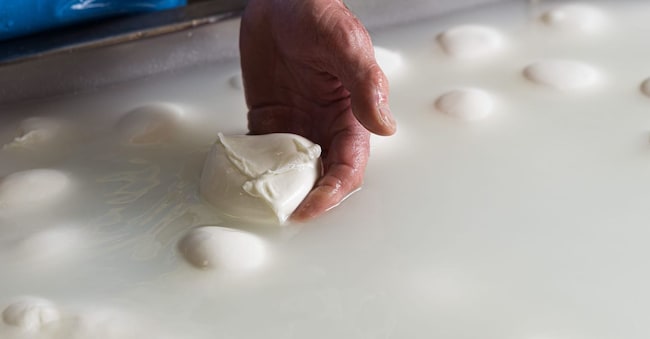
The lorry drivers’ protest is also having a severe impact on the buffalo milk supply chain, which is already grappling with an exponential rise in production costs that are bringing farms and processors to their knees. The warning comes from the Consortium for the Protection of Mozzarella di Bufala Campana PDO, which states that ‘not only is PDO buffalo mozzarella now in short supply even in supermarkets, but the real problem is the halt in production. This situation risks dealing a devastating blow to the sector’ and is compounded by very high levels of milk in storage, which had already caused concern amongst industry operators.”

‘The Campania Buffalo Mozzarella PDO is a fresh product, and is therefore particularly affected by the current difficulties. At present, farmers are producing milk but are unable to get it to the dairies due to the transport ban; as a result, many dairies have been closed since yesterday because they do not have the milk available to process into PDO mozzarella within 60 hours, as required by the product specification,” explains the director of the Consortium, Pier Maria Saccani.

Loading...

On top of the closure of the dairies, there are the difficulties faced by the farmers, “who, of course, are still milking their buffaloes, but do not know where to store the milk and are not receiving supplies for their herds”, Saccani points out.

Meanwhile, between January and August, production of Mozzarella di Bufala Campana PDO (by volume) increased by 3.72%. However, over the same period non-PDO production fell by 4 per cent: it is clear that there has been a shift in consumption from non-PDO to PDO products, following a trend that has been underway for several years. “This is a sign,” explains Pier Maria Saccani, director of the Consortium for the Protection of Mozzarella di Bufala DOP , “that demand is shifting towards the Protected Designation of Origin, which consumers recognise and appreciate.”

Despite the growth in demand, the traditional cheese sector is also currently facing both new and long-standing problems. These were discussed at a meeting held a few days ago at the Prefecture in Caserta, attended by representatives of buffalo farms and trade associations representing cheese producers.

“The atmosphere is positive,” adds Saccani, “we are all facing the same problems and seeking joint solutions. For the first time, we have all agreed that the future of the supply chain is linked to the positioning and quality of Campania PDO mozzarella.” On the agenda is the excessive build-up of stored milk: 31 million kg worth approximately 50 million, which is placing a heavy financial burden on dairies. Efforts are now being made to find a solution for utilising these stocks. According to the specific provisions of the product specification, once 60 hours have passed since milking, this milk cannot be used to produce PDO mozzarella and is therefore ‘downgraded’. It may, however, be suitable (even, for example, after being deep-frozen) for producing non-PDO products, burrata di bufala and other items.

“One avenue to pursue,” Saccani explains, “is the regulation of buffalo calving, encouraging births to take place during the warmer months, with the aim of achieving peak milk production between spring and summer, so that it coincides with the time of year when demand for mozzarella rises”. This is an issue the protection consortium has been campaigning for for some time. “This process has now begun,” Saccani notes, “but farmers point out that it will take some time to complete.”

It is clear, therefore, that birth control alone may not be sufficient to resolve the problem. Consequently, the Protection Consortium is calling for the establishment and convening of a national round table comprising representatives of farmers, dairies and institutions from the four regions – Campania, Puglia, Molise and southern Lazio – where PDO buffalo mozzarella can be produced. ‘Following the model,’ recalls Saccani, who has personally been involved in this matter in the past, ‘of what has been done in the Grana Padano production chain. Optimising the relationship between farmers and dairies would, in fact, benefit the entire supply chain’.

The talk is therefore of optimisation and, reading between the lines, other measures would be desirable: a controlled reduction in milk production, or even a reduction in herd size. At the same time, efforts must be made to capitalise on the current growth in demand for PDO mozzarella, with domestic and foreign consumption on the rise, partly thanks to intensive and targeted promotional campaigns. “But agreements and regulations are needed,” concludes the director-general, “to make the value chain more efficient.”

Copyright reserved ©
Loading...

Brand connect

Loading...

Newsletter

Notizie e approfondimenti sugli avvenimenti politici, economici e finanziari.

Iscriviti