Safety

Morocco: the counter-terrorism wall caught between Atlantic ambitions and latent crises

Rabat is asserting its stance against the jihadists, a strategy that ties in with its role as a bridge between the US, the EU and the Gulf states

 Alamy Stock Photo

5' min read

Translated by AI
Versione italiana

5' min read

Translated by AI
Versione italiana

NAIROBI – At the start of last week, Morocco was still basking in the glory of its national football team’s rise and the hopes of a repeat of their run at the World Cup in Qatar. The campaign came to an end with a 2–0 defeat at the hands of France on Thursday, the same stumbling block as four years ago. Back home, however, there were other reasons for excitement. The Bureau Central d’Investigations Judiciaires (BCIJ), the so-called ‘Moroccan FBI’, announced the arrest of around ten activists linked to an Islamic State cell in the province of Western Sahel, a group that affiliated itself with ISIS in 2022 and operates primarily in the border triangle between Burkina Faso, Mali and Niger: one of the epicentres of the insurgency by armed groups that has been ravaging the Sahel region for over a decade, and which was again designated in 2025 by the Global Terrorism Index report as the global epicentre of terrorism.

The Moroccan counter-terrorism agency has stated that it has carried out joint operations in the cities of Agadir, Taroudant, Tetouan, El Hajeb, Fquih Ben Salah, Casablanca and Safi, thereby foiling future attacks and dismantling the infiltration plot hatched by the leadership of the so-called ISSP to gain a foothold in Morocco.

Loading...

According to the authorities’ statement, the suspects are said to have ‘received instructions and direct communications from the leaders of the ISIS branch in the Sahel’ to remain in Morocco and ‘carry on with the group’s programme, postponing their plans to travel to the group’s strongholds abroad’. The searches uncovered firearms, military-style uniforms, instructions for assembling explosive devices and an SUV with a modified fuel tank, which investigators have classified as a vehicle intended for suicide attacks or attacks on ‘sensitive targets’.

The anti-terrorism wall and the (reduced) risk of jihadists

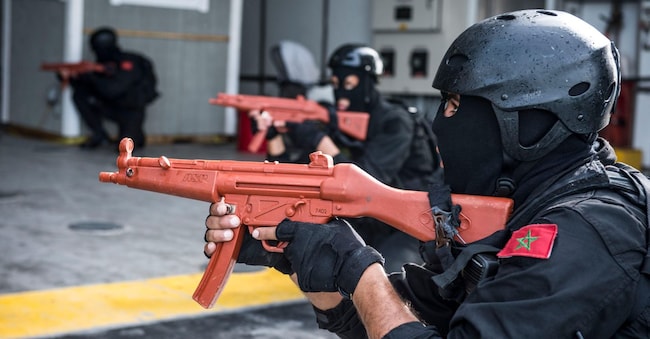
The BCIJ regularly announces the arrest of terrorists or the foiling of plots by Islamist groups operating beyond its southern borders. Anadolu Ajansı, the Turkish news agency, reports that at least 200 cells have been dismantled since 2003, a trend that culminated in the latest raid attributed to ISIS: the 2023 attack in Casablanca, when three men linked to the Islamic State killed a police officer. Rabat, one of the most prosperous economies in North Africa and on the continent, has established a counter-terrorism infrastructure that contributes to a sense of security amidst the unrest pervading North and West Africa, starting with the Sahelian border regions.

This strategy goes hand in hand with and is intertwined with substantial defence spending, with a budget equivalent to approximately 157 billion Moroccan dirhams (15.7 billion dollars) under the 2026 Finance Act: an initial tranche of 73 billion dirhams (over 7 billion dollars) will be allocated to the budget immediately, whilst the remainder is earmarked for future expenditure commitments. Upcoming projects include the Tata Advanced Systems Morocco armoured vehicle plant in Berrechid, a maintenance facility for F-16 and C-130 aircraft, and plans for a centre to produce military drones by the Israeli firm BlueBird Aero Systems.

Beyond the announcements from Rabat, it is unclear to what extent jihadist-affiliated militias are actually expanding in Morocco. Analysts interviewed by Il Sole 24 Ore Next Med are adopting a cautious stance. Morocco may be of “strategic interest to grassroots militants in the Sahel”, explains Beverly Ochieng of Control Risks, but “this will remain confined to isolated individuals influenced by online propaganda or symbolism, rather than direct links with IS (Islamic State)’’.

Self-radicalisation and exposure to extremist ideology online may fuel the phenomenon, says Ochieng, but “the proactive stance of the Moroccan security apparatus will minimise the broader threats”.

Even the spillover to the north of the jihadist insurgency appears to be limited, particularly when compared with the offshoots observed along the West African coast. Morocco, as Luca Raineri of the Sant’Anna School of Advanced Studies in Pisa points out, has a ‘long history’ of Moroccans enlisting as foreign fighters with ISIS and subsequently entering a government ‘deradicalisation’ programme with uncertain outcomes: even in the absence of a return to violence, the social marginalisation surrounding them represents the most fertile ground for new extremist tendencies. ‘Amongst these individuals, it is conceivable that a certain sympathy for jihadist subversion continues to exist,’ says Raineri, but ‘it remains to be seen how genuine and effective these connections are: I doubt they are able to send money, men or orders to one another, apart from a general strategic direction’.

La pressione Jihadista sulle infrastrutture

Loading...

Atlantic projection and internal repression

Rabat’s anti-terrorism activism ties in with the country’s strategic vision, as it continues to grow in stature as a diplomatic partner and pro-Western actor with ties to the EU, Israel and the United States. On the military and security front, “Morocco wants to present itself to Europe and the United States as a bulwark against the spread of jihadist terrorism originating in the Sahel,” says Ignacio Cembrero, a Spanish journalist and analyst specialising in the Maghreb. Timing and relationships are working in its favour: Rabat, says Cembrero, is “convinced that France’s expulsion from the Sahel and the strained relations between Algeria and Mali present an opportunity” and maintains “excellent relations with the military juntas governing the Sahelian countries”.

On the diplomatic and economic front, Rabat has recently seen its influence grow on the North African and international stage.

“His most notable achievement is ‘the diplomatic paradigm shift on the Western Sahara issue, enshrined in the UN Security Council resolution of October 2025’,” explains Dario Cristiani of the Institute of International Affairs, referring to the shift in approach in favour of Morocco’s position on the Western Sahara issue: the position of autonomy under Rabat’s administration, now also endorsed by France and the United States. On other fronts, Cristiani notes, Morocco has managed to avoid a setback in its relations with Israel following the Iran-Iraq War and is strengthening ties with the Sahelian countries themselves ahead of the Atlantic Initiative: the initiative launched in 2023 by King Mohamed VI to open an ocean route to Mali, Niger, Burkina Faso and Chad, positioning the country as a commercial bridge between the Gulf, Europe and the US.

Rabat’s vibrancy clashes with the country’s internal tensions, caught between aspirations for record growth, a web of alliances and domestic hardships, channelled by a movement with both African and global resonance: GenZ212, the wave of protests by very young members of Generation Z against political repression, unemployment, a lack of services and the ‘scandal’ surrounding investment in the 2030 World Cup. Even claims regarding the successes of counter-terrorism must be ‘viewed with caution’, explains Karim Mezran of the Atlantic Council think tank, as they may serve as a ‘justification for the repression and intimidation’ taking place in the country.

Today, says Mezran, Morocco ‘finds itself in a “mixed” situation, caught between modern, reformist forces and an authoritarian, repressive tendency that cannot be ignored. Let us consider the issue of the Abraham Accords: the elite are in favour, but the majority of the country is not. What might happen when a breaking point is reached?’

Copyright reserved ©
  • Alberto Magnani

    Alberto MagnaniCorrispondente

    Luogo: Nairobi

    Lingue parlate: inglese, tedesco

    Argomenti: Lavoro, Unione europea, Africa

    Premi: Premio "Alimentiamo il nostro futuro, nutriamo il mondo. Verso Expo 2015" di Agrofarma Federchimica e Fondazione Veronesi; Premio giornalistico State Street, categoria "Innovation"

Loading...

Brand connect

Loading...

Newsletter

Notizie e approfondimenti sugli avvenimenti politici, economici e finanziari.

Iscriviti