
Motors: the Autonomous Car Grand Prix makes its debut at the Imola circuit
On 5 September, five driverless cars controlled by algorithms will take to the track. The competition is organised by the Abu Dhabi Autonomous Racing League (A2RL)

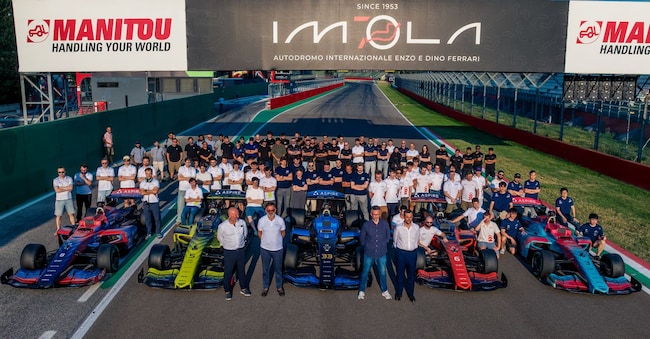
On the circuit where Senna, Schumacher and the great names of Formula 1 made history, the driver will not be there on 5 September. Imola will in fact host the international debut of the Abu Dhabi Autonomous Racing League (A2RL), a competition featuring fully autonomous single-seaters that takes the battle between artificial intelligence systems – racing at speeds of over 250 kilometres per hour – outside the Emirates for the first time.
A race in which, once the lights go out, the engineers will no longer be able to intervene: from that moment on, it will be the algorithms that decide when to brake, how hard to push, which line to take on the Acque Minerali straight, and whether to attempt an overtaking manoeuvre or hold back. This is where the race will be decided.
The cars are identical, built on the Dallara Super Formula SF23 platform and converted into the EAV-26: around 500 cavalli, a theoretical top speed of 300 kilometres per hour and seven cameras. What sets them apart is the ‘brain’ – the human minds of the engineers who develop the algorithm. Each team develops the software that must read hundreds of signals in real time, interpret the environment, predict the behaviour of the other cars and control the steering, brakes, gearbox and strategy. Each lap can generate 500 gigabytes of data. The difference between winning and losing will therefore lie in a single line of code, in a decision taken a hundredth of a second before the others.
Five university teams will be competing in the fully autonomous car race. Two are Italian – the Politecnico di Milano and the University of Modena and Reggio Emilia – whilst the others are Germany’s TUM, Kinetiz from the United Arab Emirates and Switzerland’s Constructor.
However, the Romagna circuit is not the only element of Italian character in this challenge, which is in fact 100 per cent ‘Motor Valley’: all the single-seaters are built on Dallara chassis, the Varano de’ Melegari-based company that epitomises research and competition. For Imola, this marks a symbolic leap forward. A circuit that has built its identity on traditional motorsport is now becoming a testing ground for the mobility of the future.

