Hospitality & the environment

Mountain huts: the unsustainable burden of overtourism

A study of 226 high-altitude establishments reveals that the area is suffering from over-tourism, with high demand for hotel accommodation. This is having an impact on the environment

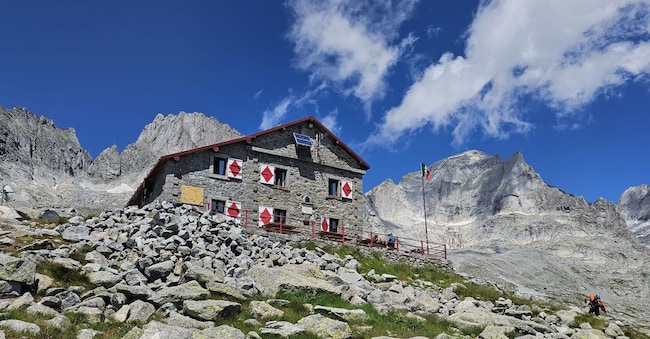
Valtellina. Il Rifugio Giannetti è gestito dal 1986 da Giacomo “Mimmo” Fiorelli

5' min read

Translated by AI
Versione italiana

5' min read

Translated by AI
Versione italiana

In the past, when you arrived at a mountain refuge, you’d eat whatever was available and sleep wherever you could. These days, you might find yourself booking not only a bed, but also a slot for lunch. People ask for a twin room, internet access, a menu suitable for food intolerances and, if possible, a hot shower. This is a sign of a transformation that, in recent years, has changed both the guests and the managers of alpine huts. But to what extent can a hut change without becoming a high-altitude hotel?

This change is also documented in a study published in the Journal of Outdoor Recreation and Tourism. The study, led by Riccardo Beltramo, a lecturer at the University of Turin, gathered responses from the managers of 226 mountain huts – around a quarter of all managed facilities surveyed across the Italian Alps. Mountain hut managers are in a unique position to observe what happens at high altitudes: they meet visitors every day and, at the same time, have to contend with the physical and environmental constraints of the mountains.

Loading...

The study identifies signs that tourism capacity is being exceeded — ranging from overcrowding to environmental degradation, and including growing management difficulties — and points to changes in tourism demand as one of the main factors driving this pressure. This does not mean that overtourism is widespread, but that in some locations the limits are beginning to become apparent.

“When we started working on mountain huts in the late 1990s, the few operators who had decided to create four-bed rooms were ridiculed. Today, many mountain huts have family rooms,” says Beltramo.

The regulars – the mountaineers and hikers willing to make do with a dormitory and a basic menu – haven’t gone anywhere. But alongside them, new groups have arrived: mountain bikers and e-bikers, trail runners, families with children, and also many people who rarely visit the mountains and discover a mountain refuge through a photograph or video on social media.

“Many mountain huts have become destinations for people who may never have been to the mountains before. Someone posts a picture of a spectacular landscape, the place goes viral, and you can find yourself facing an exponential increase in visitor numbers,” Beltramo adds.

Instagram-worthy mountain

But it’s not just about Instagram. There has also been a growing interest in outdoor activities, and the way people experience high-altitude areas has changed. A mountain refuge is no longer necessarily just a stop-off point along the more than 60,000 kilometres of trails criss-crossing the peninsula. Increasingly, it is the destination itself. And this profoundly alters their significance.

Sometimes it becomes something quite different. There are mountain huts that organise children’s weeks, university seminars, concerts, book launches and documentary screenings. ‘If I organise a concert at the mountain hut, I can attract an audience that would otherwise never have come. If I organise a climbing competition, the climbers will turn up.’ Increasingly, mountain huts are also becoming promoters of cultural and tourist activities.

The mountain hut, as Beltramo points out, “is also a business” and, like any business, it seeks to understand – and sometimes anticipate – demand. As a result, the menus, the spaces, the rooms and the way the hut is marketed have all changed. First Facebook, then Instagram and now TikTok have enabled the managers to build a direct relationship with guests and to transform the mountain hut itself into a destination. Older managers recall a time when mountain huts were primarily a starting point for mountaineering expeditions. Today, with the boom in hiking, “traditional mountaineering has declined somewhat; instead, many people come here to spend the night and return to the valley the next day or head to a nearby mountain hut,” says Giacomo “Mimmo” Fiorelli, who, at 72, has been running the Rifugio Giannetti in Valtellina since 1986.

This transformation, however, gives rise to a misunderstanding. Particularly in easily accessible mountain huts, some visitors expect a level of service similar to that of a restaurant or hotel. ‘People confuse a mountain refuge with a restaurant or a hotel,’ observes Beltramo, confirming the view held by Fiorelli and many other managers. Consequently, expectations have changed: waiting times, the choice of dishes, value for money, and the availability of hot water.

Loading...

This mountain hut is not a resort

Water, for example, is not an infinite resource. Many operators report periods of scarcity and are forced to ration its use. At the same time, providing more services means consuming more energy. For example, by increasing the number of helicopter flights to transport materials and supplies.

It is one of the paradoxes of the modern mountains: whilst climate change is making the resources on which mountain huts depend increasingly fragile, visitors are demanding ever-higher standards of comfort.

Then there is the issue of numbers. The growth in local tourism and the ability of social media to suddenly draw thousands of people to the same place can lead to overcrowding that is difficult to predict. Site managers report, in particular, littering and pressure on the surrounding areas.

One of the ways of managing visitor numbers is through booking. Whilst this is now standard practice for accommodation, some mountain huts are extending it to meals as well. “I recently happened to visit a very busy mountain hut and was put on the second seating for lunch, at half past two,” says Beltramo.

But controlling access is no easy task. When a place goes viral, the phenomenon can affect not only the mountain refuge itself, but also footpaths, car parks and entire protected areas. And the issue is no longer just a matter for the refuge managers; it also involves local councils, national parks and public authorities.

A question of sustainability

Yet a survey of 2,900 members of the Italian Alpine Club shows that the majority are in favour of restrictive measures to protect the environment from the negative effects of overcrowding. Measures such as increasing entry fees and limiting the number of visitors in certain areas are seen as necessary to protect natural resources and ensure a more sustainable visitor experience.

Fiorelli also speaks of environmental change: ‘We’ve made a lot of changes. First, we installed a micro-turbine that harnessed meltwater from the snow. But since there’s been a shortage of this, we’ve introduced solar panels.” As for environmental awareness, Fiorelli says this has increased: “People ask us for bins, or at any rate everyone takes their own rubbish back down to the valley; before, we weren’t as mindful of these things.”

A broken promise?

Finally, there is a limit that is more difficult to measure: the point beyond which an increase in services alters the very nature of the mountain refuge. Prices have already risen, and for a family, spending a weekend in the mountains can represent a significant expense. Further increasing comfort levels and rates risks transforming a place that has historically been accessible into something different – something elitist.

“If the mountain refuge becomes a high-altitude hotel,” observes Beltramo, “it betrays its very purpose.”

The question, then, is not whether the mountain huts should remain as they were. They could not do so: the mountain, tourism and the people who visit it have all changed. The challenge is to understand how far they can change without losing what sets them apart from any other place offering hospitality.

‘We want to preserve the character of the refuge. We have shared dormitories and communal bathrooms,” says Fiorelli, who adds, however: “Of course, we’ve introduced showers. Many people ask for them, just as we’ve had to cater for a wide range of different dietary requirements. But we’re still a high-altitude mountain refuge; we’re at 2,500 metres.”

A mountain hut may have Wi-Fi, a double room and a vegetarian menu, but it is still situated in an environment where water can run out, electricity has to be generated, and what is taken for granted in the city is by no means a given at two thousand metres.

Copyright reserved ©
Loading...

Brand connect

Loading...

Newsletter

Notizie e approfondimenti sugli avvenimenti politici, economici e finanziari.

Iscriviti