

Magnetic resonance imaging: with AI, scanning travels 50% faster
Agreement between Bari-based Predict and South Korean AIRS Medical for enhanced software that improves image quality and reduces reporting times

2' min read
2' min read
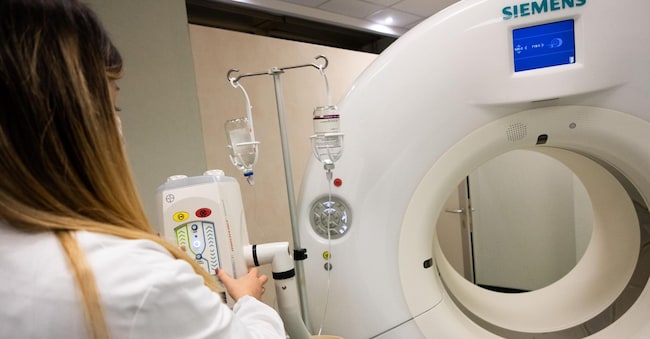
The distribution of SwiftMR, an AI-powered software for acquiring and reporting MRI scans that improves image quality and reduces scanning times, has also started in Puglia. The agreement for its distribution was signed by Predict - a Bari-based SME active in healthcare and in particular in in vivo diagnostics - with Ars Medical Europe Gm, the European branch of the South Korean AIRS Medical Inc., a leader in AI-powered diagnostic imaging.
Software features
.The special feature of SwiftMR,' they explain at Predict, 'is that it allows the scanning time of any MRI device to be reduced by up to 50 per cent, fitting seamlessly into existing flows, without interruptions and additional equipment, thus ensuring scanning accuracy, patient comfort and a significant increase in productivity.
"The cloud-based architecture of the system," explains Daniele Volpicella, Predict's service manager, "allows each facility that implements it to optimise productivity and quality of service with virtually zero infrastructure investment. The non-exclusive distribution contract for Puglia will last 28 months and allows Predict to expand its portfolio with a new service dedicated to MRI.
The Imaging business unit is strengthened
.For Predict - €6.3 million turnover in 2024, 27 employees, 4 strategic units - the agreement consolidates one of its most important SBUs (Strategic Business Units). Together with the 'Imaging' SBU, which is dedicated to the commercialisation of in vivo diagnostic imaging equipment, such as ultrasound and X-ray systems, Predict has also developed the 'MIstral' SBU - for the design, development and commercialisation of breath analysis solutions for the search for volatile organic compounds in breath - and the 'Digital Healthcare' SBU, for the design, development and commercialisation of technologies to communicate remotely, using augmented reality, and improve patient care processes in hospitals through social and collaborative robotics.

