
Bioristor: the technology that saves 45% water in tomato cultivation
An innovative sensor developed by Mutti and Imen-Cnr optimises water use

2' min read
2' min read
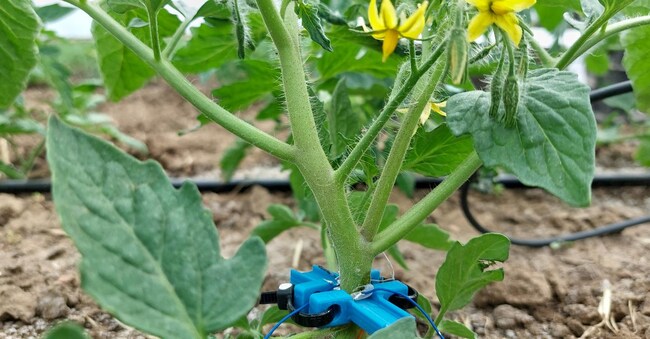
An innovative sensor applied to the stems of vegetable or fruit plants to calculate their needs, and which in experiments on tomatoes saved 45% water compared to traditional practices. The system is called Bioristor and has been fielded by Mutti, a leader in the tomato derivatives market, and the Institute for Materials for Electronics and Magnetism of the National Research Council (Imen-Cnr).
Bioristor, the researchers explain, is able to monitor plant health in real time, analysing their fundamental physiological processes and communicating directly with farmers, thanks to photovoltaic energy and the IoT connection system.
"Global agriculture, which is responsible for 70 per cent of the planet's freshwater consumption, is facing increasingly pressing challenges due to ongoing climate change. Rising temperatures and decreasing rainfall make it crucial to adopt new technologies to deal with the water emergency," says Massimo Perboni, Director of Mutti's Agricultural Service. Bioristor offers an unprecedented opportunity in our industry to monitor and optimise the use of water in our crops, helping to ensure the quality of our products in an increasingly efficient and responsible manner.
The system has been successfully used to monitorkiwifruit, grapevines and apple trees during the production season and, for the first time in 2023, was used in a joint trial between Imem-Cnr and Mutti at the Stuard company in Parma.
"Thanks to an artificial intelligence-based irrigation protocol," the researchers explain, "it was possible to achieve 45% water savings compared to conventional methods. While there was a slight decrease in gross field yield, there was a significant increase in Brix, the soluble part of the tomato and indicator of its quality, and product conformity".
"The Bioristor together with the artificial intelligence algorithm," says Michela Janni, researcher at Imen-Cnr, "represents a step forward in precision agriculture, making it possible to maximise irrigation efficiency and achieve high quality production even in adverse conditions.


