Mind the Economy/Justice 125

Nancy Fraser and 'three-dimensional' justice

The American philosopher explores justice beyond redistribution and recognition, introducing political representation as a third dimension

by Vittorio Pelligra *

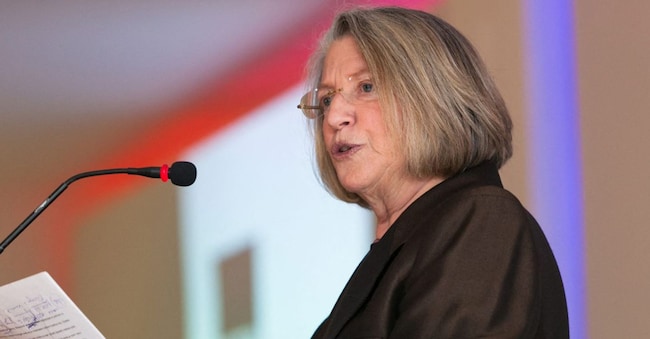
La professoressa del New Yorker Nancy Fraser tiene una conferenza sul tema "Dalla crisi al cambiamento?" presso la Fondazione Einstein di Berlino. (Foto di Moritz Vennemann / picture alliance / dpa Picture-Alliance via AFP)

7' min read

Translated by AI
Versione italiana

7' min read

Translated by AI
Versione italiana

There is a fundamental question, in the contemporary debate on justice, in which economy meets, or clashes with, ethics. It is a question that interrogates politics, urging it to cast off the robes of the mere administration of what exists in order to return to the question of the meaning of living together, which is its deepest meaning. It is on this question, in this borderland between economics, philosophy of justice and politics, that the thought of the philosopher Nancy Fraser moves with decision and courage. The issue is that of redistribution and recognition. The idea, that is, that a just society is not only a society capable of distributing resources, rights, and opportunities in a fair and inclusive manner, but must also be a society capable of recognising the value, dignity and cultural identity of each of its members, because material resources and moral recognition cannot be thought of as alternatives, but as coessential dimensions of the same idea of justice.

Born in Baltimore in 1947, Nancy Fraser is the kind of intellectual who does not just interpret the world, but forces it to question itself. A philosopher of justice and democracy, she has traversed feminism, critical theory and political philosophy with the sideways gaze of one who observes from the peripheries: those of excluded voices, invisible faces, and denied dignity. A voice that urges us to rethink the moral foundations of coexistence and to reunite what modernity has separated: economics and ethics, recognition and justice, freedom and care.

Loading...

In search of 'participatory equality'

Fraser realised, before many others, that the crisis of Western democracies is not only economic, but also and perhaps mainly symbolic. It is not enough to redistribute income if society continues to humiliate, to exclude, to deny visibility and respect to large parts of its members. And at the same time it tells us that not even the recognition of value and differences can suffice on its own, if it remains confined to the plane of language and symbols, without touching the substance of material inequalities. Only a society that succeeds in giving complete answers to the dual need for full economic and generative participation as well as inclusion and worthy moral and symbolic recognition is just, the philosopher tells us. A condition that Fraser calls 'participatory equality'. He writes together with Axel Honneth in Redistribution and Recognition:

"For participatory equality to be possible, I believe that at least two conditions must be fulfilled. As a first condition, the distribution of material resources must guarantee independence and 'voice' for participants. I call this condition the 'objective condition' of participatory equality, which precludes forms and levels of economic dependence and inequality that prevent participatory equality (...) The second condition requires, on the other hand, that institutionalised cultural value patterns express equal respect for all participants and guarantee equal opportunities for the achievement of social esteem. I call this condition the 'intersubjective condition' of participatory equality, which precludes the institutionalisation of norms that systematically disregard certain categories of people and their associated characteristics" (2007, p. 56).

The 'objective condition' thus precludes "social arrangements that institutionalise a state of poverty, exploitation and strong disparities in wealth, income and leisure, and which deny some people the opportunities and means to interact as equals with others". The "intersubjective condition", on the other hand, opposes "institutionalised value models that deny some people - either through the imputation of their excessive 'difference' or through the failure to recognise their diversity - the status of full partners in interaction".

Participatory equality, on the one hand, implies the removal of economic obstacles to full social participation; on the other, it requires the removal of all those cultural and institutional obstacles that prevent full recognition of the value and different identities of each member of society. Redistribution addresses 'socio-economic' injustices - exploitation, marginalisation, deprivation - rooted in the economic structure of capitalism, while recognition addresses 'cultural' injustices - contempt, denigration, invisibility - that affect groups stigmatised by gender, ethnicity, orientation or status. Women's underpaid work, racial discrimination in the labour market, the precarisation of care work: all these show that cultural and economic injustices are interconnected and mutually reinforcing, and only an integrated approach can break the resulting vicious circle. Therefore, the philosopher proposes a notion of 'two-dimensional justice': redistributing resources and, at the same time, transforming the cultural codes that define who deserves respect and why.

Giving justice and dignity

In recent decades, says Fraser, politics has splintered along these lines. The social left has defended redistribution, while the cultural left has favoured recognition. On the one hand, class struggle; on the other, identity politics. But this dualism has weakened both. Only if the struggle for the emancipation of the last will return to speak a common language, capable of uniting the struggles for dignity with those for economic justice, will this process be able to gain the strength and consensus that it seems to have lost for some time now.

The deepest merit of Nancy Fraser's reflection lies precisely here: in having restored unity to the theory of justice, bringing back to the centre the organic link between economics and moral recognition, between production and dignity. Hers is an embodied philosophy of justice, rooted in the real world, which is not afraid to confront the contradictions of history and the transformations of contemporary capitalism.

In Redistribution or Recognition?, written with Axel Honneth, the initial opposition between the two philosophers - one concerned with economic structure, the other with processes of symbolic identification - dissolves into a fruitful tension. Fraser does not reject Honneth's theory of recognition, but shows its limitations when he disregards the material roots of inequality. From this dialectic comes her idea of justice as participation, a model that abandons the abstractions of liberalism and the postmodern drifts of identity to return to the terrain of concrete democracy. Indeed, Fraser is convinced that inequality is never just a question of income, but a question of participatory power. Contemporary societies, globalised and digitalised, produce new forms of exclusion that mix economic and symbolic domination. Job insecurity, the commodification of care, the culture of perpetual competition: these are all mechanisms that limit the ability of certain groups to count and be heard. This is why participatory equality is not an abstract ideal for her, but a concrete measure of the degree of democracy in a society.

The question of political representation

More recently, in his Scales of Justice, Fraser further broadens the horizon of reflection by introducing a third dimension of justice: that of political representation. In a world marked by globalisation, inequalities are no longer played out only between social groups within individual states, but cross national borders. The question, then, is no longer just who gets what or who is recognised, but who counts as a subject of justice, who has a voice in defining the rules of the game. Redistribution, recognition and representation thus become the three axes of a now 'three-dimensional' justice, capable of interpreting the systemic injustices of global capitalism, the asymmetries of power between the global North and South, and the crisis of democratic sovereignty.

In Fraser's thought, the analytical clarity of political philosophy and the moral urgency of a critical theory coexist. Hers is an emancipatory project that rejects both economic fatalism and identity romanticism. Instead, she proposes a politics of the global common good, founded on what she calls a 'renewed public reason': the collective capacity to deliberate on the shared ends, priorities and forms of reciprocity that make democratic life possible. Against the meritocratic rhetoric that justifies inequalities as the 'just' outcomes of individual talents and efforts, Fraser claims a justice that does not measure the value of people by their success, but by their contribution to common life. Here then, his apparently theoretical reflection becomes political again in the highest sense of the term: a politics that puts dignity, cooperation and a sense of mutual responsibility back at the centre. In an age that has separated freedom from solidarity, Fraser reminds us that justice cannot only be freedom from want, but must also be freedom to participate. "No conception of democratic justice," he writes, "can be credible unless it guarantees all members of society the opportunity to participate, as equals, in shaping the rules that govern them" (2007, p. 171-172).

The essence of democracy

Perhaps Nancy Fraser's most profound contribution to the theory of justice lies in having taught us that freedom, alone, is not enough; that dignity, alone, does not redeem; and that justice, if it is to be real, must become flesh in institutions, in language, in the everyday gestures of living together. His idea of 'participatory equality' is not just a theoretical formula: it is the moral measure of our age, of the profound quality of our communities. It is the question that forces us to look inside our democracies and ask ourselves whether everyone really has a voice, whether everyone really can participate in defining common ends, whether they are, in the end, true democracies.

Fraser shows us that growing inequality is not an accident of history, but a way in which power disguises itself as a natural order. And that neither economic growth nor the rhetoric of rights is enough to overturn it. What is needed is a new political language capable of naming both the pain of the world and the promise of its healing. What is needed is a public ethic of mutual responsibility, a collective reason that unites what the economy separates: production and care, income and relationship, success and recognition. Justice, in Fraser's perspective, is never an achieved equilibrium, but an uninterrupted movement between redistribution and recognition, between the transformation of structures and the transformation of gazes. It is always an unfinished process, because each step towards equality opens up new demands for respect and new forms of dignity to be recognised. At a time when the voice of the many is often drowned out by the noise of the few, his reflection stands as a call to rediscover a broader 'we', a community capable of transcending the boundaries of identity and profit. Not to erase differences, but to make them the very fabric of democracy.

Perhaps this is, after all, the deepest imprint of his thinking: the idea that a just society is not one in which everyone has an equal part, but one in which everyone has a part. A part in the word, in the decision, in the construction of the common good. And that justice, even before being a principle, is a way of being in the world, together.

* Vittorio Pelligra, Professor of Economics C-BASS, Center for Behavioral and Statistical Sciences, Director Department of Economics and Business, University of Cagliari

Brand connect

Loading...

Newsletter

Notizie e approfondimenti sugli avvenimenti politici, economici e finanziari.

Iscriviti