The new race to the Moon

NASA is aiming to confirm 2027 as the launch date for Artemis III. Mission details

NASA (and China too) are preparing complex missions to the Moon’s south pole, using crews and advanced technologies to explore and, in the future, inhabit the Moon

5' min read

Translated by AI
Versione italiana

5' min read

Translated by AI
Versione italiana

The second race to the Moon is back in the spotlight following a lengthy NASA press conference – lasting over two hours – held yesterday and attended by CEO Iared Isaacman and the Agency’s top officials. The main message of the press conference was that NASA is doing everything possible to confirm 2027 as the launch date for the Artemis III lunar mission, in which Luca Parmitano will also take part, and 2028 for the first moon landing. Artemis III is a highly complex mission and NASA is at least 90 days behind schedule, according to sources within the agency, but they are doing their utmost. Perhaps this is also due to the proximity of the US mid-term elections, which have always posed a threat to the incumbent President.
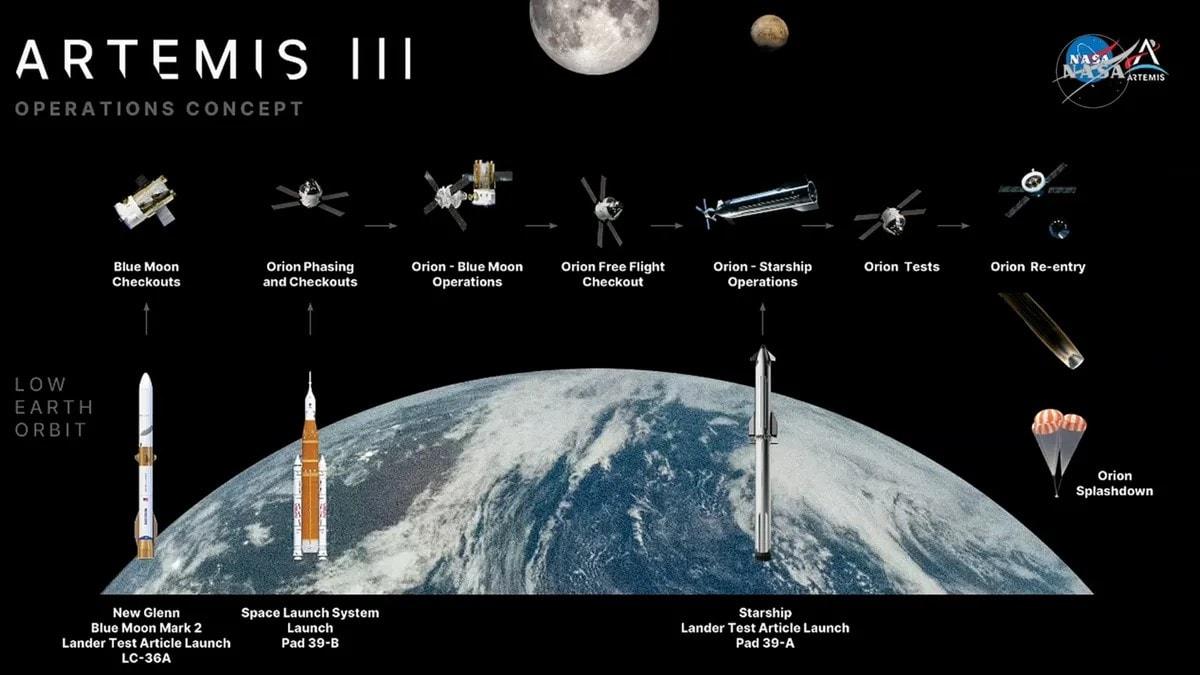
The key to understanding the Artemis III mission is that, in order to return to the Moon, the astronauts will first need to practise near Earth. The mission, the operational plan for which NASA outlined in detail during the press conference, will be a dress rehearsal, in Earth orbit, of the rendezvous and docking manoeuvres between the Orion capsule and the vehicles designed to carry crews to the lunar surface.

Loading...

“Probably the most complex launch campaign ever undertaken,” is how Jeremy Parsons, head of the Artemis programme, described it. It will require three of the largest rockets ever built, all launching from Florida. The first will be New Glenn, which will carry Blue Moon into Earth orbit; followed by NASA’s Space Launch System, which will carry the four astronauts in the Orion capsule: the Americans Randy Bresnik, Andre Douglas and Frank Rubio, and the Italian Luca Parmitano, from the European Space Agency. The third will be SpaceX’s Starship, famously owned by Elon Musk, whilst Blue Moon belongs to Jeff Bezos, meaning that the rivalry between the multi-billionaires is now shifting towards the Moon.

After two days of checks, Orion will dock with Blue Moon. The astronauts will open the hatches and enter the lunar module to check its life-support systems, internal pressure and emergency procedures. It will also be a test for the teams on Earth, who will be required to coordinate different vehicles and make critical decisions in real time.
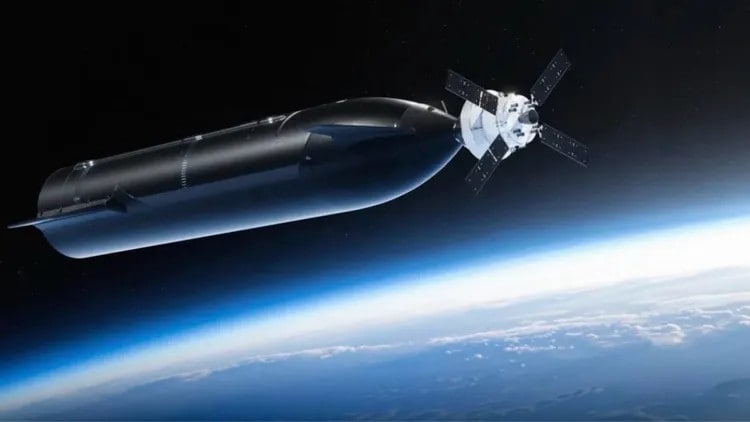
Starship aggancia la capsula Orion

Around the sixth day, Starship will launch, fitted with a special docking adapter. The rendezvous with Orion is scheduled for two days later, but will last only a couple of hours and will not involve the transfer of the astronauts. The aim will be to measure the stresses and test the behaviour of the two vehicles whilst docked together.
The mission will last 14 days in total, extendable to 17, and will conclude with Orion’s splashdown. The programme includes a host of other tests: from survival suits to health assessments, as well as scientific experiments and technological demonstrations. This is the dress rehearsal before the big leap to our natural satellite, and it is essential to minimise the risks of future expeditions: from Earth’s orbit, if something goes wrong, re-entry is much quicker than from the Moon.

Looking further ahead, we can see the next mission, if all goes well: Artemis IV, which will finally return astronauts to the lunar surface in 2028, near the south pole. It has not yet been decided whether Blue Moon or Starship will make the landing: the agency is keeping both options open.

The Artemis III timetable also remains challenging. The target is summer 2027, but accumulated delays and difficulties with the supply of lunar modules could cause it to be postponed.

Il supercomputer lunare FLIP

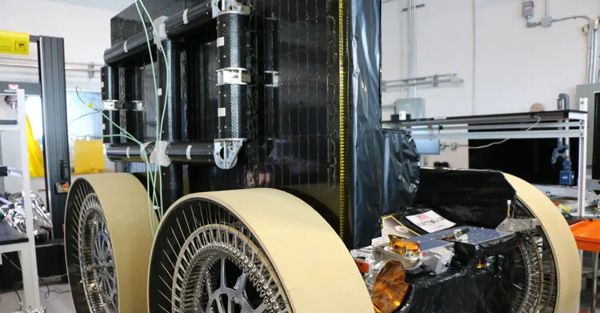
However, there is more in store for the Moon in the coming weeks: a lunar rover carrying a genuine supercomputer on board will arrive. It is being delivered by Astrolab, a Californian company working for NASA, as part of its Griffin-1 mission, which will land an unmanned vehicle, FLIP, at the Moon’s south pole. The vehicle will carry Hewlett Packard Enterprise’s (HPE) Spaceborne Computer-4, built to bring supercomputing capabilities to the lunar surface and to test an artificial intelligence system in situ.

The aim is to ascertain whether these technologies can function in such a hostile environment and, in the long term, contribute to the astronauts’ activities and the development of a lunar economy. “We will be sending the first HPE supercomputer to the Moon’s surface,” announced Jaret Matthews, founder and chief executive of Astrolab, whilst presenting the project at the company’s headquarters.

Loading...

It is a very compact, lightweight and fanless system, which uses a low-power processor with a GPU – a graphics processing unit – that can also be used for artificial intelligence. It will be connected to the rover’s cooling system and will be powered by its batteries and solar cells.

The first test will be endurance. The device, constructed from aluminium to aid heat dissipation, has been designed and tested for conditions at the lunar south pole: it must now prove in the field that it can withstand them. It is a far more significant experiment than it might appear at first glance. Matthews describes a broader challenge for rovers intended for future explorations: to last a year, to survive periods of darkness lasting over 150 hours without energy or heat from the Sun, and to travel hundreds of kilometres, operating semi-autonomously for months when astronauts are not present.

It is certainly about survival, but also about work: the system will analyse the images collected during the mission, and artificial intelligence applications will be tested, although their precise uses and future contribution to crewed missions remain to be defined. A mission running alongside the Artemis programme which is nonetheless of vital importance.

Chang’e-7

China’s objectives

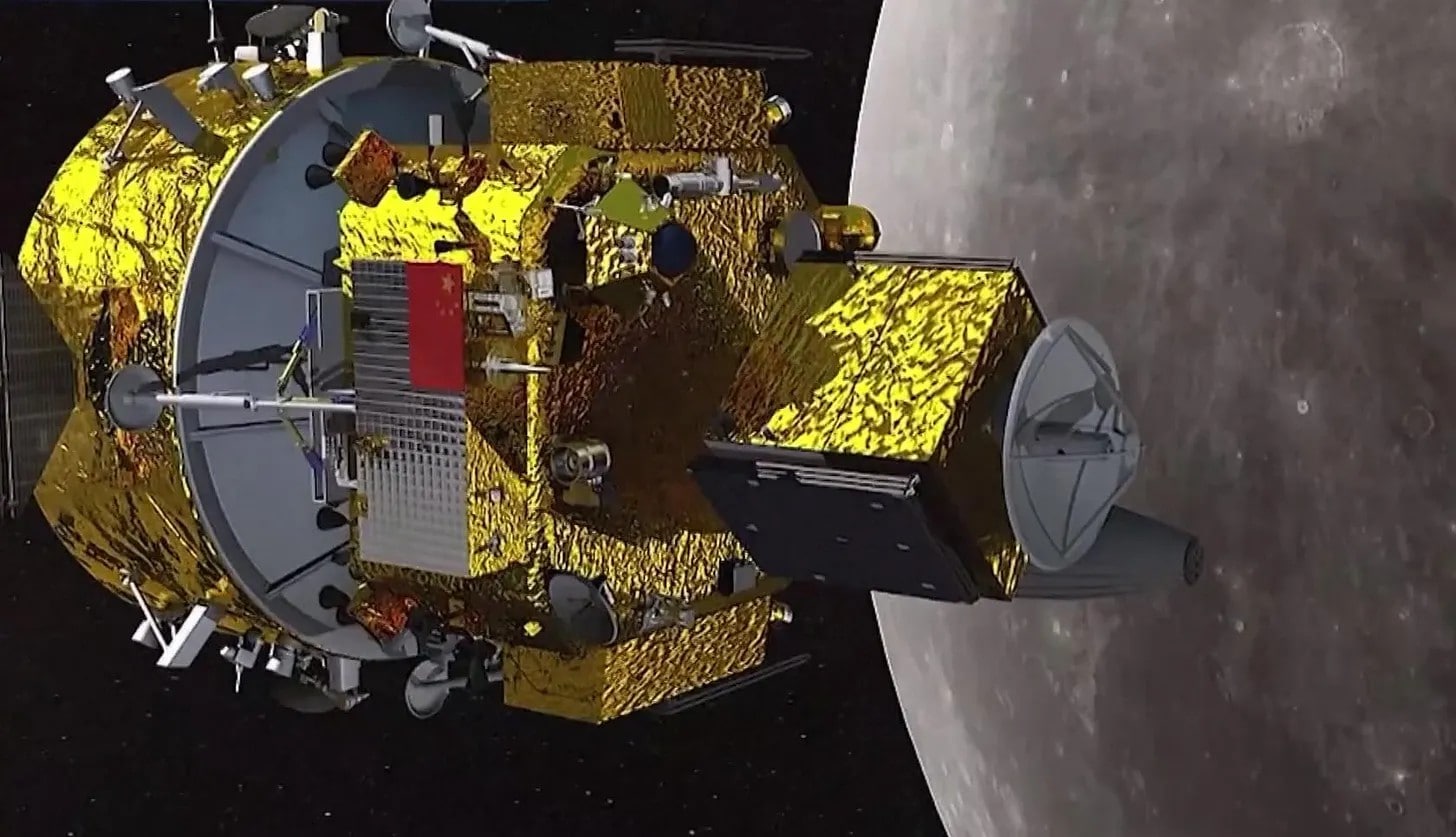
China, too, has its sights set on the lunar south pole, and China, too, is lagging behind. The lunar mission involves four different components and phases: a lunar orbiter, a lunar lander, a rover and a small robot capable of hopping. Chang’e-7. Next up will be the Chang’e-8 mission, described as ‘the most ambitious, comprehensive and complex robotic lunar mission ever attempted’. The launch, scheduled to take place from Wenchang using a Long March 5 rocket, has, however, been postponed, probably until next year, officially due to bad weather.

The planned destination is the Shackleton Crater region. Here, the robot – which can also move by hopping – will have to travel from sunlit areas to those in the shade, where water ice is most likely to be found. The aim is not only to determine whether ice is present, but also to understand its distribution and accessibility for future expeditions.

The project’s success lies primarily in integration: observing from orbit, taking measurements on the surface, exploring with the rover, and using the hopping robot to reach places that are difficult to access. All this is aimed at carrying out a definitive assessment of the site ahead of China’s manned lunar landing – a stated objective of Beijing to be achieved by 2030. On board is an Italian instrument: a laser retroreflector for the lunar surface developed by the Frascati National Laboratories of the National Institute of Nuclear Physics.

Chang’e-7, however, looks beyond this single mission. Together with Chang’e-8, scheduled for around 2028, it aims to test technologies that utilise regolith – a material found in abundance in the lunar soil – for the construction of roads, dwellings, laboratories and the future International Lunar Research Station led by China. We have a great deal to learn if we are to not only reach the Moon, but also live and work there.

Copyright reserved ©
Loading...

Brand connect

Loading...

Newsletter

Notizie e approfondimenti sugli avvenimenti politici, economici e finanziari.

Iscriviti