
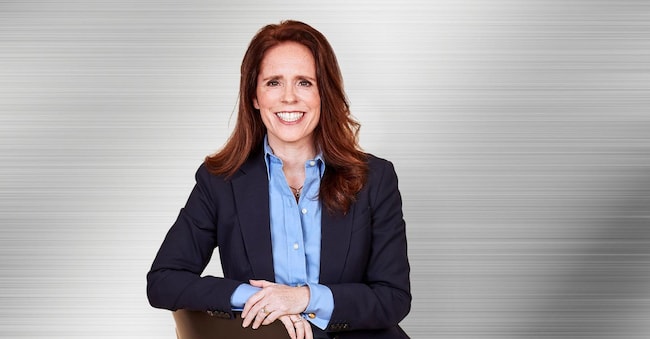
Natalie Knight (Stellantis): so we will produce customised cars at lower prices
Profitability, consolidation, China. The chief financial officer comments on the strategies of Europe's largest group by capitalisation

4' min read
4' min read
First European group by capitalisation. Third in the world after the two giants Tesla and Toyota. With the jump of the share price, almost 6% to an all-time high of EUR 23.87, following the announcement of the financial results for 2023, Stellantis took the podium, ahead of Porsche, Mercedes-Benz, and Volkswagen. The run-up did not start on Thursday, 15 February. Over the past 12 months, the markets have recognised the car manufacturer, whose brands include Peugeot, Jeep, and Fiat, as increasing in value, by a total of 50%. The rally that produced the record was supported by the strong increase (+16%) in the annual dividend and the announcement of a EUR 3 billion buyback.
Figures that temporarily overshadowed the drop in the operating margin in 2023 (12.8%, down from 13.4 in 2022) and the challenges of a year that has only just begun but is expected to be, a term used by Stellantis' top management, 'turbulent'. An uncertain macroeconomic framework (the rate cut seems close but may not be so close); weak demand for electric cars, which are still too expensive (in Germany -50% for Bevs in January on an annual basis); the thorn in the side of costs, which include the onerous new contract resulting from the North American strikes in October. And of course, the increasingly fierce competition. Chinese in the lead.
'We are faced with very changeable market conditions,' Stellantis chief financial officer Natalie Knight told Il Sole 24 Ore, 'but we are prepared. I would like to remind you that Stellantis was only born three years ago (January 2021, from the merger of Psa and Fiat, ed.) but we have been able to design the right approach to the electric car market. We have great quality products. And we have the cheapest product made in Europe, I am referring to the new Citroën ë-C3. We are convinced that we have the best range around, I am thinking for example of the Peugeot 3008. And we have 18 new products coming in the next year, including one in the United States'.
How will you manage to stay 'on track' on the cost and profitability front?
The answer lies in our two new platforms, STLA Medium and STLA Large. Designed with unprecedented technological flexibility, they will enable a wide variety of vehicles to be produced. Production processes will be much more cost-efficient and can be replicated in different plants. This means that if for some reason demand does not meet our expectations or if incentives or even certain regulations change, we will be able to cope with new developments with a capacity that I believe is greater than that of most of our competitors. So, the terrain might be rougher than expected, the market evolution slower, in any case we will not be unprepared. Flexibility will be the key to success.


