

NATO and the Gulf States discuss joint security in the Strait of Hormuz and cyber security
At the Ankara summit between NATO and the ICI, discussions will focus on establishing a permanent mechanism for the security of the Strait and drawing up a NATO-Gulf agreement on cyber security. This change of pace has been driven by Donald Trump’s actions
by 24Ore NextMed
 Aggiungi Il Sole 24 Ore
ai preferiti su Google
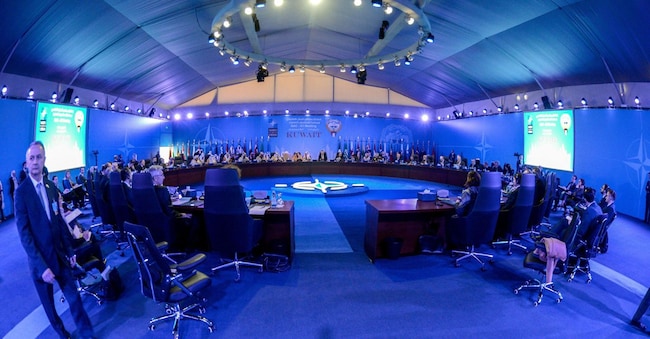
NATO, the Gulf States and the host, Recep Erdogan. The NATO summit scheduled to take place in Ankara on 7–8 July 2026 looks set to be a potentially decisive event for the future of relations between the Atlantic Alliance and the Gulf States. The participation of the four members of the Istanbul Cooperation Initiative (ICI) – the United Arab Emirates, Kuwait, Qatar and Bahrain – is taking place against a backdrop that has changed from the past, marked by the conflict between the United States, Israel and Iran, Iranian attacks on the countries of the Gulf Cooperation Council and the closure of the Strait of Hormuz, one of the main hubs of global energy trade. Recent events have brought the need to strengthen cooperation between NATO and the Gulf States back to the forefront of the debate, highlighting the limitations of the current regional security architecture and the growing interdependence between stability in the Gulf and Euro-Atlantic security. ‘The reasons for the limited success of the ICI can be attributed to four main factors,’ states a report drawn up by the Emirates Policy Centre. ‘Firstly, differing strategic expectations: whilst NATO has always regarded the ICI as a tool for strengthening the military and institutional capabilities of regional partners, the Gulf States aspired above all to obtain security guarantees comparable to those provided for in Article 5 of the North Atlantic Treaty. Added to this were the failure of Saudi Arabia and Oman to join, which limited the regional scope of the initiative; the gradual shift in NATO’s priorities towards the eastern front following Russia’s invasion of Ukraine; and the persistent divergence in perceptions of the main security threats.”
A change of pace
The war with Iran, however, has changed the landscape. The conflict has highlighted the vulnerabilities of the Gulf’s security system and fuelled doubts amongst GCC countries about the United States’ ability to continue acting as the sole guarantor of regional stability. Consequently, the Gulf monarchies now appear set to diversify their strategic partnerships – according to analysts at Emirates Policy – by strengthening their institutional ties with NATO without sacrificing the flexibility afforded by bilateral agreements. The Hormuz crisis has confirmed just how much European energy security depends on stability in the Gulf, whilst the growing presence of Russia and China in the region is prompting NATO to consolidate its southern flank and strengthen dialogue with regional partners.
The partnership
‘The prospect of the Gulf states joining NATO remains, however, unrealistic,’ continues the Emirates Policy Centre. ‘More plausible is the creation of a strengthened partnership modelled on the Enhanced Opportunities Partners scheme, which would allow the Gulf states to access a higher level of cooperation without benefiting from the collective defence guarantees provided for under Article 5. Such a framework could include the sharing of classified information, the adoption of common interoperability standards, participation in NATO planning processes and the organisation of joint exercises, particularly in the maritime domain.” Even without creating a new institutional model, the Ankara summit could yield concrete results by strengthening existing structures. Among the most realistic measures are the strengthening of the NATO-ICI Regional Centre in Kuwait, the establishment of a permanent maritime security force, the launch of working groups on cyber defence, and greater cooperation in the protection of critical infrastructure.
The three proposals
In terms of proposals, the Gulf States could focus their efforts on three priorities: the establishment of a permanent mechanism for the security of the Strait of Hormuz; the launch of a structured dialogue on energy security and the protection of strategic infrastructure; and the establishment of a NATO-Gulf agreement on cyber security, based on the exchange of information and the coordination of digital defence capabilities. However, obstacles remain. The differences between the United States and Europe over the handling of the Iranian crisis risk limiting the summit’s political ambition, whilst the absence of a genuinely common defence policy within the GCC continues to favour bilateral agreements over multilateral initiatives. Furthermore, the exclusion of Saudi Arabia and Oman from the ICI represents a structural limitation that reduces the strategic scope of the entire project. Despite these constraints, the current context appears favourable to a qualitative leap in relations between NATO and the Gulf States. “The war with Iran has demonstrated the inadequacy of the current regional security architecture, whilst the need to protect energy routes, counter hybrid threats and contain Russian-Chinese influence is driving both sides towards closer cooperation”, concludes the Emirates Policy Centre report. Whilst the formation of a genuine military alliance remains unlikely, a strengthened strategic partnership now represents the most realistic option for consolidating security in the Gulf and contributing to the stability of the entire Euro-Atlantic area.

