

The Middle East’s ‘NATO’ is only half-functional. The Turks and Saudis do not want a confrontation with Iran
Whilst the White House is signalling a withdrawal from the region in the run-up to the mid-term elections, the alliance formed to protect Riyadh is struggling to gain momentum for fear of provoking Tehran. At least until the geopolitical balance of power has become clearer

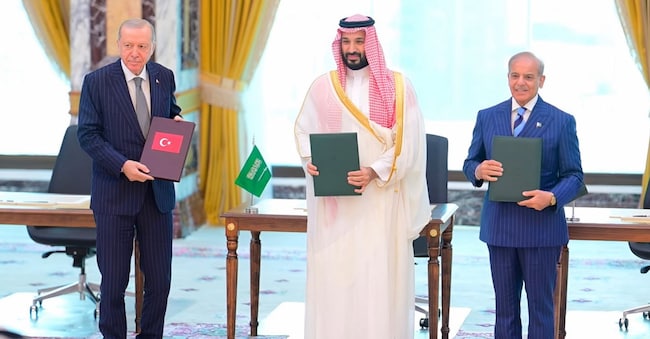
Exactly a century ago, the last troops of the Ottoman Empire left the desert of Saudi Arabia. Defeat in the First World War cost the Turks the humiliation of seeing their empire – which had stretched from the Atlantic to the Persian Gulf – carved up. Just over a hundred years later, the Turkish president Recep Tayyip Erdogan has brought ships flying the crescent-and-star flag back to the heart of the Mediterranean and is preparing to send troops into the desert in support of his Saudi ally. This is the dual effect of a shifting geopolitical landscape and the withdrawal of the United States from the Middle East. A few weeks ago, Turkey, Pakistan and Saudi Arabia signed a mutual assistance and defence agreement which could be invoked and put into effect as early as the next few days.
No ground combat
The Saudis, in fact, are trying not to cross the red line in their confrontation with the Yemeni Houthis, who are backed by the regime in Tehran. Riyadh would have the strength, the resources and the interest to launch a more extensive war against the Yemeni rebels, who are now the guardians of the Bab el-Mandeb Strait, but above all the driving force behind a military escalation that has gone so far as to target critical infrastructure such as refineries and civilian airports. The Saudis are aware, however, that a ground invasion would trigger a violent reaction from an Iran that, whilst weakened, remains formidable and capable of inflicting painful retaliation, some of which were already endured during the most intense phase of the US and Israeli operations in the Gulf.
In the quest for this unlikely balance, there is a growing risk that the holy cities of Mecca and Medina will be targeted by increasingly sophisticated missiles and drones, the holy cities of Mecca and Medina – a resounding blow to the Saudi regime, which continues to present itself to the world as a new centre of stability and prosperity.
The Turkish President Erdogan has long presented himself as the political bulwark of Islam throughout the region, raising the banner of the Palestinian cause against Israel and seeking to assert his role as the dominant guardian of values and beliefs – a role obviously linked to Turkey’s new power politics.
It may even seem paradoxical, given that, historically, the Al Saud monarchy derives part of its legitimacy precisely from its role as custodian of Islam’s holiest sites within its territory. The truth is that the military pact binding the three Asian powers is based on pure opportunism and is intended to serve interests that are as powerful as they are contingent.

