The interview

Netflix bets on Italy: 'Focus on local stories and more investment'

Co-CEO Ted Sarandos: 'We had an impact of 1.1 billion on the Italian economy. The tariffs issue? Ready to handle it anyway'

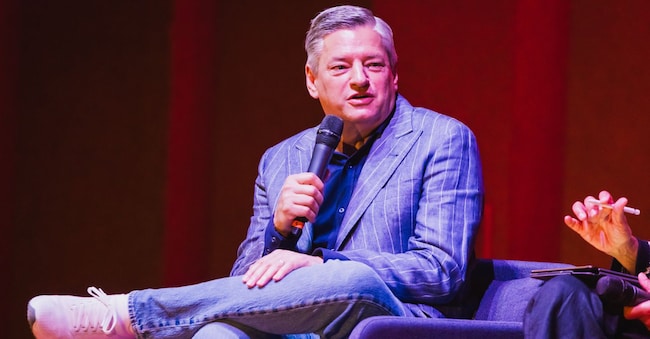
by Andrea Biondi

Il co-ceo di Netflix Ted Sarandos

4' min read

Translated by AI
Versione italiana

4' min read

Translated by AI
Versione italiana

Ten years of presence in our country, over a thousand Italian projects made available worldwide, an economic impact of 1.1 billion and a prospect of further growth. 61-year-old Ted Sarandos, co-CEO of Netflix, recounts how Italy has become a strategic element for the streaming service, which looks to the future between local productions, new technologies and games. The video-on-demand bigwig is also being looked to for developments in live sports, after the rumours of a possible commitment, as Amazon did with the Champions League. On this front there is no comment. "Our goal - says Sarandos speaking of the overall offer - is to continue to be the public's favourite choice, with quality stories and an increasingly personalised viewing experience".

Ten years of Netflix in Italy. What is the balance?

Loading...

It was extraordinary, for the speed with which we had an impact on the country and for the way we managed to involve consumers and creative communities. Not to mention the economic impact, with an added value generated of more than EUR 1.1 billion in four years, from 2021 to 2024. We have filmed our shows and original films in more than 100 Italian cities and launched about a thousand Italian titles, including originals and licensed titles, in these ten years. I would add that in addition to the approximately 120 employees in the country, between 2021 and 2024 we employed 5,500 people in our productions. We do not intend to stop. In the last three years we have doubled our investment in Italy. And it will continue to grow.

Netflix is a global player. Is there room to grow only in emerging markets or also in mature ones such as the US?

Absolutely. In the US, we account for only 10 per cent of TV time and 5 per cent of consumer spending on entertainment. This means that there is still plenty of room to grow, by increasing engagement and offering content that captures new audiences.

In an increasingly competitive landscape, from Disney+ to Amazon Prime Video, do you think you have a competitive advantage?

Our advantage stems from a combination of several factors: original content that people love, technology that helps people discover what suits their individual tastes, and a global reach that allows us to invest in local productions in 50 countries. Moreover, unlike other operators who do many things, we do just that: we tell stories. It is our job, and it is what allows us to connect directly with our audience. Finally, it should not be forgotten that we started first.

How do you plan to balance multi-billion dollar and growing investments in production, $18 billion this year, with the need to maintain margins and satisfy shareholders?

The margin comes from the quality of the investment. When you make projects that people love, working with creators who are able to bring those stories to the screen, you create value. The more we can connect the stories with the audience, the more revenues and margins increase. It's a virtuous circle that combines engagement, profits and new investments.

Where will you focus your growth efforts? Will games be the next frontier?

We are only at the beginning, but I strongly believe in the potential of games. The new generations want a more interactive experience and to play a more active role in the narrative worlds they love. Gaming can strengthen our intellectual property, allowing viewers to experience stories even between seasons or between films. At the moment, games are only available on mobile devices, but soon they will also come to TV.

How do you respond to those who say that you 'extract value' without giving enough back to the local system, including in terms of taxes?

I don't know who could have claimed such a thing, especially since, as I said, we have generated an added value on the Italian economy of more than EUR 1.1 billion in four years. In addition, we pay taxes due in Italy. We are in fact a major contributor to the local economy.

An issue in Europe is that of minimum quotas for local production and rules for streaming services. How do you deal with such a fragmented regulatory environment?

For us, the important thing is that any regulatory system is simple, fair and predictable. If one of these elements is missing, a country becomes less attractive. I would add that Netflix produces local content not because it is an obligation, but because it makes economic and cultural sense. Local stories are what the audience wants.

And the competition with traditional TV, from Rai to Mediaset?

We compete worldwide with linear TV, but we believe that the choice and control brought by streaming is what consumers want. The Internet has made a new level of freedom possible: choosing what to watch, when and where. This is the added value we offer. However, we are partners with the companies you mentioned, because we collaborate and buy content for our offer.

President Trump has speculated about applying tariffs or barriers to non-US film productions and series. What do you think about this and what impact could it have on a global player like Netflix?

The scenario is still unclear. We focus on what we can control and manage. And this is certainly one of those things that we cannot control, but we can manage, whatever the outcome.

Copyright reserved ©
Loading...

Brand connect

Loading...

Newsletter

Notizie e approfondimenti sugli avvenimenti politici, economici e finanziari.

Iscriviti