
The new Dacia Spring: how does this compact electric car perform?
The electric city car is changing in size, platform and origin

Key points
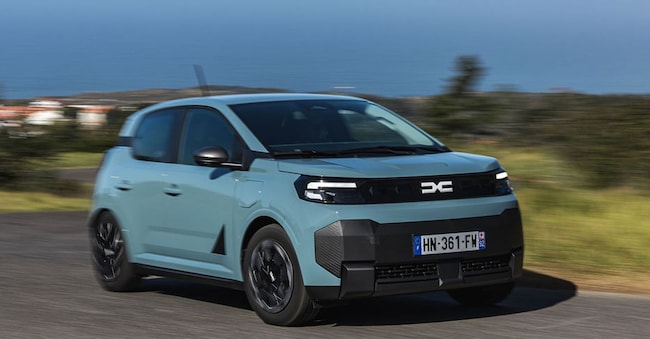
The Dacia Spring enters its second generation with changes to its dimensions, platform, production location and performance. Whilst the first generation, launched in 2021, was built in China, the new electric model is manufactured in Novo Mesto, Slovenia, on the Rgev Small platform shared with the Renault Twingo. We test-drove it in Portugal: compared to its predecessor, it is more precise, comfortable and quiet.
More space, new design
The Spring is 3.85 metres long – 15 centimetres longer than the previous model – and 1.74 metres wide, an increase of 18 centimetres. The height remains at 1.52 metres. The increased width makes the interior more practical; load capacity has also increased: the boot offers 337 litres, rising to 1,283 litres when the 50/50 split rear seat is folded down. An optional 18-litre front storage compartment is available, useful for stowing the charging cable. The design is all-new and more boxy, with vertical front and rear ends and black plastic protective trim on the bumpers, designed to better withstand scratches and scuffs. The technical similarities with the Twingo are not particularly obvious, with the exception of the rear door handle.
Interior and features
The dashboard has a simple layout. In front of the driver is a 7-inch digital instrument cluster; the Journey comes with the Media Nav Live system as standard, featuring a 10.1-inch touchscreen, sat-nav, connected services and compatibility with Apple CarPlay and Android Auto. On the Expression, the Media Control system relies on steering wheel controls and a smartphone: multimedia functions can be managed via the dedicated Dacia app. The Spring also features YouClip mounting points, a height-adjustable driver’s seat and a steering wheel that is adjustable for height and reach. When driving, however, the front left-hand pillar partially restricts visibility. Furthermore, the rear windows open in a scissor-style.
The road test
During our first test drive in Portugal, we found the Spring to be more precise than the previous generation. The new platform delivers a more convincing road holding and greater comfort. Ride quietness has also improved, whilst the brakes proved effective and easy to modulate for a city car. The 80 cavalli engine allows the car to accelerate from 0 to 100 km/h in 12.1 seconds, compared with 13.7 seconds for the previous, more powerful 65 cavalli version. The top speed is 130 km/h. The certified range is 250 kilometres in the WLTP combined cycle, compared with 225 for the outgoing generation. During our initial test drive, we recorded fuel consumption slightly higher than the stated figure.
Engine, battery and charging
The electric motor delivers 60 kW, equivalent to 80 cavalli, and 175 Nm of torque. The LFP battery has a usable capacity of 27.5 kWh. The official energy consumption starts at 12.7 kWh per 100 kilometres and the kerb weight at 1,212 kg. A 6.6 kW AC charger is fitted as standard. The fast-charging package increases the AC charging power to 11 kW and adds DC charging up to 50 kW: it takes 28 minutes to charge from 15% to 80%. With the Power Pack, the V2L function is also available, allowing external devices to be powered using energy from the battery.

