Ministry of Culture

New shake-up at MiC: General Director Cinema and Audiovisual Nicola Borrelli resigns

The backward step communicated after midnight to the minister, who is grappling with the controversy over his non-participation in the Strega Prize

by Andrea Biondi

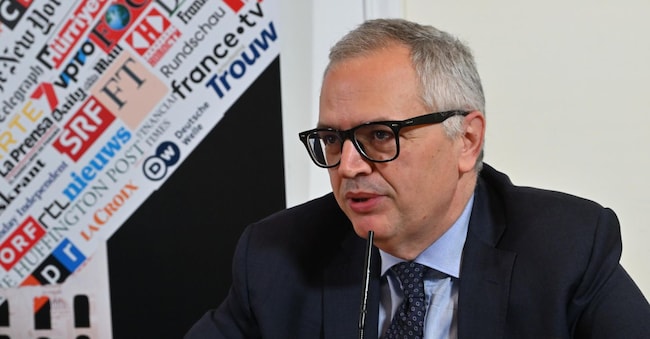
L’ex direttore generale Cinema e audiovisivo del Ministero della Cultura, Nicola Borrelli

4' min read

4' min read

Another restless night for the Ministry of Culture, another chair jumping. In a terse communiqué issued late in the day, Minister Alessandro Giuli announced that he had 'taken note' of the resignation of Nicola Borrelli, the MiC's historic Director General for Cinema and Audiovisual. The exit from the scene, which came at a time of growing tension, represents yet another shake-up for a strategic but tormented sector, right in the heart of the Roman summer.

Villa Pamphili, Giuli: "Inchiesta su Kaufmann? Quando si muove Procura è rassicurante"

Borrelli is leaving after years of a silent but influential reign, in which he had managed the delicate mechanisms of tax credit and relations with a film industry perennially poised between creativity and bureaucracy. His departure, however, inevitably appears as a sign that the boiling point has been reached in the film and audiovisual sector at the Ministry.

Loading...

The Kaufmann case

.

Behind Borrelli's resignation lies the long shadow of the so-called 'Kaufmann case'. Francis Kaufmann, involved in a double murder at Villa Pamphili, is alleged to have benefited - through his Italian partner Marco Perotti of Coevolution srl - from an €860,000 tax credit for the film 'Stars of the Night', which never really took off. The suspicion? That it is yet another 'ghost film'.

Roma, Giuli: "Tax credit a Kaufmann? Con riforma non ci saranno altri casi simili"

The public prosecutor's office has opened an investigation and last week documents were seized in the offices of the General Directorate for Cinema, where Minister Giuli personally appeared with the judicial police. 'No more phantom films', thundered the Culture Minister in Parliament, promising a drastic tightening of controls and a reform of the 'fraud-proof' incentive system.

A farewell that weighs

.

Nicola Borrelli is no ordinary official: he is one of the most long-lived and respected figures in the world of Italian cinema. Leaving in silence, in the middle of the night, is a gesture that carries weight. Officially, no polemical statement. Only the minister's thanks and the ritual 'confirmation of esteem'. But, in the sector, many read the move as a result of management pressurised by too many cross-pressures.

The Showdown

.

Borrelli's resignation followed a few days later the equally noisy one of Chiara Sbarigia from the presidency of Cinecittà. The manager claimed she wanted to concentrate on the Apa (Audiovisual Producers Association) - moreover, with the renewal of the presidency just around the corner - and on a possible leadership of the Maximo Foundation. But the timing, the sentence she had said only a few days earlier to the Sole 24 Ore in which she spoke of the double role (presidency of Apa and Cinecittà) as 'an opportunity' and the backstage (the alleged disagreements with Minister Giuli, and the shadows on a consultant who allegedly proposed paid moderations to soften the press) fuelled suspicions and poisons.

A poisoned climate, in short, in which a node would also be the underground war that insiders record between the minister and the Legahist under-secretary Lucia Borgonzoni, who is herself credited with a very close relationship with Chiara Sbarigia. And this is why the step back of the former president of Cinecittà was also seen as the result of a showdown between the minister and the Legahist undersecretary, without reaching a showdown between the two that could have been too heavy for relations between the FdI and the Lega.

Borrelli's resignation thus appears to be the final chapter - or perhaps just the new beginning - of a showdown that affects the entire chain of command of the Ministry of Culture, in a delicate phase between international projects and decisive reforms for the future of the sector.

Minister Giuli defected from Strega

.

In the meantime, Minister Giuli also deserted the Premio Strega, polemising for not having 'received the books'. This led to an immediate response from Italy's leading literary award: "Relations with the minister have always been friendly, we greeted each other cordially at the last Book Fair in Turin. We did not send him the prize books because we ask publishers to send them only to the Strega jury, from which he resigned the same day he was appointed to the Ministry of Culture,' stressed the director of the Bellonci Foundation, Stefano Petrocchi. "Naturally, the minister was among the guests at tomorrow's final evening at Villa Giulia, as he was previously at that of the Strega Poetry Prize last 9 October, and we will be happy to welcome him back next year for our 80th edition. Should he also wish to return as a member of the prize jury, we would be equally honoured'.

But Mic sources were quick to point out the 'institutional ungrammaticality': 'The Foundation, who knows why, thought neither of reinviting Giuli as a minister to be a member of the prize jury, nor of sending him the books of the dozen, or the five finalists for the final evening'.

Certainly, they added from the Collegio Romano, 'Petrocchi has downgraded the Strega, distancing it from its natural institutional referent'. Minister Giuli concluded by joking about his absence: 'The evening will be beautiful all the same. Maybe a little less funny without Geppi Cucciari and Alessandro Giuli'.

Copyright reserved ©
Loading...

Brand connect

Loading...

Newsletter

Notizie e approfondimenti sugli avvenimenti politici, economici e finanziari.

Iscriviti