Space

The Moon is closer: Musk's new Starship successfully tested

Successful 12th launch of Starship, the largest and most powerful version of its monumental rocket ever built

by Leopoldo Benacchio

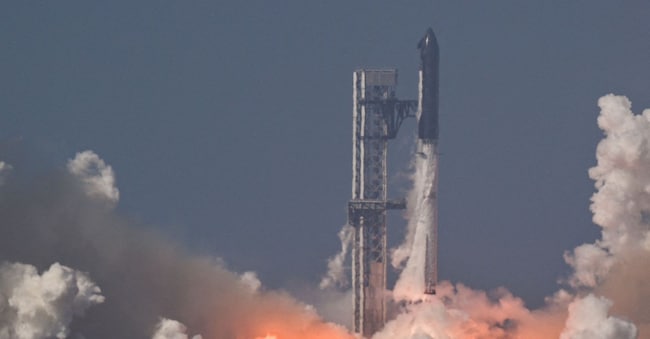
A SpaceX Super Heavy booster carrying the Starship spacecraft lifts off on its 12th test flight at Starbase, Texas, U.S., May 22, 2026. REUTERS/Steve Nesius     TPX IMAGES OF THE DAY REUTERS

4' min read

Translated by AI
Versione italiana

4' min read

Translated by AI
Versione italiana

The Moon is nearer, and the biggest IPO in history now has all the makings of an appearance.

SpaceX has finally succeeded with its twelfth launch of Starship, the largest and most powerful version of its monumental rocket ever built. V3 is the unfortunate acronym for this version, which has been much revamped compared to its predecessor, with different, structured tanks throughout the third-generation launcher.

Loading...

Two postponements this week, but this time, Friday night in Texas, almost everything worked, it seems only one engine gave up, but the suborbital trajectory, Starship has so far never made a full orbit, remained stable.

The gigantic rocket, over 120 metres, consists of an upper stage, often abbreviated to Ship, and a powerful 33-engine propeller stage, the Super Heavy, which has flown solo several times already.

As expected, it released 20 realistic models of Starlink satellites, Elon Musk's proprietary broadcast network, as well as two small satellites with cameras that filmed the short but crucial journey of the most powerful rocket ever built. After travelling halfway around the globe, it ended up in the Indian Ocean, as planned.

Elon Musk said that this launch was 'epic' and thanked his large team with a football metaphor: 'You scored a goal for mankind'.

But it also marked his SpaceX, which goes public with its most impressive IPO ever, in a few weeks' time. Failure would probably have been fatal, even if Musk's other ventures, both real and visionary, are also inside the container that wants to list itself on the stock exchange asking for a sum never even seen on Wall Street: from Starlink to the future massive space computing centres to Mars.

Another point, little emphasised by the media, is that in this way SpaceX has caught up with Jeff Bezos, its antagonist in the private race to the Moon, to whom Nasa has devolved the task of building an alternative lunar landing craft to Starship.

With this launch, the twelfth test of the Starship programme, the moon landing of the first human crew on the Moon since 1972 is 'one step closer to the Moon', as Nasa Administrator Jared Isaacman put it, and 2028 seems a little more realistic, even if the path remains full of technical obstacles to overcome.

Having therefore forgotten the many failures of the two previous versions, especially the second one, we are now looking to the near future, bearing in mind that the main task, while waiting for the Moon and Mars, will be to continuously put into orbit the Starlink satellites, which must reach the incredible number of 40,000, to complete the initial project. We are currently above 10,000, quite a difference, which will require continuous launches, several times a month. This brings with it the problem of the reusability of the shuttle, which is difficult to solve: it is one thing to survive the terrible heating due to re-entry into the atmosphere, it is quite another to overcome it so brilliantly that the shuttle is immediately reusable for the next flight, without the need for maintenance. No one has ever done this and even Musk is a little doubtful that he will succeed.

The heat shield is made up of tiles that can also come off, as has happened to other spacecraft, or become damaged, and thus require a period of maintenance and then goodbye immediate reusability and consequently lower costs. In fact, continuous flights of even more than one a week are planned.

Thanks to Starship's load capacity, a record-breaking 200 tonnes, SpaceX wants to bring the cost per kilo down from the current $1,000, $4,000 for customers, to around $190, and therein lies the key to the feat and the real bonus for those who will fly Starship.

SpaceX, between 1 January and 10 May 2026, is the current ruler of space and has launched 55 rockets into space, all of which have been successful.

The comparison with the rest of the world is almost merciless: China, the second largest launcher, Russia, Europe, India, Japan and all the other private companies together have made fewer launches than the private company SpaceX. In 2025, it was even worse for the others. As far as we are concerned, Europe has launched twenty times fewer rockets, and so far the industry here is essentially public.

But Starlink, with its 40,000 satellites, is only one of Musk's major projects: the other, which is very difficult to realise, is to build a solar-powered data centre in orbit, hence the name Suncatcher, using Google vector units, in practice a real cloud for artificial intelligence.

Many problems, including the unexpected difficulty of cooling computers in a space environment a hundred degrees below zero. But here on Earth, it is the air, the atmosphere that takes the heat away, as the fans in our PCs also remind us. by

SpaceX, with all its ventures, is today valued at $1,250 billion, and aims to list in June to raise at least $50-70 billion, in the biggest IPO ever.

For this evaluation, the idea that the company will expand production and data centres for artificial intelligence in space is important, Mars aside.

But dreams don't go down at dawn, as a famous movie goes, and SpaceX has already punched its first ticket to the Red Planet: billionaire Chun Wang, a Chinese-born, Maltese-born cryptocurrency investor and co-founder of F2Pool, one of the first Bitcoin mining pools, bought it. No figure or departure date is known and hopefully it will be a round trip.

Copyright reserved ©
Loading...

Brand connect

Loading...

Newsletter

Notizie e approfondimenti sugli avvenimenti politici, economici e finanziari.

Iscriviti