
The war continues

New super-drones loom over Ukraine, Libya and the Gulf

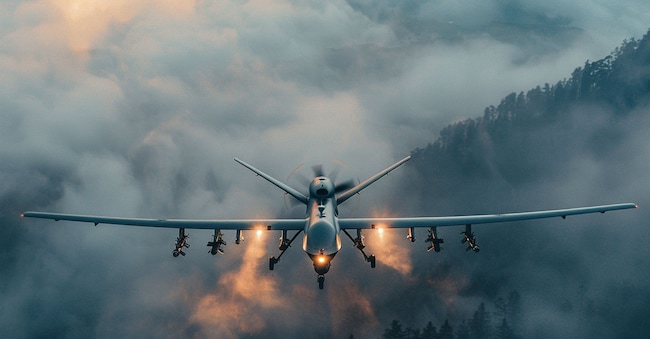
Moscow is testing unmanned jet aircraft which, according to information released by Kyiv, are capable of reaching 1,000 kilometres per hour. Their emergence is altering Ukraine’s air defence calculations and raising new questions about military cooperation between Russia and Iran. The potential proliferation of these technologies risks widening the scope of the threat

 Imagoeconomica

5' min read

Translated by AI
Versione italiana

5' min read

Translated by AI
Versione italiana

On the night of 17–18 November, the Ukrainian Air Force detected 141 drones heading towards the country. Of these, 73 were jet-powered aircraft. This indicates that a growing proportion of Russian attacks is putting defence systems to the test – systems designed to intercept threats that vary greatly in terms of speed, altitude and flight patterns. At precisely that time, the Ukrainian MP Fedir Venislavskyi, a member of the Committee on National Security, Defence and Intelligence Committee, told RBC-Ukraine that Moscow is reportedly testing a new model, called Geran-6, capable of reaching 1,000 kilometres per hour.

The report has not yet been independently verified. It is, however, worth noting that, should the speed cited by Venislavskyi be confirmed, Russia would have taken another step forward in the transformation of its attack drones, with consequences that could extend far beyond the Ukrainian theatre.

Loading...

The Russian race for jet propulsion

The Geran-6 remains, for the time being, an experimental programme. It is, however, worth exercising some caution, given that a previous assessment by Ukrainian intelligence had already indicated a speed of 1,000 kilometres per hour. On 9 November, Kyiv had in fact presented the results of an analysis of a Geran-5 K5-K that had been recovered almost intact. According to the Ukrainian authorities, the aircraft has a cruising speed of over 450 kilometres per hour, with peaks approaching 1,000 during certain manoeuvres.

The difference compared with the first generation of Russian drones is, however, clear. The Shahed-131 and Shahed-136 of Iranian design, subsequently manufactured in Russia under the designations Geran-1 and Geran-2, use propeller engines and travel at approximately 180 kilometres per hour, according to data from the Centre for Strategic and International Studies. In 2023, Tehran unveiled the Shahed-238, a jet-powered version of its family of unmanned aerial vehicles. Moscow subsequently developed the Geran-3, which is also jet-powered, whilst in the autumn of 2026 Kyiv reported the deployment of an upgraded version of the Geran-4.

It is this sequence of events that lends credibility to the direction taken by the Russian defence industry. The increased speed reduces the time available to defences to detect the threat, track its trajectory and organise an interception. On the night of 17 November, the Ukrainians stated that they had shot down or neutralised 126 of the 141 aircraft detected, including 59 jet-powered drones.

The tally of wiretaps

For Kyiv, the issue is primarily economic and industrial. In April 2026, Reuters reported an estimate of approximately $35,000 for the production of a Russian Shahed. The cheapest Ukrainian interceptor drones, according to manufacturers consulted by the agency, cost less than $1,500. This difference explains the interest in solutions capable of shooting down incoming aircraft without constantly using up missiles intended for more complex threats.

Against a jet-powered drone, however, the operational margin narrows. Slower interceptors may continue to play an important role against traditional Shaheds, whilst the emergence of faster aircraft is likely to necessitate greater reliance on missile systems. The true cost of defence will therefore depend not only on the price of an individual interceptor, but also on the number of attempts required, the available stocks and the time taken to replace the equipment used.

European allies are being called upon to take action in this very area. At the Ramstein summit on 17 November, the Ukrainian Ministry of Defence reported new commitments regarding missiles, radars and interceptor drones. Norway has pledged support specifically aimed at countering jet-powered Shahed drones. Germany has included IRIS-T systems, radars and interceptors in its contribution, whilst the United Kingdom has announced £240 million to strengthen Ukraine’s air defence through the supply of missiles, radars and other systems.

Italia and France are also working to strengthen European capabilities. The French Directorate-General for Armaments has commissioned the development of a multi-layer configuration of the SAMP/T NG, in cooperation with Rome. The programme aims to strengthen ground-based defence and shared industrial capacity, but deliveries of the new configuration are not expected to begin until 2030. This is an important development from a strategic perspective, but it does not address Ukraine’s immediate needs.

Cooperation between Moscow and Tehran

The second aspect concerns the possibility that technologies developed or refined in Russia might find their way into other countries. The most significant precedent is precisely the collaboration between Moscow and Tehran. In July 2023, the wreckage of two Russian-made Geran-2 drones had already been recovered in Ukraine, and subsequently examined by Conflict Armament Research. In February 2024, the US Treasury Department had pieced together the agreement to assemble Iranian-designed Geran-2 drones in Alabuga, on Russian territory, alongside the expansion of local component production. In April, Washington had put the value of a Russian-Iranian contract to finance and produce attack aircraft derived from Iranian designs at $1.75 billion.

Loading...

In just a few years, this collaboration has enabled Moscow to transform a foreign supply chain into a domestic production capacity. The strategic partnership treaty signed in January 2025 has further strengthened relations between the two countries, including in the defence sector. During 2026, the US Treasury reported that Russia had made offers to Tehran to provide military and technical assistance. In March Volodymyr Zelensky claimed that Iran had used Shahed drones manufactured in Russia. In November, a report by the Centre for a New American Security cited an investigation by the Financial Times based on Western intelligence sources, according to which Moscow may have supplied drones to Tehran.

The risk to the Gulf and Libya

The consequences could primarily affect the Middle East. In March 2026, the United Arab Emirates reported incidents in which ballistic missiles, cruise missiles and drones were all deployed simultaneously in direct threats against the country. Any increase in Iranian capabilities would place further strain on defence systems already tasked with protecting energy infrastructure, military installations and populated areas. Israel and the Gulf monarchies would have to contend with a more complex threat, in which jet-powered drones could be deployed alongside the delivery systems already present in regional arsenals.

The issue also concerns the Red Sea. The United Nations panel of experts on Yemen has, over the years, documented forms of external support for the Houthis and similarities between their weaponry and that manufactured in Iran. Any transfer of new vessels could expand the group’s capabilities and increase the risks to commercial shipping along one of the world’s most important maritime routes.

Another area to monitor is Libya. Russia’s presence in the country, through military facilities and networks linked to the Kremlin, provides Moscow with a foothold from which to exert influence in the central Mediterranean and North Africa. The availability of new unmanned systems could strengthen this role, particularly in a context where military supplies and support for various local actors continue to serve as instruments of geopolitical pressure. Any proliferation of jet-powered drones in Libya would alter the balance of military capabilities on the ground and heighten concerns regarding the security of Mediterranean infrastructure and shipping lanes.

For Europe, the issue goes beyond supplies to Ukraine. NATO has already incorporated drones and cruise missiles into its integrated air defence strategy. Since September 2025, the multi-domain Eastern Sentry operation has strengthened surveillance along the Alliance’s eastern flank. At European level, the Drone Defence Initiative and Eastern Flank Watch aim to improve coordination between countries and joint procurement.

The real test will lie in the ability to turn these programmes into operational systems, with adequate munitions and stocks. If the Russian tests on the Geran-6 prove successful and the new aircraft are deployed on a permanent basis, the problem will no longer concern Ukraine alone. The combination of greater speed, industrial production and potential technology transfer could, in fact, extend military pressure from the eastern European front to the Gulf and as far as the Mediterranean.

Copyright reserved ©
Loading...

Brand connect

Loading...

Newsletter

Notizie e approfondimenti sugli avvenimenti politici, economici e finanziari.

Iscriviti