
The new Volkswagen T-Roc R: what the 333 cavalli crossover is like
The racing version of the German crossover is here

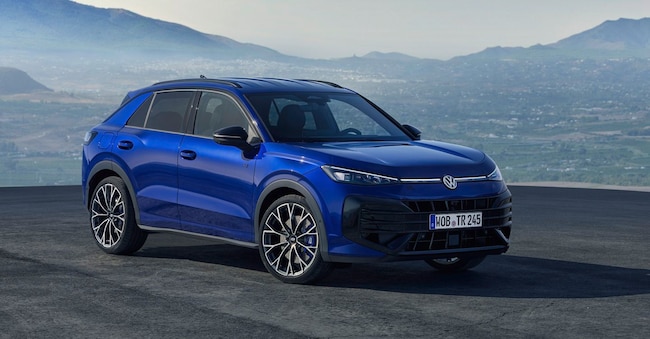
The second-generation Volkswagen T-Roc R is now a mild hybrid and even more powerful than before. The four-cylinder turbo petrol engine has been boosted from 300 to 333 cavalli, paired with 4Motion all-wheel drive. Based on the MQB evo platform, it will go on sale in the first quarter of 2027 at a price of around 60,000 euros.
New Volkswagen T-Roc R Hybrid: dimensions and styling
The T-Roc R features the bodywork of the second generation with bespoke bumpers. At the front, the air intake spans the full width, with three horizontal bars and six vertical slats in the centre. The letter ‘R’ appears on the front grille, beneath the wing mirrors and on the wheel centre caps. The wing mirror housings, roof rails and side roof moulding are painted black. The standard wheels are 19-inch Zandvoort alloys, paired with blue brake calipers; 20-inch forged Warmenau wheels are available as an option. At the rear, there are four exhaust tailpipes and a central diffuser, with an Akrapovič titanium exhaust system available as an option. The LED light clusters and rear windows are tinted. Colour options include Lapiz Blue Metallic, Canary Yellow, Pure White, Wolf Grey Metallic and Grenadil Black Metallic. The black roof cannot be combined with Grenadil Black Metallic.
Volkswagen T-Roc R, interior
Stepping inside, we find the T-Roc’s interior with a customisable 10.3-inch cockpit and a 12.9-inch central infotainment display, personalised with a range of modifications such as the R-Performance steering wheel, which features an ‘R’ button to activate Race mode, the sports seats feature the R logo and contrasting blue stitching, and the letter R also appears on the door sills. The Digital Cockpit Pro offers two Sport displays: one with a central circular rev counter and another three-dimensional one. There is also a horizontal rev counter ranging up to 8,000 rpm, with gear-change indicators. Other features include a GPS stopwatch, an accelerometer and data on turbo pressure, transmission temperature, power, torque and drive force distribution. The gearbox features steering wheel-mounted paddle shifters.
New Volkswagen T-Roc R, engine specifications
Under the bonnet is the 2.0 TSI EA888 evo5 engine with a displacement of 1,984 cm³, featuring a 48-volt mild hybrid system. The engine delivers 333 cavalli between 5,750 and 6,500 rpm and 420 Nm of torque between 1,900 and 5,250 rpm. The variable-geometry turbocharger is complemented by a 48-volt electric supercharger to boost torque at low revs. The engine, designed to meet Euro 7 standards, utilises 500 bar direct injection and the TSI evo combustion cycle with Miller cycle operation. It is the first R model to feature 48-volt mild hybrid technology. The mild hybrid system recovers energy during deceleration via a belt-driven starter-alternator and a 48-volt battery, enabling the engine to be switched off whilst coasting. The transmission features a seven-speed DSG and 4Motion all-wheel drive with R-Performance Torque Vectoring. The Torque Splitter distributes torque between the axles and between the two rear wheels, enabling it to send all available rear-axle torque to the outer rear wheel when cornering. The system takes into account the steering angle, throttle position, lateral acceleration and speed.
Acceleration from 0 to 100 km/h takes 5 seconds; the top speed is limited to 250 km/h. Launch Control comes as standard, as do the adaptive DCC suspension, progressive steering and 18-inch brakes. The suspension features MacPherson struts at the front and a multi-link setup at the rear, with specific springs, mounts and a rear stabiliser bar. The Vehicle Dynamics Manager coordinates the dampers, electronic differential and all-wheel drive. The seven driving modes – Eco, Comfort, Sport, Snow, Off-road, Race and Individual – are joined by Special and Drift. The former features a DCC setting developed for the Nürburgring’s Nordschleife, which is less stiff than the ‘Race’ setting; the latter adjusts the all-wheel drive and stability control to allow for drifting on closed circuits.

