
The Northern Lights show in Northern and Central Italy
The Aurora is one of nature's great phenomena and is quite rare in our latitudes. This year is already the second time it has happened so intensively

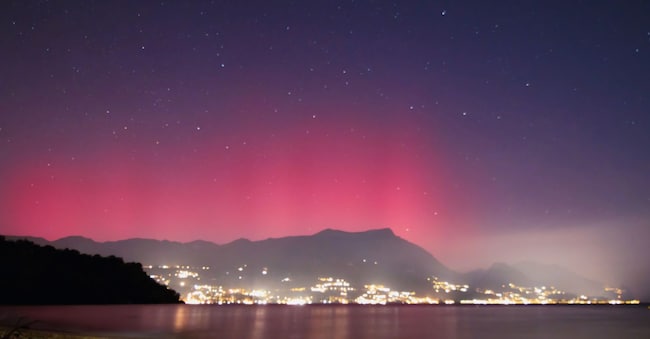
Here we go again! On the night of 12-13 November, especially in northern Italy, but possibly also in the centre, we may see an Aurora Borealis, or some related phenomenon, filling the sky with colour.
A first caveat: social networks are beginning to show many very beautiful pictures of Tuesday 11 November, but in the USA; here the phenomenon is less intense, then it must be said that a camera accumulates light, while our eye 'downloads' the image to the brain every tenth of a second, and therefore with the eyes we see less than in photos. However, there is a good point, the Aurora is one of nature's great phenomena and at our latitudes it is quite rare. This year's is already the second time it has happened in such an intense way, so: look at the sky, there is no particular direction; go to a dim area, even behind the house; no trips are necessary, just don't stand under a street lamp.
It all started on Tuesday 11 November, when two powerful flares appeared in sequence on the Sun, of class X, 5.1 the degree, in less professional words a crazy explosion of very hot gas in the plasma state, which started at 1,500 kilometres per second from the Sun's surface, one after the other. They are called coronal mass ejections of the Sun.
It's a lot of stuff, as young people say today, it can create problems for the outermost satellites, for planes in flight, but there is no need to worry, while electricity and tlc networks are now designed to take into account even these extreme phenomena. In the past, however, there have been problems with power distribution, in Canada for example.
But why do these Auroras happen?
The Sun, in these cases, emits a lot of energy and also swarms of electrically charged particles that, after a long journey, 150 million kilometres, which they make in a couple of days, arrive at the height of the Earth.


