Space

Solar storm: possible northern lights visible in half of Italy

A solar storm could bring an aurora borealis visible in Italy, with possible disturbances to power lines and GPS. The article explains how the aurora forms and how the Earth is protected from its effects by the magnetic field and atmosphere

by Leopoldo Benacchio

(Nasa)

3' min read

3' min read

Northern lights again as far as low latitudes, perhaps even over half of Italy. We say perhaps because with the aurorae borealis, the northern lights as they are often called, making precise predictions is practically impossible, given that it is a somewhat elusive phenomenon, it takes little to change it.

However, if there are any tonight, 10 October, they will be particularly intense, and in some parts of the northern hemisphere, including the US where the terrible Hurricane Milton is raging, there could be problems with power lines or GPS positioning systems, disturbed by the electromagnetic swarm that the Aurora causes.

Loading...

Let's see what we can expect with a little good weather and luck, as this is one of nature's most beautiful phenomena.

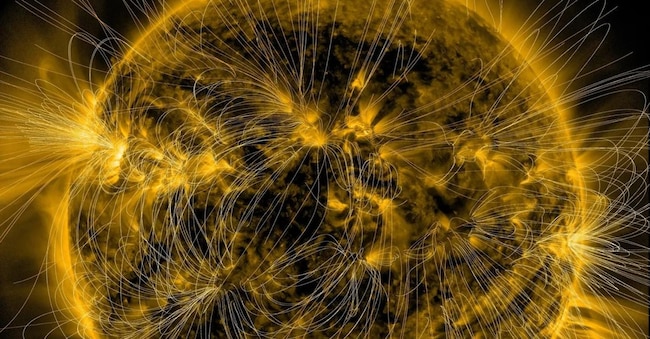
Nasa's orbiting solar observatory, SOHO the name, has recorded a large ejection of material from the Sun in recent hours. We are talking about billions of tons of gas in the plasma state with temperatures of thousands of degrees being ejected into space for a few million kilometres. Don't worry, we are a good 150 million kilometres away from our star, and in any case phenomena like this are frequent, especially during periods of maximum activity of the Sun, as we are in these months.  To this we must add that we need to see the direction in which all this material is being ejected, and this time we have it: it is being ejected right towards the Earth.

Between Wednesday evening and Thursday, until Friday morning, then this swarm of electrically charged particles will arrive at Earth and then be lost in the rest of the solar system, increasingly fading.

Put like that, it sounds rather dangerous, but we have two important defenders to preserve life on Earth. Earth's magnetic field and the atmosphere.

When they arrive in the vicinity of our planet, the charged particles find the shield of the magnetic field deflecting them, upwards, and so they leave, except for those that manage to pass by the poles, North for us but also South for us, where the magnetic field itself weakens, has a real hole, we could almost say.

At this point, however, the particles find the second barrier, the atmosphere, and it is there that the beautiful phenomenon of the aurora is formed: the charged particles hit the molecules of the atmosphere, which in turn stop them but become charged with energy, think of a spring being compressed. As per the law of nature, in the excited state, the molecules are not well and as soon as they can they release the energy they have received, like a spring that is stretched out, only here they emit light, of a different colour depending on the type of molecule. Here, then, is green if the molecule is oxygen, purple and blue if it is hydrogen or helium, and finally pink is due to nitrogen, all gases that make up our breathable atmosphere.

There is a flip side to the coin, all this energy reaching the Earth causes a real electromagnetic storm that can create serious problems for satellites, especially those furthest from the Earth, over 30,000 kilometres, and for power grids.  Again, we make it clear that there can be problems, this time the phenomenon is really strong, but power grid operators and even satellite operators have already been alerted and systems are designed with events like these, or even more violent, in mind.

In 1859, when communication networks were something else entirely, the telegraph networks, then the height of technology, went down for half a day at the beginning of September. However, a lot of water has passed under the bridge since then, although in the much closer 1989 some problems with Canada's power grid were due to a phenomenon similar to the one we are currently experiencing. Hopefully the clouds will give us a few hours of respite.

Neither the May eruption nor this week's eruption are as severe as the one known as the Carrington event that struck the Earth in 1859, interrupting telegraph stations, or another in 1989 that caused a blackout of a few hours in Quebec, Canada.

Copyright reserved ©
Loading...

Brand connect

Loading...

Newsletter

Notizie e approfondimenti sugli avvenimenti politici, economici e finanziari.

Iscriviti