

Not only reflux: don't underestimate eosinophilic oesophagitis, rare but present
The disease affects children and adults and appears to be on the rise but is unfortunately recognised even ten years later
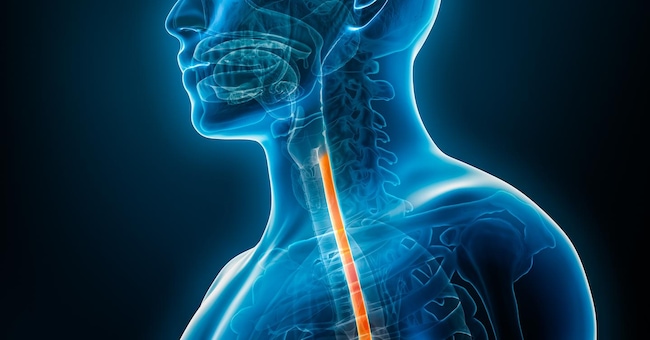
The acid rising, mercilessly, with burning and pain in the chest. The food bolus almost struggling down the oesophagus. Swallowing becomes a feat. For those with these discomforts, the biggest mistake is to underestimate them, perhaps thinking of stress or improper nutrition, relying for weeks on medication to combat acid reflux. Sometimes, behind this condition that refers to more or less intense digestive discomfort, there may be a condition that was considered rare but is not so infrequent. It is called eosinophilic oesophagitis: its origin is not related to diet, unless one suffers from an allergy that may favour the picture, nor even less to mechanical facts involving the long elastic tube that runs from behind the mouth down to the stomach. We are dealing with a chronic disease linked to the immune system, characterised by the presence on biopsy of an infiltration of particular white blood cells, the eosinophils, which somehow infiltrate the oesophageal mucosa keeping the inflammation high and generating signs and symptoms. Unfortunately, although the picture is certainly not frequent, this possibility is sometimes overlooked. The result is that the diagnosis arrives years after the onset of the discomfort, with obvious repercussions on the effectiveness of interventions.
A complex diagnosis
Eosinophilic oesophagitis is one of a series of diseases characterised by chronic inflammation: if this is not adequately treated, it inevitably leads to fibrotic remodelling of the tissues, with the oesophagus losing elasticity. Unfortunately, it is not easy to detect the picture if it is not suspected. Nicola de Bortoli, Director of the School of Specialisation in Diseases of the Digestive System at the University of Pisa, recently pointed this out. 'Despite healthcare advances based on the availability of endoscopies with biopsy, the main unmet need remains the diagnostic delay, which often ranges from 3 to 10 years,' he commented. 'This delay is due to the non-specific nature of the symptoms (which can be confused with reflux or dyspepsia) and poor clinical awareness. Another critical obstacle is the lack of non-invasive biomarkers: currently, diagnosis and monitoring require multiple biopsies via endoscopy'.
What is certain is that eosinophilic oesophagitis is on the rise. A study that recently appeared in Alimentary Pharmacology & Therapeutics reports that the condition affects at least 34 children and 42.2 adults per 100,000 inhabitants. But the numbers are probably rounded down. Above all, we are witnessing a continuous growth of cases. An Italia multicentre study, presented at the recent congress of the Association of Territorial and Hospital Allergologists Immunologists (Aaito) held in Bari, Italy, and conducted on 295 adult patients followed in 7 allergology centres confirms how the number of cases is increasing and above all how many patients arrive at the diagnosis after years of symptoms. "The increase in the number of diagnoses is an important signal, because it tells us that the disease is being sought out and recognised more," explains Alessandro Farsi, allergist and immunologist, director of the Allergology and Immunology Unit at the Santo Stefano Hospital in Prato.
The relationship with allergies
As specialists remind us, eosinophilic oesophagitis is often part of a broader allergological picture: many patients also live with asthma, allergic rhinitis, atopic dermatitis or food allergies. The link between these conditions is the so-called type 2 inflammation, an immune response common to many allergic diseases. Therefore, it is necessary to frame the situation well beyond the oesophagus. 'Eosinophilic oesophagitis is not simply a local inflammation,' Farsi emphasises. 'It is a disease that arises from the interaction between the environment, the epithelial barrier and the immune system. This requires a broader view, capable of recognising not only the oesophageal symptom, but also the patient's allergological and immunological context'. In the face of this complexity, many patients learn to live with digestive disorders by changing the way they eat, avoiding certain foods or attributing their symptoms to reflux. Thus, the disease can remain under the radar for years. According to Farsi, one must instead 'increase clinical suspicion, especially when a patient reports dysphagia, episodes of food blockage or recurrent oesophageal symptoms'.
Clinical and Future Research
The manifestations vary according to the segment involved: in adults dysphagia and impaction of the food bolus prevail, while in children food refusal and poor growth are observed. "Attention must be paid in particular to possible adaptive behaviour, i.e. drinking a lot during meals, avoiding social situations or food, chopping food a lot, in order to avoid perceiving the symptom dysphagia and consequently adapting to the unhealthy condition," de Bortoli points out. In the future, more and more available treatments will become customised according to disease subtypes defined by their underlying molecular or pathophysiological mechanisms. But that is not enough. The aim is to develop potentially less invasive monitoring methods, such as the 'string test' or the oesophageal sponge. 'They could eliminate the need for repeated endoscopies even if they are not yet recommended in clinical practice at the moment,' de Bortoli concludes. 'In recent years, scientific and pharmacological research is providing us with more and more appropriate weapons and in the near future hopefully also with diagnostic tools that are less burdensome for the patient. This is not only a clinical hope, but a necessity to improve the quality of life of those living with these chronic and relapsing diseases'.

