

Nurses are becoming increasingly ‘digital’ at the Campus Biomedico in Rome
Advanced ‘on-the-job’ training for 250 nurses and the creation of the role of ward operations facilitator

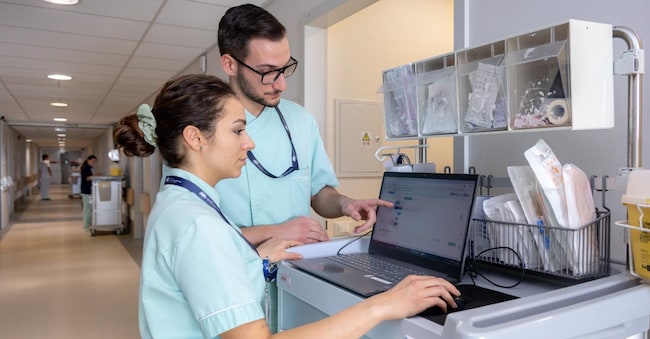
To train nurses in the use of advanced digital tools, to make their care work increasingly efficient and well-organised, and to promote personalised, high-quality care for the benefit of every patient. These are the main objectives of the Digital Nursing training programme at the Campus Bio-Medico University Hospital, which aims to strengthen the skills of nursing staff to deliver increasingly precise care centred on patients’ needs. The annual programme involves 250 nurses from the 11 inpatient wards of the Campus Bio-Medico University Polyclinic Foundation at its Trigoria site.
The ‘ward facilitator’
Among the project’s new features is the creation of the role of ward operational facilitator: a nurse selected via a dedicated recruitment process from amongst in-house staff to support colleagues in using the Professional Assessment Instrument (PAI). Developed by the Rome Nursing Council and introduced at the Campus Bio-Medico Polyclinic in March 2025, the PAI is a tool designed to support the nursing decision-making process in assessing, identifying and planning care for each individual in-patient. In the case of surgery, for example, the plan may include wound dressing, support with nutrition and hydration, as well as the steps required to help the patient walk again. Diagnoses and care interventions are thus recorded using coded entries and standardised language, making the information clearer and more objective than notes written in free text alone. Furthermore, the PAI supports nurses in selecting nursing diagnoses via a dedicated algorithm, designed to suggest the most relevant ones for each patient.
“Every person who enters a hospital brings with them needs, vulnerabilities and expectations that require a listening ear and attention,” said Federica Colzani, President of the Campus Bio-Medico University Hospital Foundation. “ Supporting nurses in their professional development means recognising the indispensable value of those who are by the patient’s side every day, so that they are placed in the best possible position to carry out their vital care work. This is also the essence of the innovation we have sought to introduce through this project: ensuring that every scientific and technological advance can be transformed into tangible support for our healthcare professionals and for those who place their trust in our care.”
Advanced on-the-job training
“The future of care is built on the ward, through day-to-day decisions and thanks to the skills and dedication of the people who work there,” commented Paolo Sormani, Chief Executive and Director-General of the Campus Bio-Medico University Hospital Foundation. He went on to add: “This is why we have chosen to consolidate the use of the PAI through advanced on-the-job training, based on the principle of ‘learning by doing’, delivered by nurses who know the wards and the challenges their colleagues face every day. The aim is to make interventions more traceable and thus ensure increasingly safe and personalised care for the benefit of patients. This commitment reflects our hospital’s mission to put technology at the service of people, in line with the humanisation of care that has always guided our activities.”
“Adopting a shared nursing vocabulary enables us to describe a person’s needs more precisely and to document the work of nurses and the results achieved day by day,” explained the Foundation’s Director of Healthcare Professions and newly appointed President of the Italian Society for the Leadership and Management of Nursing Professions (Sidmi), Daniela Tartaglini. “On this basis,” she added, “we can plan personalised interventions and assess their outcomes. Training amongst colleagues helps to consolidate this knowledge and to use the information gathered to understand patients’ care needs across different wards and to guide strategic and organisational decisions.”

