Technology

Nvidia revolutionises the PC: RTX Spark chip debuts at Computex

In collaboration with Microsoft and MediaTek, Nvidia presents a superchip for Windows on Arm laptops and desktops, capable of integrating advanced AI and high-end gaming

from our correspondent Luca Tremolada

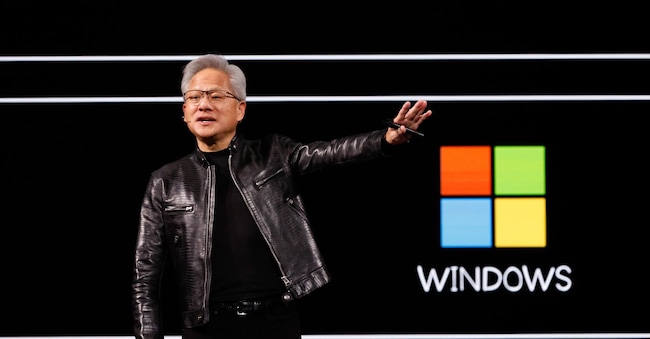
epa13008185 Il CEO di NVIDIA, Jensen Huang, annuncia una partnership con Windows durante il suo discorso di apertura nell'ambito della fiera COMPUTEX 2026 dedicata all'intelligenza artificiale, tenutasi a Taipei, Taiwan, il 1° giugno 2026.   EPA/RITCHIE B. TONGO EPA

4' min read

Translated by AI
Versione italiana

4' min read

Translated by AI
Versione italiana

TAIPEI (Taiwan) - Forty years after the birth of personal computers, Jensen Huang, the boss of Nvidia, enters the personal computer market with a new chip in collaboration with Microsoft. "This is the first line of PCs completely redesigned and reinvented for the intelligent agent era," he commented in Taipei, at the opening of Computex, Asia's most important tech fair.

Starting this autumn, the new PC chip called RTX Spark from Nvidia will debut in laptops and desktops from major brands.

Loading...

The product is a combination of microprocessor and graphics chip, made with the support of Taiwanese MediaTek, andwill run Microsoft's Windows for Arm operating system.
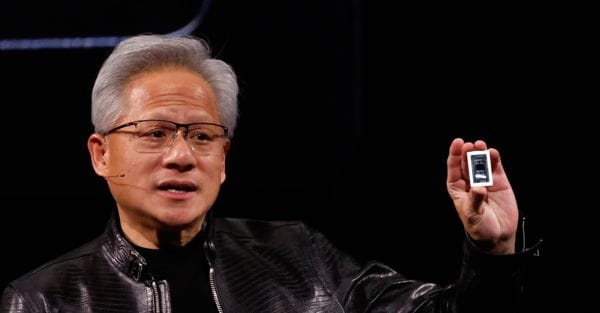
epa13008181 Il CEO di NVIDIA, Jensen Huang, mostra l'RTX Spark durante il suo discorso di apertura nell'ambito della fiera COMPUTEX 2026. EPA/RITCHIE B. TONGO

With this move, Nvidia enters the market for consumer CPUs for laptops.

The goal is to offer Windows on Arm machines that not only focus on power efficiency (as Qualcomm does), but also offer world-class graphics performance, native support for the Cuda ecosystem, and acceleration for local artificial intelligence and gaming.

Future laptops with Nvidia chips aim to compete directly with Apple Silicon processors and the traditional x86 architecture controlled by Intel and Amd.

The PC of the future according to Jensen Huang

The CEO of the $5 trillion chip manufacturer, born in the southern Taiwanese city of Tainan, enjoys rock-star fame.

At the end of an almost two-hour keynote, he explained that the RTX Superchip will feature a Cpu (central processing unit) with up to 20 computing cores and a Blackwell generation graphics processor with 6,144 cores. The two will share integrated memory, making them more capable of handling large artificial intelligence models and high-end games. They will use Nvidia's NVLink interface to communicate, bringing a slice of data centre technology to personal computers.

The chip design will be produced by Taiwan Semiconductor Manufacturing Co. (Tsmc), using the latter's 3N process technology.

The bet on intelligent agents

The real paradigm shift, however, lies in software and the convergence with artificial intelligence. The new computers will not just run simple applications, but will host real local autonomous 'agents'. "Agents," he explained, "will run in AI clouds, within companies and even on your PC."

These intelligent agents will be able to understand prompts, process artificial visions, generate video and audio, and operate continuously in a secure sandbox environment to perform complex user tasks such as 3D modelling or architectural project management.

In addition to the laptop announcement, the company revealed that the RTX Spark platform will extend into a complete line-up includingdesktop machines and powerful DGX workstations, capable of supporting trillion parameter language models.

Looking to the future, Huang drew an ambitious parallel with the mobile revolution, outlining how PCs will become true connected home command centres. "We are witnessing," he explained, "a reinvention of the computer reminiscent of that of the mobile phone when smartphones came along."

Huang's vision for the next ten years is one of total integration of AI into our lives: 'I can absolutely imagine that one day there will be an AI supercomputer in every home. And it will run all your agents, and all your assistants, doing all sorts of things for you all the time'.

According to Huang, the computer of the future will surpass the traditional PC concept: 'In time, it will become much more like R2-D2 or C-3PO than a PC.

How the PC market is changing

Nvidia's powerful new laptop processor is based on Arm architecture. Microsoft and Qualcomm have been promoting similar PCs together for over a year, albeit with limited impact. Outside of Apple's Mac line, most PCs use processors produced by Intel or Amd. Arm's advantage over these incumbents is its significantly better energy efficiency, but so far it has suffered on the software compatibility front.

The new Nvidia-based machines promise to be able to better handle Ia models and the functionality of commonly used software. The new devices will also boost gaming capabilities, allowing laptops to handle high-end titles, Huang said. However, we will have to wait to get our hands on them.

Looking forward, PCs based on the Nvidia platform will be able to run advanced artificial intelligence models directly on the device, keeping user data under control and offering simple tools to manage authorisations, access and privacy.

According to Nvidia, these guarantees will transform the computer from a simple productivity tool to a true personal assistant. It will no longer be limited to responding to user commands, but will be able to perform autonomous and contextual tasks: from searching for information within e-mails to more complex operations, such as identifying and correcting errors in the code of a website.

The company did not provide details on performance compared to competing solutions already on the market or coming in the next few months. Comparisons will be announced closer to the commercial launch of the new devices. Nvidia also stated that it does not anticipate any availability issues related to the current pressure on the semiconductor supply chain.

Copyright reserved ©
  • Luca Tremolada

    Luca TremoladaGiornalista

    Luogo: Milano via Monte Rosa 91

    Lingue parlate: Inglese, Francese

    Argomenti: Tecnologia, scienza, finanza, startup, dati

    Premi: Premio Gabriele Lanfredini sull’informazione; Premio giornalistico State Street, categoria "Innovation"; DStars 2019, categoria journalism

Loading...

Brand connect

Loading...

Newsletter

Notizie e approfondimenti sugli avvenimenti politici, economici e finanziari.

Iscriviti