The analysis

Nyt: 'Trump surrenders leadership on global economy, China wins'

According to the American newspaper, the US president used Davos to declare Washington's global leadership over

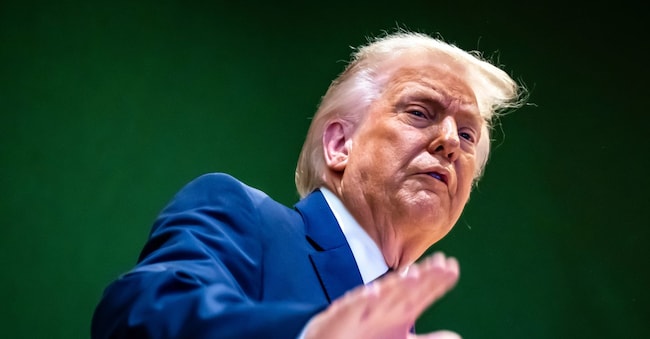
Il presidente degli Stati Uniti d’America Donald Trump

4' min read

Translated by AI
Versione italiana

4' min read

Translated by AI
Versione italiana

According to the New York Times, Donald Trump's speech at the World Economic Forum in Davos 2026 represents a historic break with the international order built by the United States after the Second World War. In his speech - long, messy, and at times self-celebratory - the US president actually pronounced what the paper calls a 'final farewell' to American leadership of the Western liberal system.

Speaking in front of an audience symbolic of globalisation, Trump argued that the US no longer intends to offer free access to its market or military protection to European allies, described as profiteers. He presented tariffs as a kind of 'ticket in' to trade with a 300 million consumer powerhouse. "The United States keeps the whole world afloat", he said. "Everyone has taken advantage of us".

Loading...
Donald Trump a Davos firma l'atto costitutivo del Board of peace per Gaza, ci sono 22 Paesi

Tariffs as a political weapon

The newspaper's analysis points out that, in the four days leading up to the speech, Trump had raised the spectre of a transatlantic trade war, threatening sanctions against several European countries if they did not accept his demands on Greenland.

Those threats produced immediate effects: falling markets, emergency meetings between European leaders, frantic phone calls to the White House and even the suspension of an EU-US trade agreement that had been negotiated for months.

Then, as often happens according to theNew York Times, Trump backtracked. He announced that he had reached a 'framework agreement' on Greenland and the Arctic and withdrew the tariffs that would have gone into effect on 1 February. Stock exchanges rose rapidly.

But for the American paperthe political damage was already done: the episode showed how fragile the global trade order has become and how unpredictable US strategy is.

A world moving away from Washington

According to the analysis, Trump's strategy is having the effect of moving historical allies away from the United States and pushing them to seek alternative partnerships, particularly with China.

The newspaper reports how several governments have tried to 'appease' Trump in recent years: lowering their own tariffs, accepting higher tariffs on exports to the US, signing agreements to avoid worse sanctions. But this approach has not stopped the escalation.

The only real exception was Beijing, which responded blow by blow to US tariffs, damaging key sectors of the US economy and forcing Trump to step back. A lesson that, according to the New York Times, Europeans may now take seriously.

Greenland: the breaking point

For the American newspaper, the crisis over Greenland marks the most serious moment in transatlantic relations in recent years. Trump openly asked Denmark to sell the island to the US, claiming that Washington would guarantee global security in return. This prompted the EU to formally suspend work on the trade agreement with the US, an unprecedented response.

Protests in Greenland - with signs 'Greenland is not for sale' - have become a symbol of political resistance to American pressure. A senior European official told the New York Times that if the issue was resolved, the trade agreement could be salvaged. But the episode has left deep wounds.

The comparison with China

The New York Times article then parallels Trump's speech with the one Xi Jinping gave in Davos in 2017. Back then, the Chinese leader presented himself as a defender of globalisation, warning that protectionism is tantamount to 'locking oneself in a dark room'.

Today, the paper notes, China appears - at least rhetorically - more committed than the United States to supporting multilateralism, global trade and international cooperation.

According to economist Eswar Prasad, quoted by the newspaper, Beijing 'wants to take on the role of the adult in the room', while Washington continues to show hostility.

Not because China has become a model - the paper recalls internal repression, state subsidies and military pressure on Taiwan - but because the US is voluntarily relinquishing global leadership.

Energy, climate and ideological divide

Trump also frontally attacked theEuropean green transition, calling it a "scam" and claiming an American return to fossil fuels. He joked about Europe buying Chinese wind turbines, claiming that Beijing 'laughs' by selling green technology to Europeans.

The New York Times points out, however, that China is investing heavily in renewables, progressively reducing its dependence on coal, while Europe and China remain industrial competitors, especially in the field of electric cars and batteries.

Ukraine, the European Red Line

According to Adam Tooze, an economic historian quoted in the newspaper,the only real obstacle to a structural rapprochement between Europe and China is Ukraine. Beijing's refusal to condemn Russian aggression makes a real strategic alliance impossible. Without that war, Tooze explains, one could imagine a kind of 'Eurasian multilateralism'.

A strategy of controlled chaos

The New York Times describes Trump's approach as a modern version of the 'madman theory': appear unpredictable in order to gain concessions. Too bad this strategy comes at a cost: it increases distrust of Washington, pushes allied countries to seek alternatives, and makes China the 'lesser evil' for many global players.

As Edward Alden of the Council on Foreign Relations observes, this crisis will reinforce the sceptics in Europe who think that 'no matter how much you concede to Trump, he will always want more'.

Copyright reserved ©

Brand connect

Loading...

Newsletter

Notizie e approfondimenti sugli avvenimenti politici, economici e finanziari.

Iscriviti