
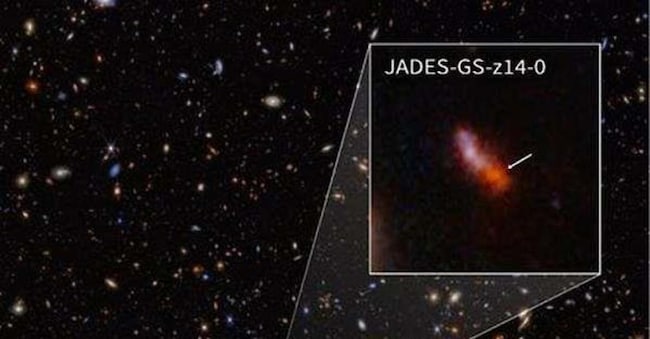
Observed 'Jades-GS-Z14-0', the closest galaxy at the time of the Big Bang
The galaxy immortalised by the JWST space telescope is the most distant galaxy ever observed: it is only 300 million years from the moment of the Big Bang
3' min read
3' min read
Records are made to be broken, someone sets them and then everyone tries to break and improve on them. It happens not only in athletics, for example, but also in science, where improving a record means taking the limit of knowledge a little further.
This is what has succeeded for a group of astrophysicists from various countries led by the Italian Stefano Carniani and united in a collaboration, called Jades, which has been working hard with the splendid JWST space telescope, the eye of mankind on the dawn of the universe, which has been operating for a couple of years and continues to amaze us with its discoveries.
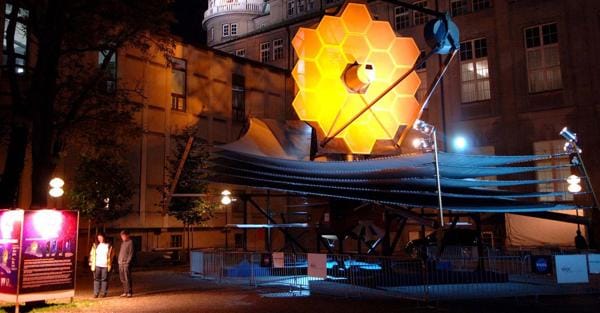
The latest one is precisely that of Jades-GS-Z14-0, the most distant galaxy ever observed, which is only 300 million years away from the moment of the Big Bang, a record-breaking observation, for those who chew a bit of astrophysics the wall of redshift 14, the red shift of light due to the enormous distance and accelerated expansion of the universe, has fallen. To try and get a good understanding, let's look at the distance value from another angle: if, as scientists say, the universe is 13.8 billion years old, then this very bright red bump is only 2% of its age. As Carniani, a researcher at the Scuola Normale Superiore in Pisa, told various media, at the beginning of the observations, the Jades group had selected as many as 650 galaxies to study, all very close to the moment of the Big Bang, even though we must always reason in astrophysical terms and are therefore talking about hundreds of millions of years. Certainly the distance issue is the figure that makes the headlines, rightly so, at that level going from the 325 million years of the previous record to just under 300 requires an impressive effort of years, however the important point is also another: the size and brightness of the galaxy itself, which sends the most accurate predictions that had been made into the dust.
Loading...
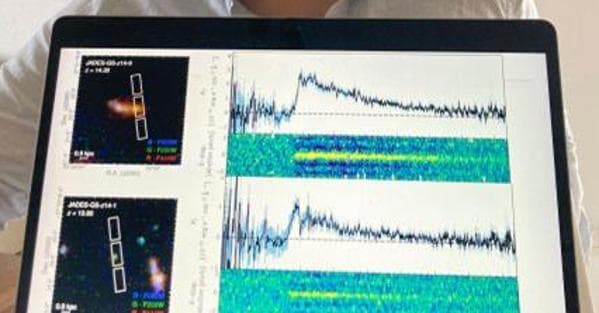
That galaxy, in short, should have been smaller and fainter, but instead there it is, asking questions. A very good result. The galaxy Jades-GS-Z14-0 was immediately noticed but raised some concerns: it seemed too bright for its age, let us say, and it is close to another galaxy, much closer to Earth, which, due to perspective effect, seemed to partly cover it. It took another 'run' of observations, another round of using the powerful 6.5 metre aperture space telescope, which sees in the infrared, to confirm the discovery. It turns out that the galaxy has a diameter of more than 1,600 light years, and that its light comes mainly from young stars and not from emission near a growing super massive black hole. Most very bright galaxies in fact generate their energy, which they then spread out as electromagnetic waves, from what happens at the edges of a large black hole central to the entire galaxy, like our own Milky Way. Analysis of that light leads one to think that the newly discovered galaxy in question is composed of stars with a total mass several hundred million times that of the Sun. Here a key question arises: how could such a bright, massive and large galaxy have been formed in less than 300 million years and also evolved quite a bit, since traces are also found of Oxygen, an element that takes a while to form from the initial hydrogen through nuclear fusion. . We don't know, it seems, and that's the real point to start from, but you have to understand, it's a good thing because it allows us to refine our knowledge and make more precise hypotheses to understand the origin and development of the Universe, in which we, planet Earth, also appeared at some point. For the moment, therefore, the record is there, but the newly discovered galaxy could, according to the researchers, soon surrender it to one of its even more distant relatives, since the space telescope instruments are not yet at their limits.


Brand connect
Loading...
