
Electoral law: here are the changes to the Stabilicum – from the bonus to closed lists
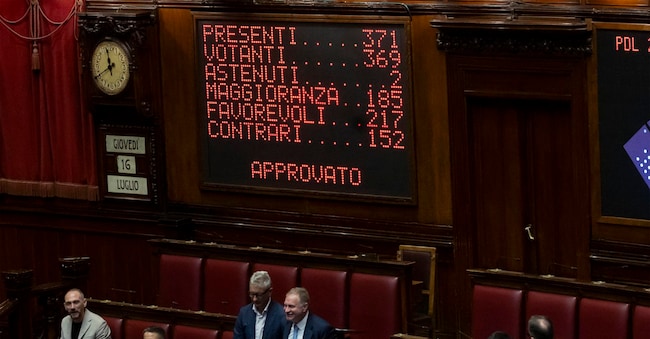
There were 217 votes in favour and 152 against. The majority parties voted in favour. All opposition parties, including Futuro Nazionale, voted against.

Key points
The centre-right’s electoral reform bill, known as the ‘Stabilicum’, has been given the green light by the Chamber of Deputies following a secret ballot. There were 217 votes in favour and 152 against. The bill now passes to the Senate. Here are the main provisions of the law:
Proportional mechanism with a governability bonus
The system provides for a proportional representation system with a majority bonus of 70 seats in the Chamber of Deputies and 35 in the Senate (up to a maximum of 220 elected members in the Chamber of Deputies and 113 in the Senate) for the coalition that secures at least 42 per cent of the vote. If no coalition reaches this threshold, or if the Chamber of Deputies and the Senate produce different election results, a purely proportional system will be applied.
Closed lists and the bonus
No preferential votes. The system uses closed lists in multi-member constituencies. The majority bonus is ‘divided’ among constituency lists, with the candidates’ names listed on the ballot paper. A candidate appearing on a list must also be included in at least one multi-member constituency within that electoral district
Qualifying thresholds and the ‘best loser’ repechage
The electoral thresholds set out in the Rosatellum remain in place for the entry of lists into Parliament: 10 per cent for coalitions and 3 per cent for lists, with a ‘repêchage’ mechanism within each electoral coalition for the first list falling below the 3 per cent threshold, which will nevertheless be included in the proportional allocation. Under an amendment approved in the Chamber, the following shall not be taken into account in the calculation of the national electoral total for a coalition, votes cast for affiliated lists that do not exceed the 3 per cent threshold and are not the ‘best loser’ list. What are the practical implications? That neither of the two main coalitions will be able to field more than one list at risk of falling below the 3 per cent threshold, so as not to risk losing votes. This strengthens the position of the only two lists that do not need to collect signatures: Italia Viva on the centre-left and Noi Moderati on the centre-right. The other smaller parties will have to join existing lists.
Petition and exemptions
An exemption from the requirement to collect signatures is envisaged for parties that have a parliamentary group in one of the two Houses, provided this was the case before 31 December 2025. Futuro Nazionale and +Europa will not be eligible for this exemption.


