

WHO pandemic plan, here's why Italy abstained (along with ten other countries)
A choice under the banner of 'sovereignty', the one reiterated by the Ministry of Health to explain the rejection of the 35-article document, which, however, puts clear stakes in the way of interference in the autonomy of individual states

5' min read
Key points
5' min read
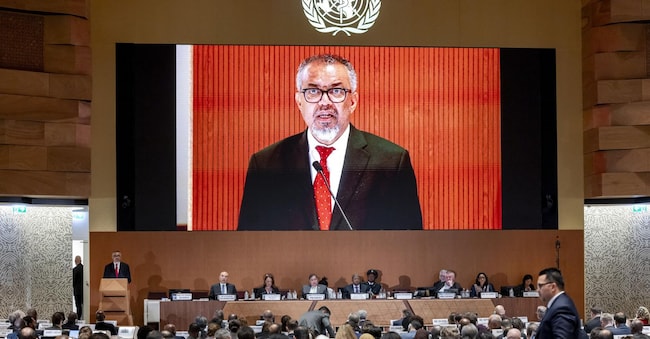
The key word is 'sovereignty': it is to this concept that Italy, represented by Health Minister Orazio Schillaci, has traced the decision to abstain on the World Health Organisation's pandemic plan in the vote in Geneva for the 78th WHO Assembly. A document that had been proposed three years ago, with the world still dramatically shaken by the Covid earthquake, and that we too had advocated. But the final yes - due to the change at the top of the country and the new course imposed by the reinterpretation of the management of the pandemic - did not come, despite the many adjustments to the text.
A political choice
.After multiple revisions and negotiations, the 35-article document, which received 124 votes in favour and no votes against but 11 abstentions, including ours in good company with Russia, Iran, Singapore, Romania and Bulgaria, and which aims to put in place a network of preventive security in view of a probable new pandemic, sees the instances of cession of sovereignty, which Italy continues to claim, decisively muffled. 'And which is the only possible explanation,' ministerial sources observe, 'for the failure to vote in favour. Therefore, a strictly political choice'.
Analysing the Plan, in fact, it is evident how the WHO led by Director General Tedros Adhanom Ghebreyesus - grappling with its own survival at a time of extreme crisis, including the financial crisis - in order to get the go-ahead has decidedly chosen the path of diplomacy and discretion over the borders of the member states. Respect for sovereignty, indeed: The Organisation has made it clear that "nothing in the WHO Pandemic Agreement shall be construed as conferring on the WHO Secretariat, including the Director-General, any authority to direct, order, modify or otherwise prescribe the national and/or domestic legislation, as appropriate, or policies of any Party, or to make mandatory or otherwise impose any requirement for Parties to take specific actions, such as banning or accepting travellers, imposing vaccination mandates or therapeutic or diagnostic measures, or implementing lockdowns".
The Statement of Italy
.And yet, with a choice that appears asynchronous to these declarations, our country, while reporting the WHO statements, has persisted in its all-out defence of self-protection: 'With today's abstention, Italy intends to reaffirm its position on the need to reaffirm the sovereignty of states in addressing public health issues. We appreciate," the statement reads, "that this principle has been included in the text of the Pandemic Agreement. We also welcome the fact that, in announcing the conclusion of the negotiations, the WHO specified that the Pandemic Agreement does not authorise the WHO to direct, order, modify or prescribe national laws or policies, nor to require states to take specific measures, such as banning or accepting travellers, imposing vaccinations or therapeutic or diagnostic measures, or implementing lockdowns. We also believe that the Agreement must be implemented in full respect of the principles of proportionality and protection of fundamental rights, including the protection of personal data and individual freedoms".
The "unfinished business"
.The conclusion: 'With these principles in mind, Italy hopes to continue to work with the other WHO member states to define outstanding issues that, in our opinion, merit further investigation'. What the outstanding issues are, the Ministry of Health does not make clear. What is certain is that the choice of abstention has had the effect of polarising the political world: on the one hand, Senator Marco Lisei, president of the Covid Commission, according to whom 'Italy, even on the front of health prophylaxis strategies, has finally returned to playing a role no longer as a gregarious but as a protagonist in the international forum, and this episode proves it'. The Fratelli d'Italia senator admits that 'The text has now improved, thanks also to Italy's interventions, but still not enough. It was right to abstain, also in view of the upcoming appointments and negotiations'. On the other side, there is the voice of the opposition: 'The choice to abstain on the global pandemic plan promoted by the WHO is very serious. The Meloni government decides to isolate the country to follow the denialist and anti-scientific sirens. No lesson from Covid, rather a closure in the face of the reasons of science and the need to coordinate strategies, resources and research at a global level,' said Chiara Braga, leader of the PD group in the Chamber of Deputies. While even former Minister Beatrice Lorenzin, vice-president of the PD senators, speaks of an 'incomprehensible and anti-historical choice' and Andrea Quartini, group leader of the 5 Star Movement in the Social Affairs Commission at the Chamber of Deputies and Coordinator of the M5S Health and Social Inclusion Political Committee, goes so far as to say that 'Schillaci should distance himself from sovereignism or leave'.

