

Precision oncology: liquid biopsy at Gemelli, clear tests and fast diagnosis
Inauguration of the platform developed in partnership with the American Guardant Health: from now on, samples will be analysed in-house

Key points
No more sending samples to European or overseas hubs, from now on cancer patients will be able to take the innovative liquid biopsy test directly at the Policlinico Gemelli Irccs, with a significant reduction in waiting times for diagnosis and subsequent treatment decisions. A result made possible thanks to a highly specialised infrastructure based on Guardant360 technology, developed in partnership with the American company Guardant Health. In the course of 2026 the platform will also be accessible to other hospitals, Irccs and territorial networks, through a dedicated service programme. Gemelli will thus be able to support networks in the territory by supporting oncological pathways and identifying a national reference organisational model.
The project is the result of investments and donations
"This is a very important goal," emphasises the general director of the Fondazione Policlinico Universitario Agostino Gemelli Irccs, Daniele Piacentini, "made possible thanks to a virtuous combination of strategic investments, industrial partnerships, and philanthropic donations, such as those collected at the last Charity Dinner at Gemelli. All this has enabled us to acquire new technologies and train our staff in these new skills. We are truly grateful to all those who have chosen to support a project with a high social, scientific and clinical impact such as FPG 360'.
"This collaboration between public healthcare and private innovation allows for broader access to cancer profiling through blood analysis and genomic information," says Helmy Eltoukhy, president and co-CEO of Guardant Health. "Bringing our liquid biopsy technology to one of Europe's leading cancer centres is another step in our mission to help clinicians around the world create more personalised treatment plans and improve therapeutic outcomes.
The Gemelli stands as a hub for Central and Southern Europe
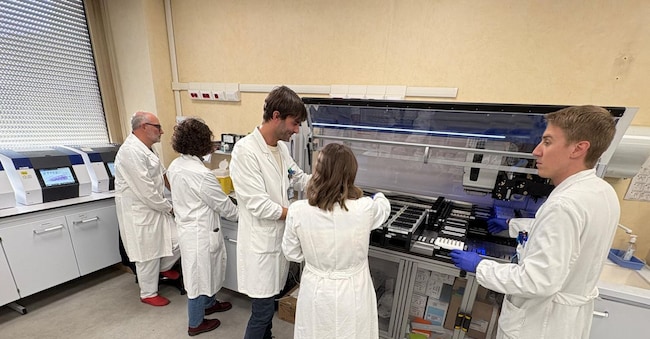
'Technology transfer,' explains Antonio Gasbarrini, scientific director of the Irccs Gemelli and professor of Internal Medicine at the Catholic University of the Sacred Heart, 'consists in acquiring the ability to perform procedures that are normally carried out in an industrial environment. In this case, our genomics laboratory, directed by Angelo Minucci, had to learn all the steps to carry out a next-generation liquid biopsy test (i.e. the analysis of circulating tumour DNA or ctDna) exactly as the central industrial laboratory in Palo Alto of Guardant Health, the company with which we signed an agreement a year ago, would do'. Until the end of the year, the laboratory will only process in-house examinations, while in the course of 2026, Gasparrini emphasises, 'we will also open up to requests from other hospitals with the further prospect of becoming a hub for the whole of Central-Southern Europe in the next few years, together with a laboratory similar to ours, located at the Val d'Hebron/VHIO Hospital in Barcelona and at the Royal Marsden Hospital in London, the only centres that have completed this Technology Transfer acquisition process in the European region'.
Precise analysis avoiding double testing
"Guardant Health's test is one of the most accurate liquid biopsy tests on the market, and this avoids the 'double test', i.e. having to repeat it to confirm the results," emphasises Giampaolo Tortora, professor of Oncology at the Catholic University of the Sacred Heart and director of the Gemelli Comprehensive Cancer Centre. "Doing it 'in house' also allows us to shorten diagnostic times. This is not negligible, because that wait has an enormous cost, in terms of patient anxiety, therapeutic opportunities, and disease progression'.

