
Salvini, final acquittal in the Open Arms case
The per saltum appeal filed by the Palermo Public Prosecutor's Office after the first instance ruling was rejected

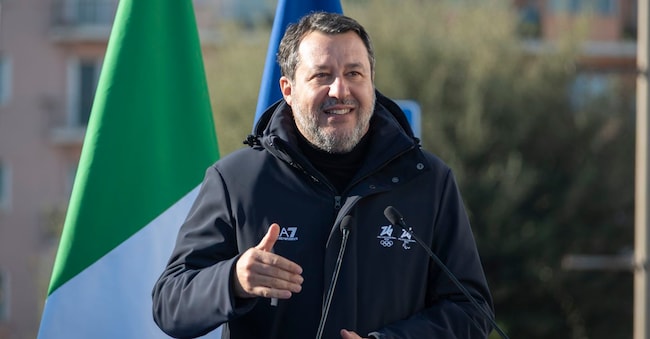
the acquittal for the minister Matteo Salvini accused of kidnapping and refusal to perform acts of office for the Open Arms affair when, in August 2019, 147 migrants were banned for a few days from disembarking from the Spanish NGO's ship that arrived near the Italian coast, in Lampedusa. This was decided by the judges of the fifth collegial section of the Supreme Court who, after about four hours of council chamber, rejected the appeal per saltum presented by the Palermo Public Prosecutor's Office against the ruling, which came on 20 December last year, with which the Sicilian judges dropped the accusatory system against the then Minister of the Interior. The vice-premier comments narrowly. "Five years of trial: defending borders is not a crime," he writes on X under a photo of him on which 'acquitted' is written. Prime Minister Giorgia Meloni - who applauded in the Senate chamber after learning of the news - speaks of 'good news', adding that the accusation was 'unfounded' and the supreme judges' pronouncement 'confirms a simple and fundamental principle: a minister who defends Italy's borders does not commit a crime, but performs his duty'.
For the minister's defender, lawyer Giulia Bongiorno, 'this is a trial that should not have even begun and this definitive solution highlights what I argued in the courtroom: the prosecutor's appeal was totally out of the world, but what interests us is the correctness of Salvini's actions'. Satisfaction expressed by all government leaders. "He acted in Italy's interest, justice is done," says Deputy Prime Minister Antonio Tajani. Hungarian Prime Minister Viktor Orban also exults: 'My dear patriot friend Matteo Salvini has been the subject of a political witch hunt for five years,' he comments on social media. For his part, the founder of the Spanish NGO, Oscar Camps, asserts that we are in the presence of a 'political decision', claiming that 'justice has not been done today either, but impunity has been constructed'.
The judges essentially accepted the request of the Prosecutor General's Office, which in a memorandum of about fifty pages, filed a few weeks ago, reaffirmed the inexistence of the charges against the League leader. For the Public Prosecutor's Office, the appeal 'focused exclusively on the conduct depriving of personal freedom (the action), without addressing the reconstructive profiles of the element of "guilt": and this without taking into consideration - it is said in the memorandum - that elements of exclusion (or, at least, of strong doubt) of intent related to the charges were present and valued in the contested judgment'. For the Deputy Attorneys General, this is tantamount to configuring 'a demonstrative deficit of the existence of the constituent elements of the crimes ascribed to the defendant'. In essence, - argues the Attorney General's Office in the document brought to the attention of the Supreme Judges - if the position of guarantee, which subsisted in the head of the Minister of the Interior, can go so far as to justify and substantiate the challenge of the limitation of personal freedom, in the sense that he should have allowed the disembarkation of migrants 'not yet fully identified and potentially entitled to asylum, moreover legitimately entered the Italian territorial sea by virtue of a provision of the Lazio Regional Administrative Court, there is however no significant argumentation aimed at demonstrating the existence of guilt or the other constituent elements of the crime, pointing only to the existence of the conduct and the naturalistic event connected to it'.
In the motivations of the first instance judgement, the Palermo court stated that Italy, and therefore the then head of the Viminale, were not obliged to assign a safe port (Pos) to the Spanish ship Open Arms because it was up to the Iberian authorities to do so. For the court, the obligation to protect the refugees, made to disembark at the end of a tug-of-war only after the intervention of the Agrigento prosecutors, was Spain's. Because its maritime coordination and rescue centre had 'operated, from the outset, an albeit minimal 'first contact' coordination'; because Malta, 'in declining its responsibility for the first two rescue events,' they explained, 'had clearly indicated Spain (the flag state) as the only authority that should have assisted the vessel'.

