

Robots in the operating theatre, but the surgeon can still monitor the heart remotely
Technology reduces the physical distance from the patient, but we must ensure that the human distance between those who care for patients and those being cared for does not grow

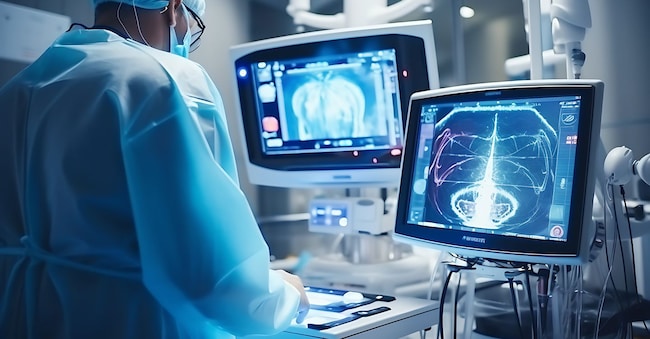
In less than twenty years’ time, patients across the globe could routinely undergo remote heart surgery, performed by surgeons who may be tens of thousands of kilometres away. In real time, wherever they live and regardless of their economic and social status. This offers a real prospect of universal access and the democratisation of healthcare.
Here is one of the most interesting outcomes of robotic surgery: a genuine globalisation of expertise, which no hospital can or will ever be able to provide on its own. The robot that is already assisting us in the operating theatre, therefore, will not only make our surgical procedures increasingly precise and less invasive, but will also enable us to bring specialist expertise to patients even over (long) distances. As a cardiac surgeon, I am left with just one concern: if technology reduces the physical distance between surgeon and patient, will we be able to prevent the human distance between those who treat and those who are treated from growing?
The standard of tomorrow
In fact, what is set to become the standard has already been tried and tested for some time. It was back in 2001 when, as part of Operation Lindbergh, the first transatlantic surgical procedure in history was carried out, between New York and Strasbourg. A cholecystectomy (removal of the gallbladder) was carried out over 7,000 kilometres apart, which required the setting up of an extremely expensive, bespoke network. Today, thanks to 5G, satellite networks and ultra-fast internet, that dream could become clinical practice. Of course, when it comes to cardiac surgery, things are a little more complex: the heart is an organ that is both incredibly powerful and extremely delicate. Let us not forget, however, that technology and cardiac surgery have always gone hand in hand: the first cardiac suture dates back to 1895, the first open-heart operation to 1952, and the first using robotic technology to 1998. Three key moments, in which the evolution of the instruments available to the surgeon proved decisive. Without them, it would not have been possible to continually expand the surgeon’s surgical capabilities.
Minimally invasive procedures
Today, that journey has reached a new milestone. First the US Food and Drug Administration (January 2026) and then the European Commission (September 2026) have approved the use of the da Vinci 5 robotic surgical system for specific minimally invasive cardiac procedures, such as mitral valve repair. According to some figures, around 20 million operations have been performed worldwide using this technology. Of these, over 140,000 were cardiac procedures. This figure is inevitably set to rise.
Robotic cardiac surgery is a technique that reduces tissue trauma, causes less pain, results in smaller scars, carries a lower risk of infection and often leads to a quicker recovery for the patient compared to open surgery. It is an approach that combines the surgeon’s eyes and hands with technical micro-precision. And, together with the advent of artificial intelligence, it significantly enhances the surgeon’s capabilities without replacing them. The robot, in fact, offers six degrees of freedom of movement, eliminates tremor, provides a three-dimensional view and alerts the surgeon to any errors in their movements. These are new possibilities, and none of them takes away the surgeon’s control over decision-making. Without the surgeon, the machine does not make decisions. The robot can also support essential teamwork, as it increases the number of occasions on which all team members share what they see and make decisions.

