
Santa Cecilia Orchestra among world leaders for foreign tours and productions
The British magazine Bachtrack ranks the Academy sixth among world institutions. In 2025, 29 concerts between Europe and Asia. Audience and takings also grow

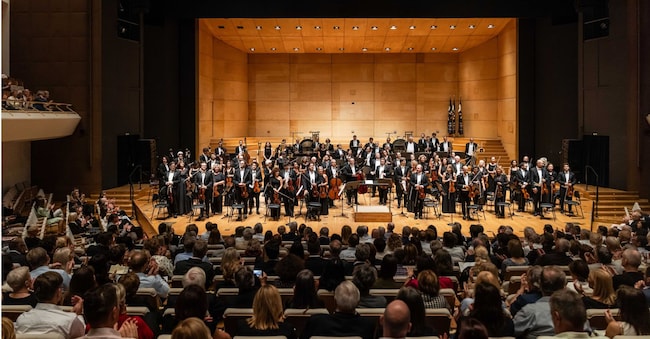
A flagship of Italian culture that is good for the whole country: Massimo Biscardi, who has been leading the Accademia nazionale di Santa Cecilia in Rome for the past year, is convinced of this. With its 500 years of history, it is one of Italy's most important lyrical-symphonic foundations, well known and appreciated abroad as well, as demonstrated not only by the number of tours in other countries and their success, but also by an important award that arrived a few days ago from the English magazine 'Bachtrack'.
In fact, the magazine (which analyses the activities of major musical institutions around the world) placed the Accademia Orchestra in sixth place in the international ranking of leading orchestras in terms of the number of countries toured and gave it seventh place for the total number of concerts and productions. "I believe it is also important for Italia that there are realities such as the Accademia or the Scala of Milan that appear in the playbills of the world's greatest theatres, thanks to the quality and fame of their productions," says Biscardi, who is president, superintendent and artistic director of the Accademia.
Strategic Activities Abroad
'Therefore,' he adds, 'Santa Cecilia must continue on this path and, indeed, further develop its activity abroad'. In 2025, there were 29 concerts performed off-site, up from 24 in 2023 and 27 in 2024, with three major tours that took the Orchestra and music director Daniel Harding to different countries in Europe and Asia. Over 35,000 spectators in the 21 European stages and around 19,000 in the Asian stages, with seven 'sold out' concerts.
"Our goal is to hold an average of around 30 concerts a year on tour and I confirm this figure in the budget for 2026. Unfortunately, there is a problem of an economic nature that we have to solve,' Biscardi points out. 'Until December 2o24 there was a government support measure in place, which allowed lyric-symphonic foundations to request a contribution for travel expenses, but this measure has not been renewed and, starting in 2025, we have to look for private sposnsors to support this type of activity. And while it is true that an institution such as the Accademia di Santa Cecilia enjoys the support of many patrons and private sponsors (who contributed almost €3 million to activities in 2025), finding partners for activities abroad is generally less easy. "We will roll up our sleeves and find a solution, but I invite the government to reconsider its decision and propose the contribution again, at least for some extraordinary cases," says the president.
Audience and takings up
Biscardi also takes stock of his first year in office, with very positive results that go against the trend: 'After the Covid 19 pandemic, the audience for opera gradually increased, while the opposite happened for symphonic music. We, on the other hand, are growing'. The 2025-2026 season has recorded (as at 2 February) over 51 thousand tickets sold (almost 5 thousand more than last season on the same date) for a total of 1.78 million euro grossed (281 thousand euro more) and subscriptions and carnet sales have increased, in particular, those dedicated to young people, which have risen by 10%, perhaps also the result of the many activities and courses aimed at young people and children. Not to mention the sold out of almost all the Saturday performances (2,756 seats), with an average of 7-8 thousand spectators per week.

