
Orsini: Energy priority, Europe unites on real industrial policies
The president of Confindustria: 'We do not want to deindustrialise the continent. I hope for a solution for Hormuz. Housing plan and merit to attract young people"

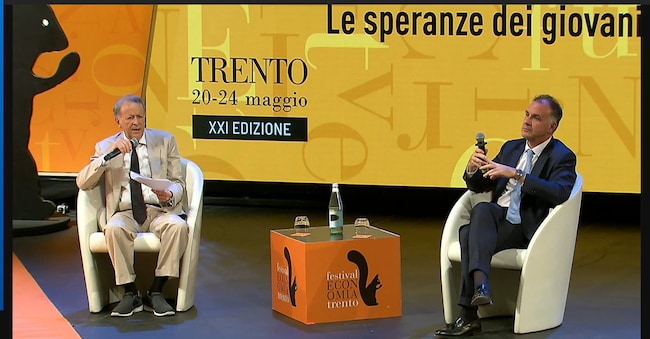
Creating the conditions to make companies competitive. The priority of energy, a European industrial policy, the youth question. The president of Confindustria, Emanuele Orsini, addressed a wide range of issues affecting the competitiveness of the country, answering questions from the director of Il Sole 24 Ore, Fabio Tamburini, in the interview that concluded the Trento Festival of Economics, organised by the Il Sole 24 Ore Group and Trentino Marketing, on behalf of the Autonomous Province of Trento.
"Italian industry is penalised by high energy costs, we have a gap that sees us ranked 27th in the EU. This is a problem, we hope that a solution can be found for Hormuz and that the conflict can end. We do not want to relocate our industries and deindustrialise our continent," said the president of Confindustria in response to a question on what risks our manufacturing runs. 'At a time like this, Europe,' Orsini continued, 'must unite in order to be able to implement real economic policies to support companies. Enterprises and workers are the same thing, the social stability of Italia and the EU is at stake. To date, however, European policies are deficient'.
No European country, Orsini emphasised, can delude itself into thinking it can do it alone. 'The EU has to play the game, but unfortunately it is more focused on building rules. It has understood the problem, there is the diagnosis but not the cure'. Amongst the questions, Director Tamburini raised the automotive and white goods crisis as the iceberg tips of the industry's difficulties. 'We have to create the enabling conditions for production to stay with us. And the first problem is energy, as a cost factor. It is too high here,' said the president of Confindustria, urging the need for a single EU energy market. In the automotive industry, he stressed, 'we do not want screwdriver factories, assembling components from abroad, we must safeguard the entire supply chain. We have to reckon with Chinese competition: 'those who produce in China are 30% supported by the state to conquer new markets. Without technological neutrality we have given a piece of the automotive industry to the Chinese. They have become the first on automotive, on televisions and on white, and the EU is a spectator, playing referee with the whistle between the US and China,' Orsini continued, adding that Chinese exports to the EU grew by 30% in 2025 and that this meant the loss of one million jobs and citing the figure of 1.2 trillion positive balance of China's exports to the world.
Orsini also called the EU Commission's 72 demands on our bill decree 'madness'. And he renewed his appeal to the Italian regions to unblock the renewable energy concessions, a good 4,000 worth 137 GW: 'being able to have national coordination will be fundamental'. He relaunched the need for nuclear power, starting at least with experimentation: 'there can be no opposing positions on this. We must also focus on productivity and competitiveness in order to win on foreign markets, a theme addressed in many of the Festival's debates, with Orsini emphasising the importance of the free trade agreement with Mercosur and the mission that Confindustria will be undertaking there in September. Among the Sole 24 Ore editor's questions was also the relationship with the trade unions: 'at the beginning of my mandate it had been seven years since we had met. We have found many points on which to work and that means putting the general welfare at the centre'. Young people were a theme that was addressed at length yesterday, as in the Festival's panels: in 2040 there will be a shortage of 5 million people, said Orsini, it is necessary to make Italia attractive to young people, there is a salary issue, 'Confindustria has renewed 94% of contracts, we need to fight the pirate ones', merit must be put at the centre and affordable housing must be offered: the Piano casa, of which Orsini's Confindustria was the promoter, 'is moving forward, the important thing is that it moves and that there are answers not only in the big cities but where there is strong manufacturing'.
At the beginning of the interview, the first question was about his first two years as president of Confindustria: 'a wonderful experience. The thing that gave me the most was bringing people together. The team we reconfirmed and the reforms we made were unanimously approved. We have always stayed out of the political debate, protecting businesses without harming the country and focusing on growth'. And to the final question, in which Tamburini asked whether he shared the invitation to young people launched at the Festival by Alessandro Benetton and Cardinal Ravasi to have courage and not be afraid to go against the tide, Orsini replied: 'I think you will read the word courage a lot in my report on Tuesday,' referring to the Confindustria public assembly to be held tomorrow in Rome.


