

From bacteria to plastics: our health depends on the health of the oceans
The ISS, operating from Navy vessels including the Vespucci, has already collected 4,000 samples from more than 140 sites across the main basins

From antibiotic-resistant bacteria found everywhere beneath the sea’s surface, even at the North Pole, to the Covid virus (SARS-CoV-2) detected in the middle of the Atlantic Ocean. From microplastics concentrated even in the seas closest to us, such as the Mediterranean, to paints from the 1950s that the ‘blue planet’ cannot rid itself of. And then there are PFAS pollutants, present even above the thresholds set for drinking water, and metals such as cadmium, lead, uranium and vanadium found in traces and ‘ultra-traces’ thanks to the most sophisticated methods.
It is the oceans, which cover a full 70% of our planet, that present us, through their ‘memory’, with the bill for the damage that we ourselves almost always cause and which, like a boomerang, comes back to affect our health. But it is certainly from the oceans, in their role as a “blue pharmacy”, that solutions can emerge, as well as responses to be devised against high-impact phenomena. Starting with climate change, which displaces huge swathes of the population, striking at the heart of any claim to equity in access to resources and the right to a dignified existence.
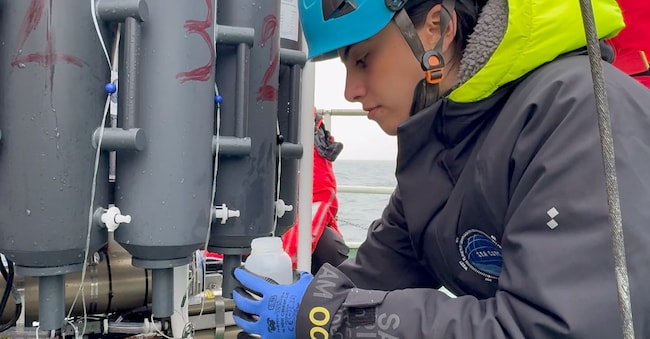
The all-Italian project “Sea Care”, conceived by Andrea Piccioli, Director-General of the Italian National Institute of Health (ISS), who leads it in collaboration with the Italian Navy and a network of leading laboratories, thanks to a national and international partnership. An initiative that travels – or rather sails – aboard the grey ships of our Navy and ‘stars’ such as the Amerigo Vespucci. And which is innovative precisely because of this logistics approach, characterised by minimal economic impact and maximum scientific output: ‘In the first three years of operation between 2022 and 2025,’ explains Director General Piccioli, ‘around sixty young ISS researchers embarked on shifts during which they shared the deck of the ships hosting them, following pre-established routes. Thanks to a small mobile laboratory, the more than 4,000 samples already collected from over 140 sites spread across all the major basins from the Mediterranean to the Arctic and the Indian Ocean have been analysed using a rigorous scientific method, which allows for the assessment of the chemical and biological composition of the waters.” This activity, never undertaken before, provides a very precise picture of the oceans and their link to our health, so much so that the project has been incorporated into the UN Water Agenda 2030. “A necessary step in the current Anthropocene era,” Piccioli adds, “in which human impact on the environment is stronger than ever and where it would be appropriate to speak of a single ocean to be studied, given the interconnection between systems facilitated by currents that carry everything everywhere.”
The Sea Care project – extended until 2028 with a mission for this three-year period to study the deep sea – was one of the key features of the first “Ocean and Human Health International High Level Forum”, organised yesterday by the Italian National Institute of Health in Rome with the endorsement of UNESCO, which included it among the official activities of World Oceans Day. The objective is almost unprecedented: to discuss the effects of ocean conditions on human health and – ultimately – to care for the seas through prevention by fostering synergies at national and international levels. This was emphasised by the Minister of Health Orazio Schillaci: ‘If we want to protect the health of present generations and, above all, future ones, if we want to build truly resilient health systems, we must strengthen our ability to understand and manage the interconnections between health, the environment and sustainable development,’ he remarked.
Ten priority actions emerged from the conference which, on a planet increasingly divided by war and economic competition, reaffirm the value of collaboration between leading researchers, from China and the United States to our own CNR and National Institute of Health. Crucial among these is is the ‘From Source to Sea’ approach, which requires an integrated view of the entire water cycle, starting from the realisation that every form of pollution produced inland travels across environmental sectors and borders and ultimately impacts our health through food, water and air. As a corollary, the scientists are calling for the protection of human health and well-being to be included in the High Seas Treaty, which came into force on 17 January, with the challenge of developing prevention strategies that simultaneously protect marine ecosystems and global communities.

