

Over 550 automotive sites in the Maghreb. Competition from Asia and the US, but also synergies with the EU
A survey of production and component manufacturing in Morocco, Tunisia and Algeria demonstrates just how much the industrial geography of the EU car sector no longer coincides with the borders of the European Union. This is particularly true for Renault and Stellantis. The risk is that the southern Mediterranean region could develop significant industrial capacity without Europe gaining greater technological autonomy, due to the presence of Chinese, Korean and Japanese firms. Greater synergies would help to revitalise the Old Continent

Key points
For the European car industry, 2025 was not even one of the worst years since the Covid-19 pandemic. The sector ended the year with 10.8 million cars produced – slightly more than in 2024. If we rewind the clock to 2015, however, the number of cars rolling off production lines at factories based in Europe stood at around 21 million units. And little would have changed had the UK been part of the EU at the time. Today, there are 260 production, component and electric battery manufacturing sites (Acea data), and the EU’s automotive sector has been rendered extremely fragile by a range of competitive factors, issues relating to raw materials and energy costs, and, above all, EU policy decisions that have ultimately accelerated a process of deindustrialisation. The political push towards electric cars has drastically altered the business models of numerous brands. On the one hand, it has enabled battery-powered models to gain market share; on the other, it has seen the steady growth of Chinese brands. Today, the European car industry has weathered the storm, but it remains a character in search of an author. In the coming years, it will be essential to consolidate the market and seek alliances beyond the 27 Member States. The crisis facing German brands and the long-standing market relationships with China suggest that it would be wise to at least review industrial policy, with an eye towards the nearest southern neighbours and thus the Maghreb.
Analysis by the NextMed Observatory
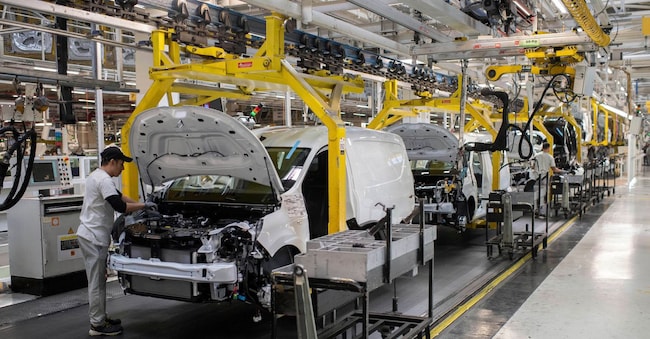
With the involvement of the NextMed Observatory, we have therefore sought to collate some data to map production in the area, distinguishing between operational plants and the capacity to develop the components supply chain. Finally, we have sought to measure the competition posed by non-EU players, not only through car imports from the Maghreb, but also by examining investment in factories, wiring harness plants, electronics and software. The result is that, whilst the EU is home to a total of 260 production sites, Morocco, Algeria and Tunisia have 556 such sites, employing a total of 405,000 people (Libya and Egypt are negligible players in the automotive sector). There are half a dozen production hubs from which cars leave ready for dispatch. For the most part, these are plants specialising in wiring harnesses and components. An analysis of economies of scale shows that some companies have both EU and non-EU customers, and that China dominates battery production. Morocco has the largest production hub, centred on Renault in Tangier and Somaca (also owned by Renault) in Casablanca, Stellantis in Kénitra and Neo Motors in Ain El Aouda. It has a broad value chain ranging from wiring harnesses to seats and uses the port of Tang-Med as a gateway to the North and the East. To give an example, in March 2022 the government signed eight investment agreements with Yazaki, Sumitomo, Lear, Stahlschmidt and TE Connectivity, with a total value of 1.7 billion dirhams (160 million euros) and nearly 12,000 direct jobs expected to be created. The investments relate to connectors, terminals, cables for electric vehicles, plastic components, precision engineering and automation. According to data provided by Amica, the Moroccan automotive industry association, the country boasts a workforce of close to 280,000 and a rate of integration between production and the supply chain of 69 per cent. This figure highlights the impressive level of (near) self-sufficiency achieved by local industrial clusters. Algeria, for its part, is rebuilding a production platform centred on the former FIAT plant in Tafraoui. It has a fair number of component manufacturers, but employment levels remain significantly lower. In fact, the number of workers in the sector does not exceed 5,000. Finally, Tunisia is primarily a powerhouse in components, wiring harnesses, electronics, software and engineering. It is not an OEM (Original Equipment Manufacturer) hub comparable to Morocco, let alone European sites.
Competition from outside the EU
Overall, in Morocco and Tunisia, there are numerous US and Japanese sites overseeing components and wiring processes. And new investment in Morocco’s electric battery supply chain is dominated by Chinese players or by joint ventures with technology linked to Beijing. Gotion, Cobco, BTR, Hailiang and other projects are shifting the value of production towards active materials, cells, anodes, cathodes and copper. It is interesting to analyse Tunisia’s export shares for automotive products. 81 per cent of output from production sites scattered across the north of the country is destined for four European nations. Of 3.9 billion in exports, 37 per cent goes to Germany. France follows with 21 per cent, Romania with 12 per cent and Italia with 11 per cent. On the one hand, this reflects Tunisia’s dependence; on the other, it presents interesting connections for Europe that are worth developing.
Opportunities for integration
Zooming out to take in both shores of the Mediterranean basin reveals a broader picture from which it is clear that the EU’s automotive industry no longer aligns with the borders of the European Union. The Maghreb is now an integral part of the EU’s automotive manufacturing sector. However, on the other hand, the advance of Chinese investors, particularly in battery production, and the strong presence of sites owned by non-EU investors, capable of supplying customers in both the Old Continent and the Far East, means we must distinguish between geographical proximity and industrial autonomy. The risk is that the Maghreb may gain industrial depth without Europe achieving greater technological autonomy. On the contrary – the EU Parliament and Commission should consider adopting a more synergistic approach with the three Maghreb partners – genuine interconnection and greater investment could revive the fortunes of the EU automotive sector, reaping the benefits of the North-South relationship whilst mitigating the problems of excessive competition on its doorstep.

