
In Italy, 578,000 non-agricultural enterprises focus on the green economy
The survey conducted by Unioncamere, Symbola Foundation and Tagliacarne Study Centre
by Lorenzo Pace
Key points
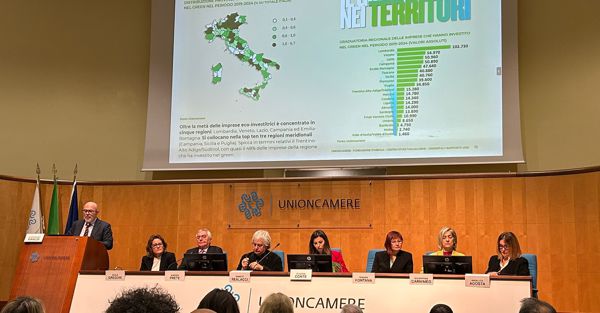
From new fields of engineering to solar system installers. Italian companies are increasingly looking for qualified profiles linked to environmental sustainability. These are the so-called 'green jobs', which in 2024 numbered 3.3 million throughout the country, 13.8% of the total number of people employed. This is stated by the sixteenth GreenItaly Report realised by Unioncamere, Symbola Foundation and Tagliacarne Study Centre, under the patronage of the Ministry for the Environment and Energy Security, presented in Rome, at the Unioncamere headquarters in Piazza Sallustio, while the Cop30 is underway in Brazil.
There is a growing demand for profiles and skills in environmental sustainability
Data confirming the search for both profiles with skills in the field of environmental sustainability and professional figures undergoing reconversion or evolution for the green transition. In 2024 there will be 3,298,000 green jobs, an increase of 4.3% (+135,000) compared to 2023, with a share of 13.8% of the total employed. With increases in almost all of the country. The only area to have fallen is the Centre (-0.5%). The breakdown therefore sees the North-West leading the way with 32.8% of 'green jobs', followed by the North-East (23.6%), the South (23.1%) and the Centre (20.5%). What companies are looking for are specialised profiles in more emerging sectors, such as solar, power electronics or renewable energy engineers. But also some 'classic' professions readapted in a green key, such as town planner or safety compliance officer.
More than 578 thousand non-agricultural enterprises have invested in the green economy in the last six years
Over the past six years, 578,450 non-agricultural companies have invested in the green economy and sustainability. More than one in three. Those who hold 'patents in strategic green technologies,' says Unioncamere president Andrea Prete, 'have on average a 17% higher level of productivity. The real limit is not the willingness of companies, but the availability of qualified professionals. Companies have difficulty finding more than half of the green jobs sought, and this blocks investment'.
Data that, for Ermete Realacci, president of the Symbola Foundation, 'confirm the concreteness of President Mattarella's invitation to make green transition and decarbonisation an important factor of competitiveness'.
Gaps in the territory
On the territorial gaps, then, the report shows 'that the difference between the performance of each area analysed and the national average tends to grow'. In Lombardy there are 102,730 eco-investor companies, then there are Veneto (54,970), Lazio (50,960), Campania (50,980) and Emilia-Romagna (47,640).

