
Medicine

Pancreatic cancer: Gemelli Hospital performs world’s first treatment using radioactive glue

At the Policlinico di Roma, the drug YntraDose was administered to a 63-year-old female patient suffering from inoperable ductal adenocarcinoma

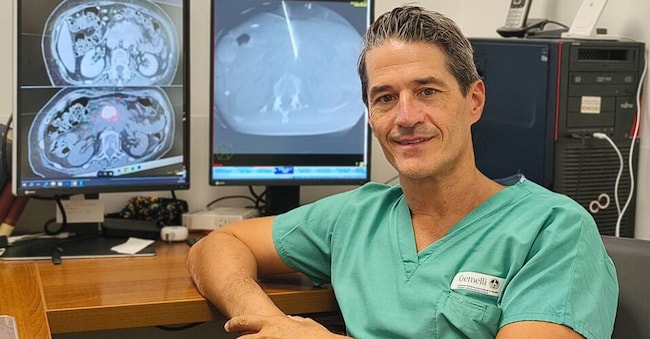
Roberto Iezzi, direttore di Radiologia interventistica al Policlinico Gemelli di Roma, ha effettuato il primo trattamento con colla radioattiva su tumore al pancreas non operabile

3' min read

Translated by AI
Versione italiana

3' min read

Translated by AI
Versione italiana

A new therapeutic approach in the fight against pancreatic cancer has reached a significant international milestone at the Policlinico Gemelli in Rome. For the first time anywhere in the world, a patient suffering from ductal adenocarcinoma of the pancreas locally advanced and inoperable has been treated using an innovative locoregional radiotherapy procedure, which involves the direct injection into the tumour of a special radioactive biological glue containing particles of Yttrium-90.

The procedure, carried out at the Agostino Gemelli University Polyclinic IRCCS Foundation, opens up new therapeutic prospects for one of the most aggressive and difficult-to-treat cancers, with the aim of transforming tumours initially deemed inoperable into lesions suitable for surgical resection.

Loading...

The procedure was carried out by Professor Roberto Iezzi, head of Interventional Radiology at Gemelli Hospital, as part of an international clinical trial coordinated by Professor Giampaolo Tortora, director of the Comprehensive Cancer Centre at the Rome-based hospital. At the heart of the trial is YntraDose, a device developed by the Italian start-up BetaGlue Therapeutics, consisting of a biological matrix capable of delivering radioactive yttrium-90 particles directly into the tumour mass.

How the new treatment works

The technique is based on a minimally invasive approach. Using a special needle guided by ultrasound or CT, doctors inject the radioactive compound directly into the pancreatic lesion. Once deposited, the material releases high-energy beta radiation which targets the tumour from within, minimising exposure to the surrounding healthy tissue.

The innovation lies precisely in the ability to focus the radiation dose on the exact site of the disease, thereby overcoming some of the difficulties traditionally associated with the treatment of advanced pancreatic cancers, which are often located in particularly sensitive areas of the body.

The patient’s suitability for the procedure was assessed by the multidisciplinary team of the Gemelli Pancreatic Tumour Board, with the involvement of specialists led by Sergio Alfieri, Antonio Gasbarrini and Giampaolo Tortora.

A one-hour operation

The first patient treated was a 63-year-old woman with locally advanced, inoperable pancreatic adenocarcinoma. The procedure was carried out under local anaesthesia with mild sedation and lasted approximately one hour.

According to the doctors, there were no post-operative complications. Check-ups carried out 24 hours and seven days later using PET-CT with Yttrium-90 confirmed the correct distribution of the radiopharmaceutical within the pancreas, with no dispersion of the material or unwanted uptake in other organs.

This is a particularly significant achievement in terms of safety, given the radioactive nature of the treatment and the need to ensure the utmost precision in the delivery of the therapeutic dose.

A multidisciplinary collaboration

The procedure required close collaboration between various professionals: interventional radiologists, nuclear medicine specialists, medical physicists responsible for dosimetric management, and radiotherapy specialists supported the patient throughout every stage of her care, from planning through to post-treatment monitoring.

Loading...

This integration of expertise is one of the defining features of a methodology that combines advanced technologies in imaging, nuclear medicine and interventional radiotherapy.

International study involving three countries

The treatment carried out in Rome represents the first patient enrolled in the international multicentre clinical trial involving Italia, Belgium and the United Kingdom. The trial, which is currently underway, aims to assess the efficacy and safety of YntraDose as a neoadjuvant therapy in patients with locally advanced pancreatic adenocarcinoma.

The aim is to ascertain whether this approach can reduce tumour volume and facilitate the transition to a state where surgery is possible, thereby increasing the chances of curative treatment.

Patient recruitment is continuing and further procedures are scheduled for the coming weeks. Should the results confirm expectations, the procedure could represent a significant breakthrough in the management of a condition which, even today, is associated with a particularly poor prognosis and limited treatment options for inoperable cases.

Copyright reserved ©
Loading...

Brand connect

Loading...

Newsletter

Notizie e approfondimenti sugli avvenimenti politici, economici e finanziari.

Iscriviti