

Patient safety: healthcare training is preparing for the future
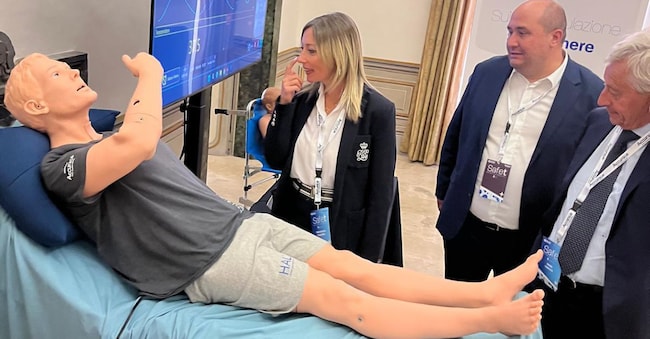
At Accurate’s “Safe-T” event, practical simulation exercises using manikins and computers to enhance doctors’ skills and improve emergency management

Key points
“Safety in healthcare is an essential strategic priority for the entire healthcare system. Safe-T is building an ecosystem that combines training, simulation and innovation, thereby investing in the quality and future sustainability of the healthcare system”. Thus, Patrizia Angelotti, CEO of Accurate (Digit’Ed Group), opened the event “Safe-T 2026 – Saving Lives Together”, organised in Rome to mark World Patient Safety Day, which is celebrated on 17 September. The event, attended by, amongst others, Fabrizio Spada, Head of Public Relations for the European Parliament in Italia, and Laura Mazza, Chair of the Interparliamentary Commission on Education and Employment, provides an opportunity to take stock of the latest practices and technologies that are making a substantial contribution to reducing the risk of errors, promoting the skills of healthcare professionals through simulation and improving the sustainability of the National Health Service, as well as access to insurance policies taken out by professionals. This approach has the backing of Farmindustria. “Prevention, innovation and skills,” said Carlo Riccini, Director-General of Farmindustria, “are the key words for the future of the healthcare system.”
Skills certification
Chronic conditions – from diabetes to respiratory diseases – which are the focus of this year’s World Health Organisation-designated World Health Day, account for 74 per cent of deaths worldwide, whilst one in ten patients suffers harm during treatment and half of this harm is considered preventable. “Today’s event,” added the CEO of Accurate, “demonstrates that there is growing awareness of patient safety and a desire to turn this awareness into concrete action. We need to take action that goes beyond merely corrective measures: simulation-based training is intended to be a preventative measure.” In over 15 years of operation, Accurate has built up a wealth of expertise and research in the field of healthcare training: over 25,000 professionals trained, more than 1,000 CME training courses delivered, 100 simulation centres designed and over 70 scientific publications.
Another key issue is the certification of skills: Accurate outlined the process it has launched for the first Italian certifications for Expert Instructors in Medical Simulation and Aesthetic Doctors Specialising in Facial Ultrasound.
Loiero: promoting a culture of prevention to reduce NHS costs
“Patient safety is a strategic investment, not a cost, and training healthcare professionals in a simulated environment is the most effective way to build a culture of prevention”, said Renato Loiero, adviser to the Prime Minister, highlighting how the contribution of simulation, artificial intelligence, immersive technologies and digitalisation is “fundamental to preventing errors and freeing up time for the doctor-patient relationship”. “Safe-T,” added the adviser to Prime Minister Meloni, “is the concrete expression of an approach based on constructive and effective collaboration between the public and private sectors.”
Campitiello: 11 million from the Department of Health for safety training
“The sentinel events reported to the Ministry of Health via Simes – which is the body responsible for monitoring and overseeing healthcare incidents – number at least a thousand a year, so we are talking about significant figures,” said Maria Rosaria Campitiello, Head of the Department of Prevention, Research and Health Emergencies, speaking at the Accurate event. In this regard, she added, “the Ministry is taking action and has invested 11 million euros in research relating to simulators, robotics and artificial intelligence, to train doctors, healthcare professionals and trainee specialists to make care safer”. “Ensuring that care and healthcare are safe, as well as appropriate and of high quality,” she explained, “also involves looking at the implementation of Ministerial Decree 77, which has reorganised the healthcare system with the launch of community care homes.” According to Campitiello, “particular attention must be paid to elderly and chronically ill patients; therefore, the institutions and the Ministry of Health have a duty to ensure that care is provided correctly and that healthcare services are properly integrated to make treatment safer. Prevention also means taking action to improve safety.”

