
Pensions, lighter cheques for those leaving work in 2060
Censis and Confcooperative study presented at the Trento Festival. Nearly 17 percentage points less in the ratio of final salary to those leaving work now

Key points
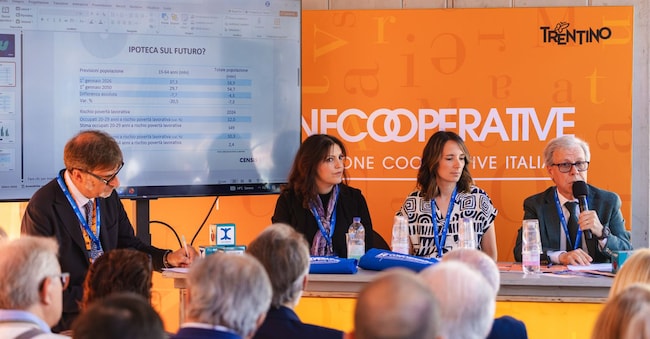
Those retiring today get 81.5 per cent on their final salary, those leaving in 2060 64.8 per cent. There is another spread that is much less talked about than that on government bonds. It is the differential in the ratio of the amount of the first pension to the last salary. Those who will leave work in 2060 at 67 years of age after having started working in 2022 will suffer a cut of almost 17 percentage points compared to those who left work at the same age in 2020 after having started in 1982. The numbers worked out by Censis and Confcooperative emerged during the panel 'Work and pensions on the roller coaster between opportunities and traps of the future' (moderated by Nicola Saldutti of the 'Corriere della Sera') at the Trento Festival of Economics.
Gardini (Confcooperative): mortgage on the future
Figures on which the president of Confcooperative Maurizio Gardini has raised the alarm: 'A real mortgage on the future that adds up to wages that are among the lowest in Europe. It is the result of cross dynamics that have intertwined and developed over the last 30 years'.
Gender inequalities
The inequalities are not only generational, but there remains a profound gender imbalance. 'There is no longer,' pointed out Alessandra Rinaldi, women president of Confcooperative, 'a linear path from training to work and retirement. It is an increasingly fragmented line, especially for women who today earn 8-10 thousand euro less per year than men. A wage gap that comes before the salary, because it concerns the path and opportunities more than the salary. Also because of the burden of care that still falls on women today. We have 61% of female employees, 27% of women in governance, rising to 34% in the case of those under 35. Data that testify to the ability of cooperation to create opportunities'.
The care of family members
'Today's generation,' explained Ilaria Miniutti, Young Entrepreneurs of Confcooperative, 'will not be able to support their children and parents in the future as they did in the past, due to lower salaries and longer stays at work. Cooperation was born to respond to a need. Today its task is to give opportunities back to young people: to have a better reconciliation between life and work, to have a decent job and to have confidence in the future'.
The impact on care
"In 2050 we will have 7.7 million fewer workers," commented Andrea Toma of Censis. The problem of current wage levels leading to even poorer pensions is also likely to have a knock-on effect on the ability to pay for domestic care work.


