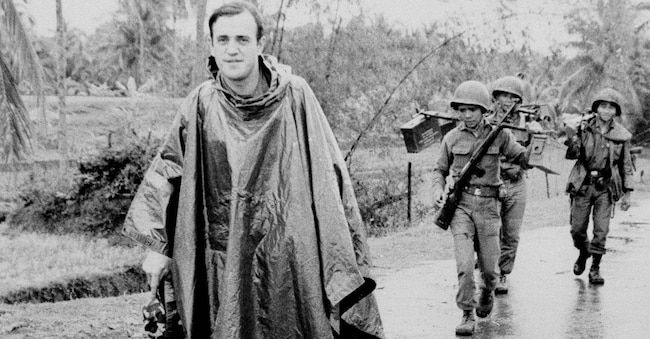
Arnett was a rebel of journalism: he distrusted authority, took calculated risks, accepted censorship in order to report the facts from the field and, when he felt it was necessary, put aside his pretended neutrality. He was often accused of sympathising with the enemies of the United States in Vietnam and Iraq. In the last years of his career he also ran into serious controversy. He left CNN in 1999 after a report on an alleged atrocity in the Vietnam war that turned out to be unfounded, and was fired from Nbc in 2003 for stating on Iraqi state television that the coalition's military plan was failing. New Zealander by birth, self-taught and an adventurer, Arnett found his professional consecration in Vietnam, where he worked for a decade. In 1966 he won the Pulitzer Prize for international journalism for his war reports, including the account of an American captain forced to watch helplessly as his men were massacred.
Peter Arnett captured the essence of war
He had nothing of the romantic hero. One observer described him as 'a scarecrow in the middle of a wheat field'. But he knew how to capture the essence of war. In 1968, in the city of Ben Tre, he quoted the famous phrase of an American major: 'It was necessary to destroy the city in order to save it', which became a symbol of the contradictions of the Vietnamese conflict. While Washington spoke of victories and a 'light at the end of the tunnel', Arnett recounted defeats and reversals from the front, questioning the official versions and anticipating the failure of American strategy.
President Lyndon B. Johnson and General William Westmoreland tried in vain to have him removed. In 1975, as Saigon fell and the last Westerners fled, Arnett remained in the city, reporting on the panic in the streets and the chaos at the US Embassy, with helicopters loaded with refugees taking off from the roof. He continued to report even after the North Vietnamese victory. In 1981 he joined CNN, then a young all-news station. He followed conflicts in Central America, the Middle East and Africa, but it was the Gulf War that made him a global figure. Left alone in Baghdad in January 1991, he became the voice and eyes of the western world for days under the bombing. His telephone connections from the Al Rashid hotel, amid sirens and explosions, were likened to Edward R. Murrow's chronicles of the blitz on London in World War II.
For many American politicians, he was a megaphone for Saddam Hussein's propaganda
Celebrated and awarded, Arnett was also harshly criticised: for many American politicians he was a megaphone of Saddam Hussein's propaganda. He always rejected the accusation: 'I only told what I saw'. In 1997 he made a long filmed interview with Osama bin Laden, who years before 9/11 openly threatened a jihad against the US. "You will see and hear about our plans," said the Al Qaeda leader. His career suffered a definitive blow in 2003, when he agreed to speak on Iraqi TV during the American invasion, praising Baghdad's resistance. Dismissed, he was unable to regain the central role he once had.
Born in 1934 in Riverton, New Zealand, Arnett left school at 17 to work for a local newspaper. After a journey that took him from Australia to Thailand, he finally landed at the Associated Press in Southeast Asia. He married Nina Nguyen, by whom he had two children. Retiring in 2007, he taught journalism in China and published two memoirs. As the Los Angeles Times wrote, his career shows that, beyond technology, good journalism is always based on the same qualities: intuition, courage, ingenuity and determination. Qualities that Peter Arnett embodied to the very end. (by Paolo Martini)