
Peter Max, the pop artist of the 1960s and marketing, has died
From his posters of the Beatles, Bob Dylan and LSD trips, he went on to design Boeing 777s and women’s fashion

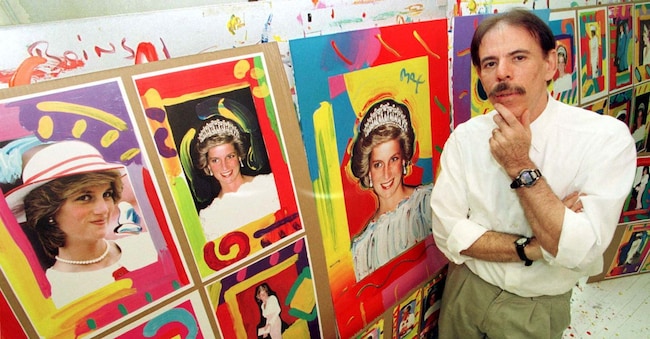
It’s a bit as if the 1960s, with their boundless creativity and all their contradictions, had come to an end yet again. Peter Max, a pop artist whose dreamlike works provided the artistic backdrop to the hippie movement, died on Monday aged 88 following a long illness. He passed away on Monday 14 September in a Manhattan hospital, but the news was only made public in the last few hours.
His posters were veritable psychedelic trips or, to use a term from that era, ‘groovy’. Whether they depicted cosmic landscapes and stellar explosions, or portrayed rock stars of the calibre of The Beatles, Jimi Hendrix and Bob Dylan. He started out as an anti-establishment artist but, as has often happened in America, the ‘establishment’ ended up adoring him. And so it embraced him, because Max decided to combine art and commerce with the same ease with which he mixed colours on the canvas. He licensed his works for around 70 products which ended up on commercial aeroplanes, cruise ships, bed linen, glasses, women’s swimwear and more.
Peter Max Finkelstein was born in Berlin in 1937 into a Jewish family and lived in China and Israel before his parents settled in New York. At the Academy of Fine Arts in the Big Apple, he studied realism, an approach which, as an artist, he made little use of. He burst onto the scene in the 1960s, an era he helped to shape iconographically: ‘His decorative posters reveal that Max is a visionary fascinated by time, space and evolution,’ noted a review in the Village Voice dated 1967. ‘A psychedelic skyline prophesies the day when skyscrapers might become temples, when the Rainbow Room at Rockefeller Centre might be used for meditation.’ A prophecy which, on reflection, proved to be quite accurate.
In the Sixties, there wasn’t a single student hall of residence in the United States without one of his posters. Max recounted how thrilled he was when former President Bill Clinton told him that his posters had adorned the walls of his room during his university days. Decades later, a series of portraits of Clinton painted by Max was exhibited in the presidential library. Ultimately, the artist’s affection for the White House was reciprocated, regardless of who occupied it: Ronald Reagan was an admirer of his, and Max donated a painting of the Statue of Liberty to the Reagan Presidential Library.
In any case, it’s been a huge success and has given rise to some fake news, such as the claim that he collaborated on the Beatles’ animated film Yellow Submarine, which was certainly influenced by Max’s style but was the work of Heinz Edelmann. In the late 1960s, Max disappeared from the public eye, devoting himself to private commissions and travel. He returned to the limelight with an exhibition at a New York gallery in 1987 and became a veritable marketing machine.


